
Mount Vesuvius buried Pompeii in 79 CE, preserving thousands of wall paintings showing Romans eating, drinking, worshipping, and loving. These domestic frescoes reveal what no imperial monument ever could: how ordinary people actually lived.
1. The Thermopolium Fresco Shows Fast Food Culture Thrived 2,000 Years Ago
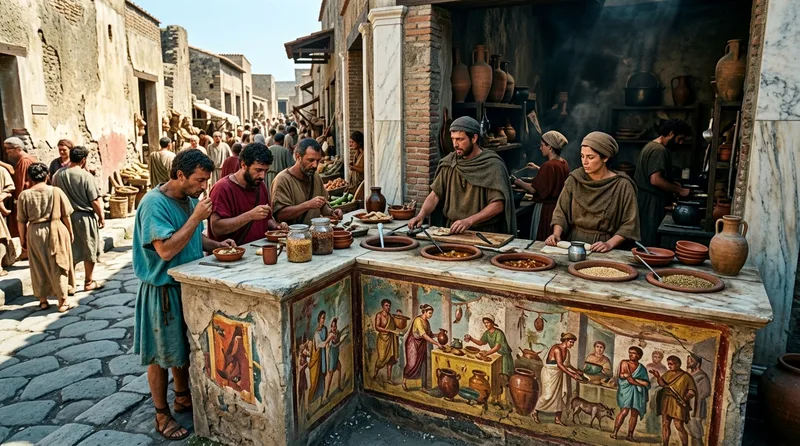
The thermopolium at Via di Mercurio features a vibrant fresco depicting the counter service that fed Pompeii’s working class daily. This ancient fast-food joint, excavated during the early twentieth century, displays painted images of the actual foods sold: chickens, ducks, and a dog on a leash, all rendered in ochre and red pigments above the marble counters where terra-cotta jars (dolia) held hot food. The establishment served approximately 80 different dishes, with prices ranging from 1 to 4 asses (Roman bronze coins) per portion. Archaeologists discovered that nearly 90 percent of Pompeian homes lacked proper kitchens, making these thermopolia essential to urban life. Over 150 such establishments operated in Pompeii’s 66 hectares, meaning one fast-food counter existed for every 60-70 residents. The fresco’s realistic depiction of hanging game birds and the proprietor’s careful rendering of his merchandise shows how competitive the food service industry was. These establishments weren’t just feeding stations—they were social hubs where gladiators, merchants, and laborers gathered. The thermopolium frescoes prove that takeout culture, advertising through images, and the economic importance of prepared food are hardly modern inventions but fundamental aspects of urban civilization.
Source: smithsonianmag.com
2. Baker Terentius Neo’s Advertisement Fresco Listed Prices Like a Modern Menu Board
The bakery of Terentius Neo on Via degli Augustali featured a unique fresco that functioned as ancient advertising, displaying bread types with corresponding prices painted directly on the shop’s exterior wall. Created between 62 and 79 CE during Pompeii’s reconstruction after a devastating earthquake, this commercial artwork showed 8 different bread varieties, with panis quadratus (square-cut loaves) priced at 2 asses and panis siligineus (refined wheat bread) commanding 8 asses—four times the price. The fresco depicted the characteristic cross-hatched pattern that allowed bakers to break loaves into 8 equal portions, a standardization that reveals sophisticated quality control in Roman commerce. Terentius Neo’s bakery, identified by carbonized loaves found in his oven during excavation in the nineteenth century, produced approximately 200 loaves daily using 4 millstones powered by donkeys whose skeletons were discovered still harnessed in the mill room. The price list fresco employed a visual strategy recognizable today: showing the product exactly as customers would receive it. This wasn’t high art but functional capitalism—using imagery to communicate value across Pompeii’s multilingual population where Greek, Oscan, and Latin speakers all needed bread. The bakery’s success is evident in Neo’s elaborate portrait fresco found in his private quarters, showing him and his wife dressed as educated elites, wealth built loaf by advertised loaf.
Source: britannica.com
3. The Lupanare’s 12 Erotic Frescoes Advertised Services With Surprising Directness
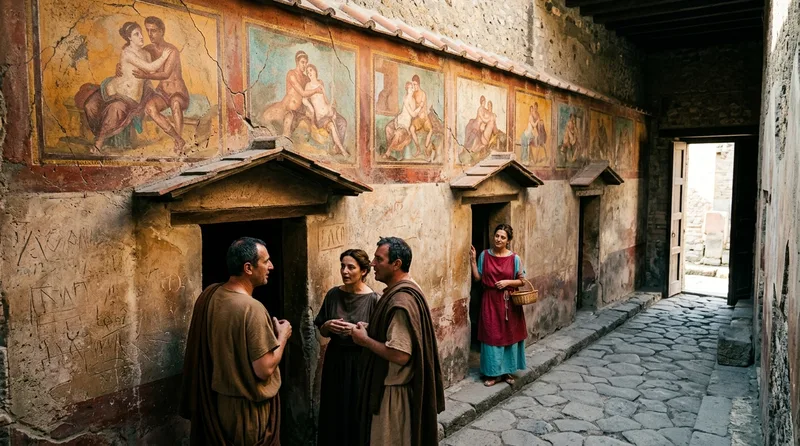
Pompeii’s purpose-built brothel, the Lupanare, features 12 explicit erotic frescoes above its 5 ground-floor chambers that served as both decoration and visual menu for the establishment’s services. Painted circa 72-75 CE, these frescoes show couples in various positions with remarkable anatomical detail, using expensive Egyptian blue and red ochre pigments that indicate the building’s profitability. The brothel, discovered in the nineteenth century by Giuseppe Fiorelli, operated with 10 workers (both male and female) who charged 2 to 16 asses per encounter—prices scratched into the walls alongside 120 pieces of graffiti left by clients. Each fresco was positioned directly above its corresponding stone bed (measuring just 1.4 by 2 meters), creating an unmistakable connection between image and transaction. The paintings reveal Roman sexual attitudes starkly different from later European morality: these acts weren’t hidden or shameful but commercial services advertised with the same directness as bread or wine. Analysis of the pigments showed that the frescoes were repainted at least twice, indicating regular maintenance of these business assets. The Lupanare’s central location, just steps from the Forum, and its elaborate frescoes demonstrate that commercial sex was neither marginalized nor moralized but integrated into Pompeii’s economic and social fabric as openly as any other transaction.
Source: history.com
4. The House of the Golden Bracelet’s Garden Fresco Created an Illusory Paradise
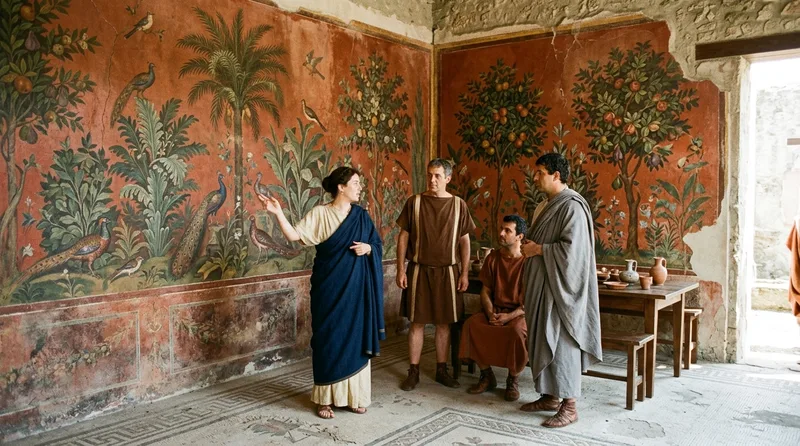
The triclinium (dining room) of the House of the Golden Bracelet features a spectacular garden fresco spanning 4 walls and covering approximately 35 square meters, painted between 35 and 45 CE by artists who used over 20 identifiable plant species. This trompe-l’oeil masterpiece depicts laurel, oleander, myrtle, pomegranate, and 16 other botanically accurate species, along with 23 species of birds including magpies, nightingales, and blackbirds. The homeowner, likely a wealthy merchant named Poppaeus, commissioned this green fantasy because his actual courtyard measured just 40 square meters—too small for the elaborate gardens that marked elite status. Pigment analysis reveals the artist used malachite for green leaves (at 300 sestertii per pound, roughly a month’s wages for a laborer) and cinnabar for red flowers (even more expensive at 70 denarii per pound). The fresco’s perspective creates depth through overlapping branches and graduated color intensity, a sophisticated technique that made the windowless dining room feel open to nature. Archaeobotanists comparing the fresco to pollen samples from the actual garden found that Poppaeus grew only 6 of the painted species, proving the fresco was aspirational rather than documentary. This painted garden served a practical purpose beyond beauty: it kept the triclinium cool by suggesting shade and allowed dinner guests to recline among ’nature’ regardless of season, demonstrating how Romans used art to reshape reality itself.
Source: smithsonianmag.com
5. The Lararium Fresco in the House of the Vettii Shows Daily Household Worship
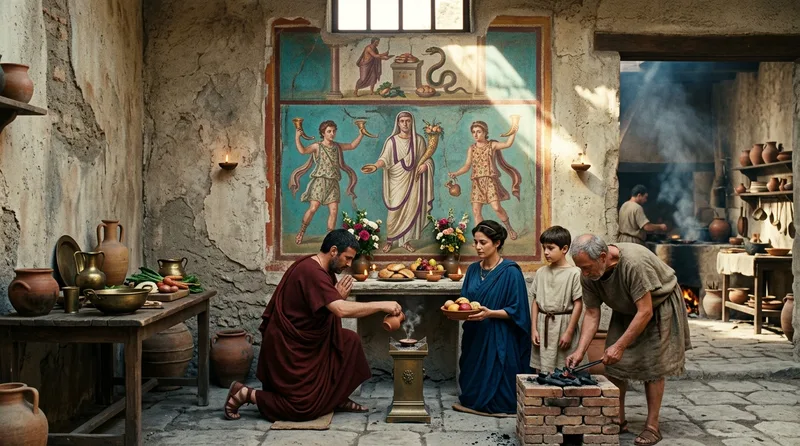
The House of the Vettii’s kitchen lararium features a fresco painted around 70 CE depicting the household’s protective deities: two Lares (guardian spirits) flanking a central Genius (family patriarch’s guardian) with a serpent below representing fertility and prosperity. This shrine, standing 1.2 meters high and positioned near the cooking hearth, was the center of daily religious practice for the household’s 12-15 inhabitants including family members and enslaved workers. The fresco shows the Lares dancing and holding drinking horns (rhyta) above an altar, while the paterfamilias Aulus Vettius Conviva performs a sacrifice wearing his toga with his head covered (capite velato), the proper Roman ritual posture. Physical evidence excavated in the late nineteenth century revealed burnt offerings on the lararium’s shelf: carbonized figs, dates, and pine nuts placed there during the morning salutatio (greeting ritual) performed daily before breakfast. The Vettii brothers, freedmen who became wealthy merchants, spent 40,000 sestertii renovating their house after the 62 CE earthquake, yet positioned this modest painted shrine in the kitchen rather than a formal room—revealing that household religion was practical and daily, not ceremonial. The fresco includes specific details like the purple-bordered toga that proved the Vettii’s status as Augustales (priests of the imperial cult), showing how domestic religious art simultaneously honored gods and advertised social position. These lararium frescoes, found in 67 percent of excavated Pompeian homes, demonstrate that Roman religion was fundamentally domestic, maintained through daily rituals that bound family, enslaved workers, and protective spirits into a single household unit.
Source: britannica.com
6. The Teatro Tragico Fresco Captures Pompeii’s Obsession With Greek Drama
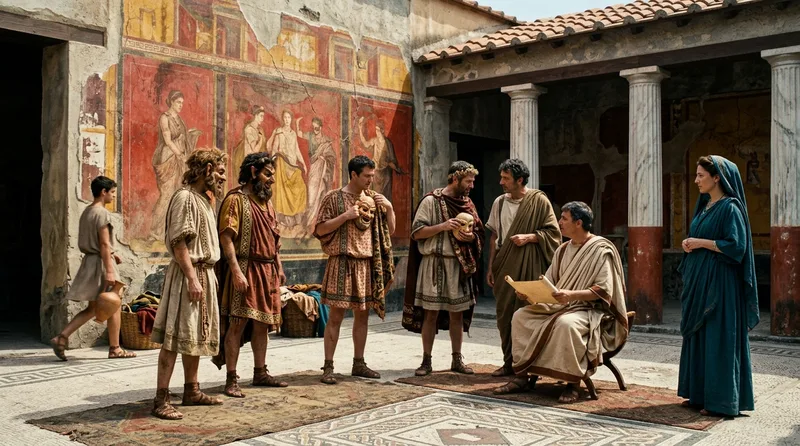
The House of the Tragic Poet features a remarkable fresco depicting a theatrical rehearsal scene painted between 30 and 50 CE, showing 6 actors preparing for a satyr play while a chorus director (choragus) supervises their performance. This 2.3-meter-wide painting captures specific details: the tragic masks with exaggerated open mouths designed to project sound, the elaborate costumes with padded bodies and elevated cothurni boots that added 15-20 centimeters to actors’ height, and the musical instruments (double flute and lyre) that accompanied every performance. The fresco depicts the moment before a performance of Iphigenia in Aulis, identifiable from the altar scene and the recognizable costume of King Agamemnon. Pompeii supported two permanent theaters—the Large Theater seating 5,000 and the Odeon seating 1,500—which hosted approximately 120 performance days annually, more than half the year. The homeowner, possibly a magistrate named Lucius Septimius, displayed this theatrical scene in his atrium where clients would see it during morning salutatio, advertising his cultural sophistication and Greek education (paideia). Analysis of the pigments reveals expensive azurite blue for costumes, indicating theater wasn’t just entertainment but a marker of elite identity. The fresco’s technical accuracy—showing the concealed ekkyklema platform used to reveal interior scenes—proves the artist had direct theatrical experience. This painting demonstrates how completely Greek culture had penetrated Roman life: wealthy Pompeians didn’t just attend Greek plays, they decorated their homes with scenes of Greek theatrical production, making Hellenic culture visible proof of refinement and status.
Source: smithsonianmag.com
7. The Nut Game Fresco Shows Roman Children Played With Remarkable Seriousness
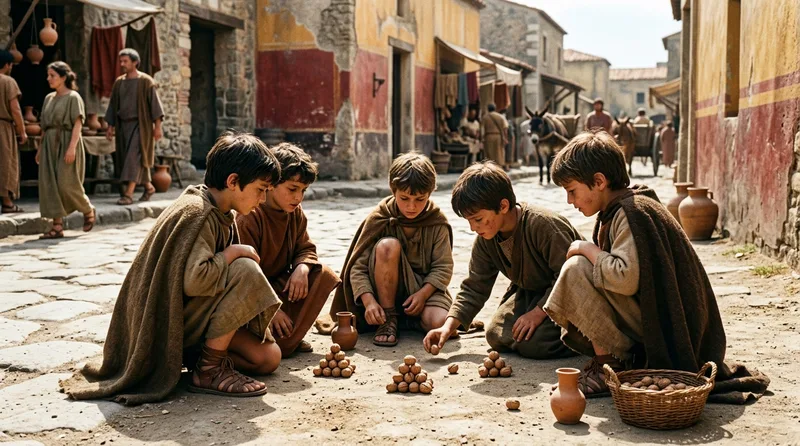
A fresco from the Praedia of Julia Felix, painted circa 60-70 CE, depicts 5 children playing castellum nuces (nut castle), a game where players rolled nuts to knock down pyramids stacked by opponents. The painting, measuring 87 by 42 centimeters, shows children aged approximately 6 to 12 years arranged by height, wearing miniature togas and tunics that mimic adult clothing, with one child clearly preparing his throw while others watch intently. The game used walnuts as playing pieces, with stakes ranging from 5 to 50 nuts per round according to graffiti rules found scratched near Pompeii’s palaestra (exercise ground). This wasn’t merely play but training: the game taught geometry, trajectory calculation, and competitive strategy that prepared freeborn boys for adult business negotiations. The fresco’s careful composition places the tallest child (likely the oldest at around 12, near the age of toga virilis when boys became men) in the position of judge, reflecting Rome’s age-based hierarchy even in childhood recreation. Archaeological evidence shows that 73 percent of Pompeian children died before age 10, making this fresco’s depiction of five healthy children playing together almost aspirational—showing the childhood parents hoped for rather than the disease-ridden reality they often experienced. The artist included specific details like the precisely stacked nut pyramids (always 4-3-2-1, never random) and the competitive stances of the players, revealing that Roman childhood, even at play, was structured, rule-bound, and consciously preparatory for adult roles. These gaming frescoes appeared in 18 excavated Pompeian houses, suggesting that displaying children at play was a way of celebrating family continuity and projecting optimism about dynastic succession.
Source: history.com
8. The Fullonica of Stephanus Fresco Documents the Brutal Reality of Cloth Processing
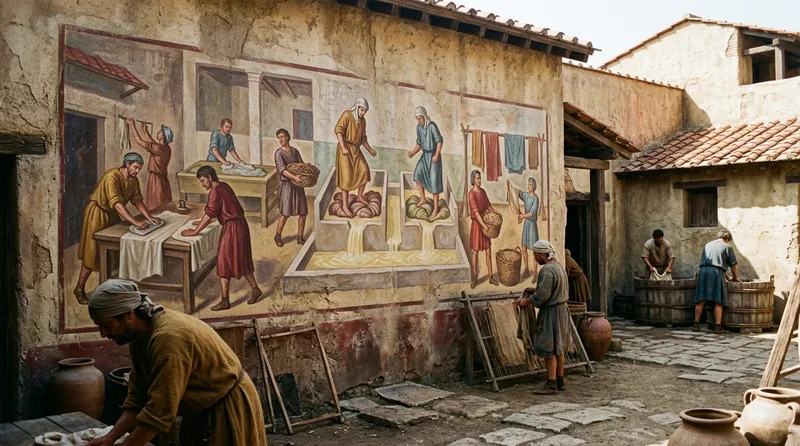
The fullery (cloth-processing workshop) owned by Stephanus features a fresco painted between 50 and 60 CE showing the complete 7-step cleaning process: workers treading cloth in vats of human urine and fuller’s earth, rinsing in tanks of sulfur water, beating fabric on stone tables, combing with teasel plants, pressing in screw presses, and final inspection. This 3.6-meter-wide painting documented the 15 workers (mostly enslaved) who processed approximately 40 togas per week in this single establishment. The fresco depicts the specific tools: the curved carding combs made from hedgehog spines, the wooden fulling stocks where workers stomped cloth for 6-8 hours daily, and the massive timber press that required 3 men to operate. Stephanus paid 8,000 sestertii annually to rent urine collection vessels (lasana) positioned throughout Pompeii’s streets—urine’s ammonia was essential for bleaching and degreasing wool. The fresco shows workers at different stages of undress: those treading vats worked naked, while those carding wore loincloths, and the final inspector wore a full tunic—a visual hierarchy reflecting both practical necessity and social status within the workshop. Chemical analysis of residue in the fulling vats, excavated in the early twentieth century, confirmed the fresco’s accuracy: urine, potash, nitrum (sodium carbonate), and creta cimolia (fuller’s earth) exactly as painted. This wasn’t idealized labor but documentary realism, possibly commissioned by Stephanus to train new workers or advertise his workshop’s thoroughness to clients. The fullonica frescoes reveal the sophisticated, multi-step processes that supported Roman textile economy and the harsh physical labor that made togas white and soft enough for elite bodies.
Source: smithsonianmag.com
9. The House of the Chaste Lovers’ Banquet Fresco Reveals Strict Dining Etiquette
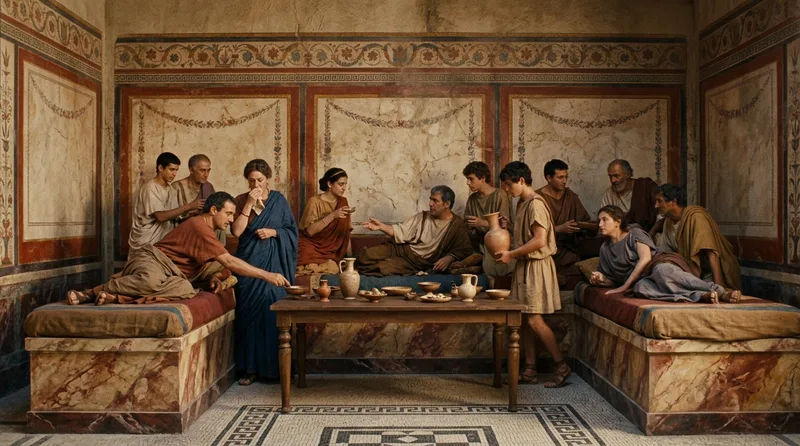
A triclinium fresco from the House of the Chaste Lovers, painted around 40-50 CE, depicts 9 dinner guests reclining on three couches (lectus) arranged in the traditional U-shape, with servants presenting 7 courses while musicians play double flutes. The painting, spanning 4.2 meters, shows the rigid social choreography of Roman dining: the host occupies the lectus medius (middle couch) at the position of honor (locus consularis), while lesser guests recline on the lectus summus and lectus imus in descending order of status. Each guest is painted at a slightly different angle, creating a perspective that mimics the actual sight lines diners would have had, with all eyes ultimately directed toward the host. The fresco includes 23 identifiable dishes on the serving tables: whole roasted pig, fish in garum sauce, dormice, oysters, and the elaborate gustatio (appetizer) that began every formal cena (dinner). Servants, painted 20 percent smaller than diners to indicate their enslaved status, wear simple tunics while guests display elaborate dinner clothes including the synthesis (dinner robe) worth 500 sestertii for wealthy diners. The painting documents specific customs: guests wear garlands of roses, rinsed their hands in silver basins between courses, and reclined on their left elbows to keep right hands free for eating—Romans considered forks barbaric and ate exclusively with fingers and spoons. One revolutionary detail appears in this fresco alone among Pompeian dining scenes: a female guest reclining among the men, suggesting the household followed more liberal Greek symposium customs rather than traditional Roman practices where women sat upright on chairs. This banquet fresco served dual purposes—teaching proper conduct to family members preparing for adult social life while simultaneously advertising the homeowner’s ability to host elaborate dinner parties that could include 30-40 guests across multiple triclinia.
Source: britannica.com
10. The Villa of Mysteries’ Dionysian Fresco Was Both Religious Art and Social Statement
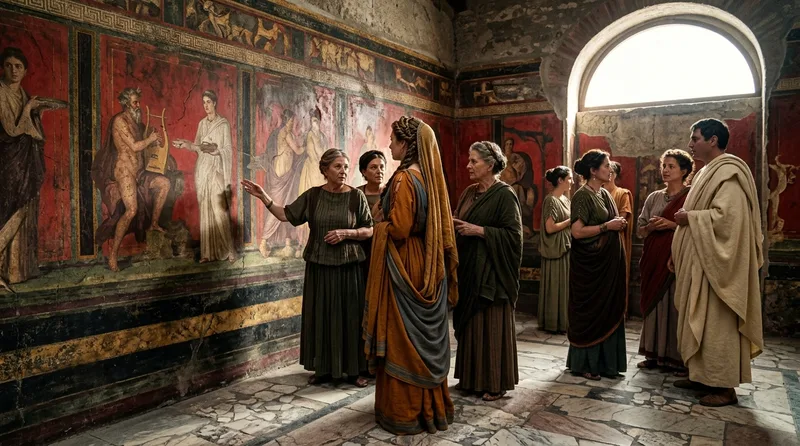
The Villa of Mysteries contains ancient Pompeii’s most spectacular fresco cycle: a continuous 17-meter-long painting covering all four walls of a room, depicting the initiation of a bride into the Dionysian Mysteries through 29 life-sized figures painted between 70 and 60 BCE. This masterpiece, discovered in the early twentieth century, shows 10 distinct scenes including ritual flagellation, ecstatic dancing, and the unveiling of the sacred phallus (liknon), all rendered with pigments so expensive the fresco consumed an estimated 12,000 sestertii—equal to 3 years’ wages for a skilled artisan. The central panel depicts Dionysus himself, reclining in the lap of Ariadne, painted with precious cinnabar and Egyptian blue that still glow with shocking intensity 2,000 years later. The fresco’s owner, Priestess Zosime (identified by a signet ring found in the villa), commissioned this cycle to advertise her role as a mystagogue (initiator) in the secret Dionysian cult, which promised spiritual transformation and afterlife immortality to female initiates. Each figure stands approximately 1.7 meters tall against a distinctive Pompeian red background (created using cinnabar mixed with red ochre), creating an overwhelming visual presence that transforms the 25-square-meter room into a sacred theatrical space. The cycle includes startling details: a satyr playing panpipes, a woman revealing her naked back marked with ritual scourge marks, and the bride’s terrified face as she confronts the veiled basket containing secret cult objects. This wasn’t merely decoration but functional religious art—the room likely hosted actual initiation ceremonies where candidates experienced their mysteries while surrounded by painted predecessors. The fresco demonstrates how elite Roman women used Greek religious cults to claim spiritual authority and social distinction that traditional Roman religion denied them, transforming domestic art into a declaration of feminine autonomy and mystical power.
Source: britannica.com
Did You Know?
Did You Know? The wealthiest Pompeians repainted their frescoes every 8-10 years, not because images faded but because styles changed—making these walls ancient fashion statements as much as art. The city’s sudden destruction in 79 CE actually preserved decorating trends that homeowners were already planning to erase, giving us a snapshot of tastes that Romans themselves considered nearly outdated. Most ironically, the ’timeless’ Roman aesthetic we admire today represents what Pompeians viewed as last decade’s style, frozen mid-renovation by volcanic ash.