
The Great Pyramid of Giza contains 2.3 million stone blocks, some weighing 15 tons, stacked with millimeter precision—without cranes or steel. Archaeology reveals copper saws, water-lubricated paths, and worker cities housed 20,000 laborers. These innovations built monuments lasting 4,500 years.
1. Copper Tools and Dolerite Pounders That Carved Mountains
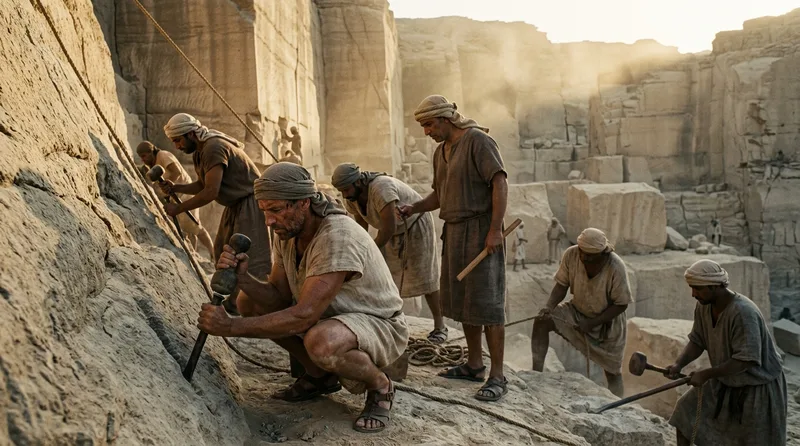
Egyptian quarry workers wielded copper chisels and tube drills to extract limestone blocks from Tura quarries starting around 2580 BCE, during Khufu’s reign. Copper, though softer than iron, became devastatingly effective when paired with quartz sand as an abrasive—creating a grinding action that carved through calcium-rich stone. Archaeologists at Hatnub quarries discovered dolerite pounders weighing up to 12 pounds each, dense igneous hammerstones that workers used to pulverize granite in the Aswan region. A single copper tube drill, rotated with sand slurry, could bore a core hole 4 inches wide through solid granite in roughly nine hours of continuous work. The Egyptians didn’t need harder metals—they engineered a system where softer copper directed harder minerals to do the cutting. Evidence from the Tura quarries shows workers extracted approximately 67,000 cubic meters of limestone for Khufu’s pyramid alone, with copper tool marks still visible on quarry walls today. This technique produced blocks so uniform that modern engineers measure tolerances of just 0.01 inches on surviving casing stones. The copper-and-sand method transformed Egypt’s landscape, moving entire cliff faces block by block across 20-year construction periods. Without this innovation, the smooth-faced pyramids we recognize would have remained rough stone hills.
Source: britannica.com
2. Internal Ramp Systems That Spiraled Skyward
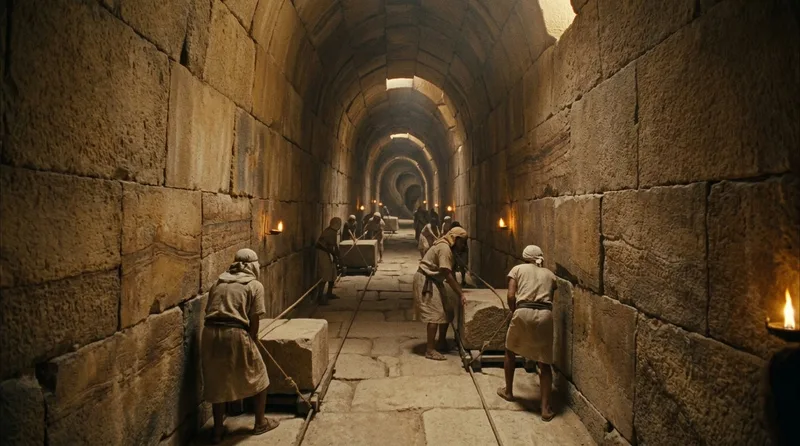
French architect Jean-Pierre Houdin proposed in the early 2000s CE that the Great Pyramid contains an internal ramp spiraling upward at a 7-degree angle, and microgravimetry scans detected less-dense corridors matching this theory. External straight ramps would have required more material than the pyramid itself—approximately 7 million cubic meters of mud brick and rubble to reach the pyramid’s 481-foot summit. The internal ramp solution allowed workers to haul 2.5-ton blocks up a continuous pathway embedded within the pyramid’s structure, switchbacking at corners to maintain the gradual incline. Evidence from the Red Pyramid at Dahshur, built around 2590 BCE, shows remnants of corner ramps that supported this vertical transportation method during construction. Workers pulled blocks along these enclosed corridors using rope teams of 8 to 10 men per stone, with the ramp’s ceiling just 6 feet high to minimize internal volume. This system explains how builders maintained construction speed even as the pyramid grew taller—external ramps would have become impossibly long and steep above 200 feet. The theory gained support when thermal scanning in the early 2000s CE revealed temperature anomalies suggesting hollow spaces spiraling through the Great Pyramid’s core. Internal ramps meant Egyptians could dismantle external earthworks after completion, leaving no trace of the massive infrastructure. This hidden engineering created the smooth-sided monuments we see today.
Source: smithsonianmag.com
3. Wooden Sledges on Water-Soaked Sand Paths
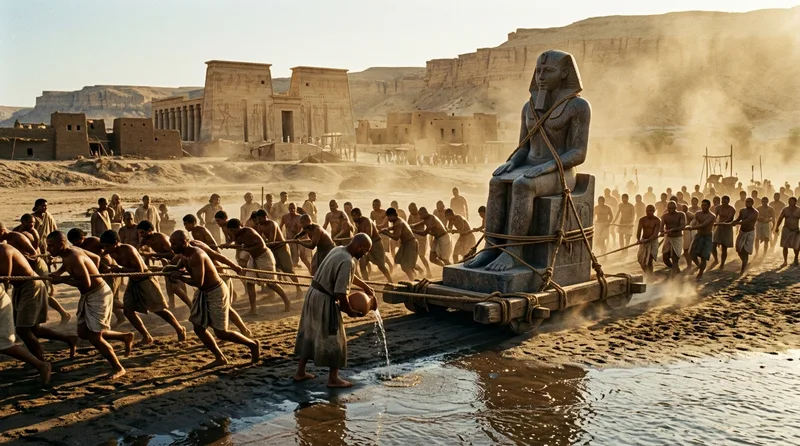
A tomb painting from Djehutihotep’s burial chamber at Deir el-Bersha, dated to the Middle Kingdom period, shows 172 men pulling a colossal statue on a wooden sledge while a worker pours liquid onto the sand ahead—direct evidence of Egypt’s friction-reduction system. Physics experiments conducted at the University of Amsterdam in the early 2000s CE demonstrated that wetting sand reduces the force needed to pull heavy loads by 50 percent, preventing sand particles from piling up before the sledge runners. The Great Pyramid’s builders transported blocks 13 miles from Tura quarries using sledges made from Lebanon cedar and acacia wood, bound with rope and capable of carrying stones weighing 15 tons. Workers maintained optimal sand moisture at roughly 5 percent water content—too dry and friction increased, too wet and the sledge bogged down in mud. Experimental archaeology shows a team of 50 workers could move a 2.5-ton block across level desert at a rate of 65 feet per minute using this technique. The Egyptians constructed causeway roads between quarries and pyramid sites, with limestone chips providing a firm base beneath the wetted sand layer. These causeways stretched over half a mile in some cases, requiring their own engineering and maintenance crews to keep surfaces smooth. The sledge system moved an estimated 12,000 tons of stone monthly during peak construction years of Khufu’s pyramid around 2560 BCE. This low-tech solution outperformed wheeled carts, which would have sunk in sand and broken under pyramid-block weights.
Source: history.com
4. Lever Systems That Positioned Multi-Ton Blocks With Precision
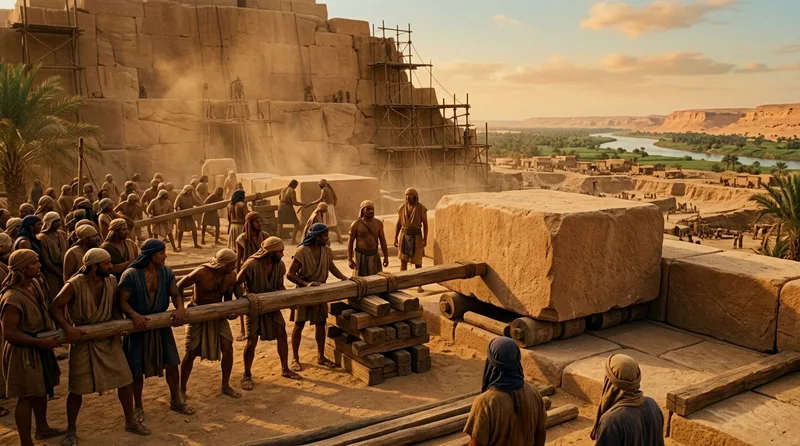
Herodotus described Egyptian builders using wooden machines made of short planks in the 5th century BCE, likely referring to lever-and-fulcrum systems that workers employed to nudge blocks into final positions with millimeter accuracy. Experimental archaeology at Giza demonstrated that a simple wooden lever 10 feet long, pivoting on a stone fulcrum, allowed three workers to lift one corner of a 2.5-ton block roughly 4 inches—enough to slide packing stones underneath. The technique involved progressive lifting: raise one corner, insert a stone wedge, raise the opposite corner, repeat until the block reached the desired height and alignment. Evidence from unfinished pyramid blocks shows pry marks and pivot indentations where bronze-tipped levers dug into limestone edges during positioning work. Workers combined levers with rocker systems—curved wooden cradles that allowed blocks to be tilted and rotated incrementally without dragging across already-placed stones. This method protected the precisely-cut surfaces of casing stones, which had to fit together with joints thinner than a human hair. At the Bent Pyramid in Dahshur, built around 2600 BCE, archaeologists found limestone chips in systematic patterns suggesting workers used the lever technique to adjust blocks after initial placement. The lever system required remarkable coordination—teams worked in synchronized movements, responding to foreman’s commands to prevent blocks from shifting catastrophically. One miscalculation could crack a block that took quarry workers a week to extract and shape. This delicate process explains why pyramid construction took decades despite large workforces—precision positioning consumed far more time than raw stone movement.
Source: britannica.com
5. Workforce Organization: Permanent Architects and Seasonal Muscle
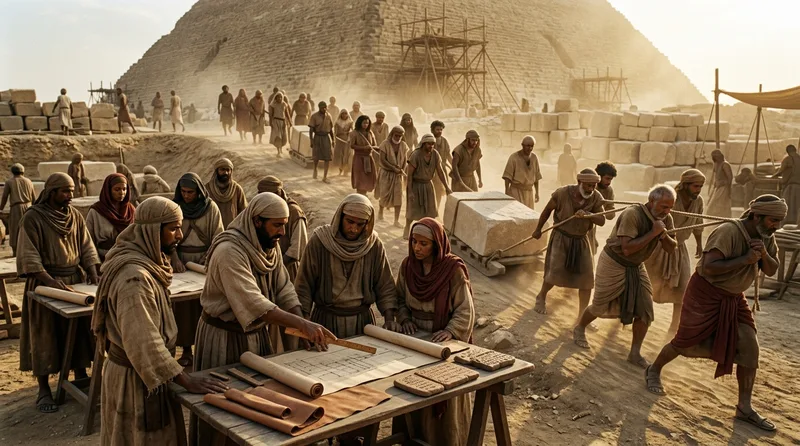
Mark Lehner’s excavations at the Giza workers’ village in the late 20th century CE revealed a sophisticated two-tier labor system—approximately 5,000 permanent skilled workers (stonecutters, engineers, metalworkers) supported by 20,000 seasonal laborers who rotated through 3-month service periods during the Nile’s flood season. Graffiti on pyramid blocks identifies work gangs with names like “Friends of Khufu” and “Drunkards of Menkaure,” showing crew organization into competing teams of roughly 2,000 men divided into smaller units of 200. The permanent workforce lived year-round in purpose-built villages at Giza, receiving daily rations of bread, beer, meat, and fish—payment records on papyrus fragments show skilled workers earned 10 times the bread rations of seasonal laborers. Seasonal workers came from agricultural districts throughout Egypt, fulfilling a labor obligation during the 4-month flood period from July to October when farming was impossible. This rotation system meant the pyramid site maintained constant workforce levels while preventing the economic collapse that would result from permanently removing 25,000 workers from agriculture. Administrative papyri from Wadi el-Jarf, dated to 2560 BCE, document Inspector Merer’s team transporting limestone from Tura, showing the bureaucratic tracking of worker assignments, tool distribution, and daily progress reports. The organization included specialized roles: water carriers, tool sharpeners, medical staff, supervisors, and scribes who recorded every block’s journey from quarry to pyramid. Workers weren’t slaves but participants in a national corvée system that Egyptians viewed as religious duty.
Source: smithsonianmag.com
6. Worker Villages With Industrial-Scale Bakeries and Hospitals
Archaeological excavations south of the Sphinx uncovered a workers’ city covering 14 acres, complete with bakeries producing 4,000 loaves daily, breweries fermenting beer in 30-gallon vats, and a medical facility with evidence of surgical bone-setting for construction injuries. The bakery complex at Giza contained conical bread molds stacked in rows—workers mixed emmer wheat dough with dates and honey, creating high-calorie rations that fueled pyramid construction from 2589 to 2504 BCE during the Fourth Dynasty. Zooarchaeological analysis of bones found in workers’ trash heaps revealed diets including cattle, sheep, and fish, with young male workers consuming approximately 4,000 calories daily to sustain the physical demands of stone hauling. The brewery installations show sophisticated fermentation technology—workers partially baked bread, crumbled it into water, and allowed natural yeasts to produce beer with roughly 5 percent alcohol content for hydration and nutrition. Medical examinations of workers’ skeletons reveal healed fractures with splints and clean amputations, indicating skilled surgical intervention by physicians trained in trauma care. The settlement included dormitory-style housing with sleeping platforms for 40 men per structure, copper-working areas producing 1,000 tools weekly, and granaries storing wheat supplies sufficient for 6 months. This infrastructure demonstrates Egypt mobilized not just labor but entire supply chains—farmers, fishermen, bakers, brewers, and doctors supporting the construction workforce. The village’s location 1,300 feet from the pyramid base minimized daily commute time, maximizing productive work hours.
Source: history.com
7. Nilometer Measurements That Timed Construction Seasons
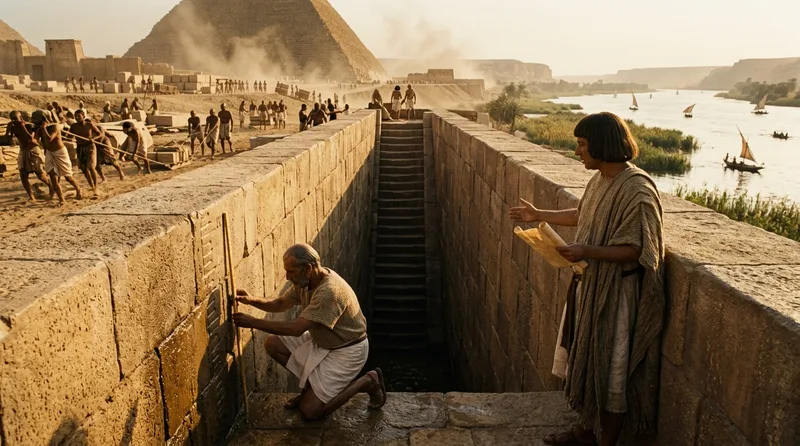
Nilometers—stone stairways descending into the Nile with measurement markings—allowed Egyptian engineers to predict flood heights and schedule pyramid construction work around the river’s annual cycle from the early third millennium BCE onward. The Nile’s inundation typically began in mid-July, peaked in September at roughly 24 feet above low-water mark, and receded by November, creating a 4-month window when quarry workers became available and stone transport by boat became possible. Temple records from the Palermo Stone document flood heights reaching 21 to 26 feet during pyramid-building periods, with engineers timing limestone deliveries from Tura quarries to coincide with peak water levels that brought boats within 600 feet of construction sites. Workers monitored nilometer readings at Memphis, where the river’s flood stage determined whether boats loaded with 40-ton granite blocks from Aswan could navigate shallow channels to Giza harbors. The flood season provided natural transportation infrastructure—channels that were dry wadis for 8 months became navigable waterways capable of floating barges carrying blocks weighing more than 10 elephants. Engineers excavated artificial harbors at pyramid sites, using nilometer data to calculate excavation depths ensuring boats could dock even during low-flood years. Poor flood years, like those recorded during the First Intermediate Period, halted pyramid construction entirely when water levels dropped below the 18-foot threshold needed for heavy barge traffic. This dependency on Nile cycles meant pyramid construction operated on nature’s schedule, with nilometer priests holding crucial roles in project planning.
Source: britannica.com
8. Gypsum Mortar and Leveling Techniques Achieving Millimeter Accuracy
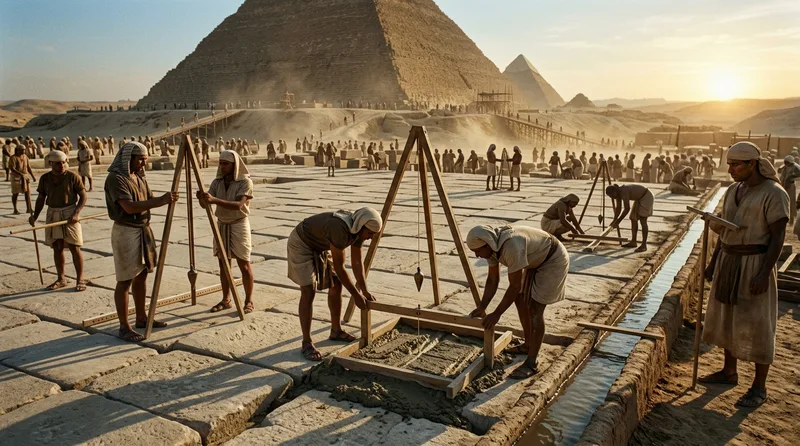
Egyptian engineers established the Great Pyramid’s 13-acre base with a deviation of just 0.05 degrees from true level—an achievement requiring gypsum mortar setting beds and water-channel leveling systems documented in construction manuals from around 2500 BCE. Workers created a network of shallow trenches across the bedrock foundation, filled them with water, and marked the water level at multiple points—water’s natural tendency to seek level provided an unerring horizontal reference across vast distances. After draining the channels, stonemasons carved the bedrock to match the water-level marks, creating a foundation platform accurate to within 1 inch across 756 feet—the length of two-and-a-half football fields. Between stone courses, workers spread gypsum mortar in layers averaging 0.02 inches thick, using the mortar not as adhesive but as a lubricant allowing blocks to slide into position before the gypsum set. Chemical analysis of mortar samples shows Egyptian builders heated gypsum rock to 300 degrees Fahrenheit, driving off water content and creating a powder that rehydrated into workable paste when mixed with Nile water. This mortar set within 30 minutes, forcing workers to position each 2.5-ton block with speed and precision before the setting window closed. The pyramid’s four sides align to cardinal directions with an average error of just 3 arc minutes—achieved using astronomical observations of circumpolar stars that never set below the horizon. Casing stones on the pyramid’s exterior fit together with joints 0.02 inches wide, tighter than the thickness of a fingernail.
Source: smithsonianmag.com
9. Stone-Cutting Accuracy Using Copper Saws and Sand Abrasive
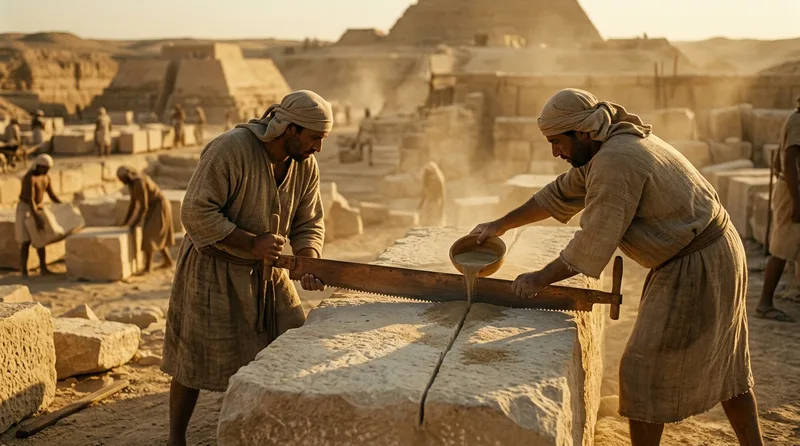
Copper saws up to 8 feet long, wielded by two-man teams and fed with quartz sand slurry, cut through limestone blocks with tolerances of 0.01 inches—precision visible today in surviving casing stones at the Great Pyramid’s base from 2560 BCE. Experimental archaeology conducted by Denys Stocks in the late 20th century CE demonstrated that a copper blade without teeth, working in combination with wet quartz sand, could cut a groove 2 inches deep through limestone in approximately 1 hour of continuous sawing motion. The copper blade didn’t cut the stone—it served as a guide that directed harder quartz particles to grind through the softer calcium carbonate crystals in limestone. Workers poured fresh sand-water mixture into the kerf every few minutes, maintaining the abrasive action as the copper blade wore grooves into its own edge from friction with sand particles. Saw marks on blocks at the Giza quarries show parallel striations spaced 0.04 inches apart, matching the spacing of quartz grains in Nile sand and confirming the cutting mechanism. For granite cutting at Aswan quarries, workers used the same technique but replaced quartz sand with harder corundum or emery powder, taking 9 times longer to achieve the same cutting depth. The process produced blocks with surfaces so flat that modern engineers measure deviations under 0.02 inches across 8-foot lengths—comparable to precision achieved by industrial sawing equipment. Egyptian workshops recycled dulled copper saws by melting and recasting them, with chemical analysis showing some copper tools were reforged 15 times before metal fatigue made them unusable.
Source: history.com
10. Logistical Planning: Quarry-to-Site Transport Networks Spanning 500 Miles
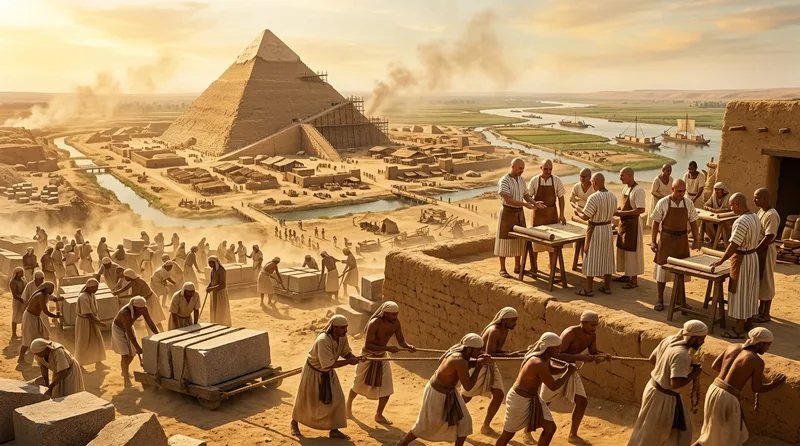
The Great Pyramid required granite from Aswan quarries 500 miles south, limestone from Tura 13 miles east, and basalt from Fayum 60 miles southwest—a supply chain coordinated through papyrus documents, boat schedules, and riverside depots operating from 2589 to 2566 BCE. Papyri discovered at Wadi el-Jarf in the early 2000s CE record Inspector Merer’s team making 40 river trips transporting limestone from Tura to Giza over a 3-month period, documenting ancient logistics with delivery dates, crew rosters, and cargo weights. Egyptian engineers constructed harbor facilities at Giza capable of receiving 30 barges simultaneously, each carrying between 2 and 12 stone blocks depending on block weight and boat capacity. The Tura-to-Giza journey took roughly 6 hours downstream during flood season when Nile currents reached 3 knots, but required tow teams of 30 men pulling boats upstream during the 18-hour return journey. For the 500-mile Aswan transport, workers carved channels around Nile cataracts—rocky rapids that blocked boat passage—creating portage routes where crews dragged boats overland for distances up to 2 miles. Administrative records show the Aswan operation delivered approximately 50 granite blocks yearly for pyramid chamber construction, with each block weighing between 25 and 80 tons and requiring specialized reinforced barges. The logistics included quarry camps housing 1,000 workers at Aswan, way-stations every 50 miles along the Nile for crew changes, and copper tool workshops at each major site. This network moved an estimated 340 stones daily to Giza during peak construction years.
Source: smithsonianmag.com
Did You Know?
Did you know the Great Pyramid’s construction consumed Egypt’s entire copper supply for 20 years, requiring constant recycling of tools? Ironically, the sophisticated engineering that built structures lasting 4,500 years relied on soft copper and wet sand—materials a modern construction site would reject. The pyramids stand not because Egyptians had superior materials, but because they perfected systems of leverage, organization, and precision that transformed simple tools into civilization’s most enduring monuments.