
The Renaissance didn’t begin with Michelangelo’s brush—it started with a rebel scholar exhuming banned books. These humanists rediscovered lost civilizations, exposed Church forgeries, and sparked an intellectual revolution that toppled medieval worldviews forever.
1. Petrarch Launched a Thousand-Year Text Hunt in the Early Fourteenth Century

Francesco Petrarca climbed Mont Ventoux in 1336 carrying only Augustine’s Confessions, but his real ascent began three years earlier when he discovered Cicero’s letters gathering dust in Verona’s cathedral library. This mid-1330s find ignited what became the Renaissance’s most obsessive treasure hunt—the recovery of classical texts lost for centuries. Petrarch spent 40 years tracking down Roman manuscripts across European monasteries, personally copying them when scribes weren’t available, and by his death in 1374, he had assembled over 200 classical works. His personal library in Arquà contained texts no European had read in eight centuries, including 16 of Cicero’s orations previously thought destroyed. He didn’t just collect these works—he lived by them, writing 350 Latin letters deliberately styled after Cicero’s prose and composing love sonnets to Laura that merged Roman elegance with Christian spirituality. His method of close textual analysis, comparing different manuscript versions to find authentic readings, created modern philology. Petrarch’s conviction that studying pagan authors made better Christians scandalized medieval scholars who believed only Scripture deserved such attention. The intellectual earthquake he triggered transformed education across Italy within two generations, as students abandoned theological disputations for grammar, rhetoric, and moral philosophy drawn from rediscovered Roman sources.
Source: britannica.com
2. Lorenzo Valla Destroyed a 700-Year-Old Lie in the Mid-Fifteenth Century

Lorenzo Valla published his Discourse on the Forgery of the Alleged Donation of Constantine in 1440, wielding grammar like a weapon to demolish the document that gave popes political control over Western Europe. The Donation of Constantine claimed Emperor Constantine granted Pope Sylvester I sovereignty over Rome and the western empire in 315 CE, but Valla proved through linguistic analysis that it was written 400 years later, using Latin vocabulary and grammatical structures that didn’t exist in the fourth century. He identified 25 specific anachronisms, including references to Constantinople as the capital three decades before Constantine founded it, and imperial titles no Roman would use. This wasn’t academic hairsplitting—the document justified papal territorial claims defended by armies and taxes. Valla faced death threats from Church officials after exposing their foundational fraud, yet his patron Alfonso V of Aragon protected him because destroying papal authority served Alfonso’s political interests. His work Elegantiae Linguae Latinae from the mid-1440s became the Renaissance’s grammar bible, printed in 59 editions before 1536 and teaching three generations of scholars his rigorous philological method. Valla demonstrated that examining language scientifically could overturn centuries of accepted truth, establishing textual criticism as a revolutionary force. His approach directly inspired Erasmus’s critical edition of the Greek New Testament, which revealed translation errors in the Church’s Latin Vulgate Bible and fueled Protestant Reformation arguments.
Source: britannica.com
3. Marsilio Ficino Translated Every Plato Dialogue by the Late 1460s

Marsilio Ficino completed his Latin translation of Plato’s complete works in 1469, making Western Europe’s most influential ancient philosopher readable for the first time since the Roman Empire’s collapse. Cosimo de’ Medici commissioned this project in 1462 and provided Ficino with a villa in Careggi plus a salary, recognizing that controlling access to Plato meant shaping Renaissance thought itself. Ficino translated all 36 dialogues from Greek manuscripts Constantinople refugees brought to Florence after 1453, working 14-hour days for seven years and cross-referencing 12 different manuscript versions to establish accurate texts. His completion in 1469 came just months before the first printing press reached Italy, allowing his translations to spread through 24 printed editions before 1500 and become standard texts in universities from Oxford to Krakow. He founded the Platonic Academy in 1462, hosting weekly discussions at the Medici villa where 40 scholars debated immortality, beauty, and love using Plato’s original arguments rather than medieval Christian interpretations. Ficino’s synthesis of Platonic philosophy and Christian theology, published as Platonic Theology in 1482, convinced Renaissance intellectuals that studying pagan wisdom strengthened rather than threatened faith. He translated Plotinus, Porphyry, and Hermetic texts, creating a complete curriculum of ancient spirituality that rivaled Aristotle’s medieval dominance. His concept of Platonic love—spiritual connection transcending physical desire—became a Renaissance cultural obsession, inspiring countless poems, paintings, and philosophical treatises.
Source: britannica.com
4. Pico della Mirandola Memorized 9 Languages by Age 23

Giovanni Pico della Mirandola composed his Oration on the Dignity of Man in 1486 at age 23, creating the Renaissance’s most radical statement on human potential—that humans alone possess no fixed nature and can choose to become angels or beasts through their actions. He wrote this speech to introduce 900 theses he planned to defend in public debate in Rome, covering topics from Kabbalah mysticism to Zoroastrian theology, drawing on texts in Latin, Greek, Hebrew, Arabic, Aramaic, and Chaldean. Pope Innocent VIII canceled the debate and condemned 13 of Pico’s theses as heretical, particularly his claim that magic and Kabbalah proved Christianity’s truth more effectively than theology. Pico fled to France, was arrested in 1488, and spent years under investigation before Lorenzo de’ Medici negotiated his release and provided sanctuary in Florence. His oration remained unpublished until 1496, two years after his death at age 31—possibly from arsenic poisoning by a secretary who stole his possessions. The speech’s famous passage declaring humans have no predetermined essence but can shape their own nature revolutionized Renaissance thought about free will and human possibility. Pico memorized entire books of Plato and Aristotle, could recite Dante’s Divine Comedy backwards, and claimed he could argue any philosophical position convincingly regardless of his actual beliefs. His syncretism—attempting to reconcile all religions and philosophies into one truth—represented humanism’s most ambitious intellectual project and its greatest hubris.
Source: britannica.com
5. Erasmus Rewrote the New Testament in the Early Sixteenth Century

Desiderius Erasmus published his Greek New Testament with new Latin translation in 1516, revealing that the Catholic Church’s official Bible contained thousands of translation errors accumulated over 1,100 years. His Novum Instrumentum compared six Greek manuscripts to produce the first printed Greek New Testament, accompanied by his own Latin translation that corrected mistakes in Jerome’s fourth-century Vulgate translation that Church law declared inerrant. He changed 157 passages in the Gospels alone, including demonstrating that 1 John 5:7’s reference to the Trinity didn’t appear in any Greek manuscript and was a later interpolation. Martin Luther used Erasmus’s 1519 second edition for his German Bible translation, making Erasmus an unwitting architect of the Protestant Reformation he spent his later years trying to prevent. His Colloquia, published in 1518 and expanded through 23 editions until 1533, used satirical dialogues to mock corrupt clergy, superstitious practices, and mindless ritual, becoming the era’s bestselling book after the Bible with over 300,000 copies sold. He created the first systematic educational program based on classical rhetoric rather than theological disputation, outlined in his 1512 De Copia, which taught students to express single ideas 150 different ways using classical techniques. Erasmus corresponded with over 500 scholars, writing 3,141 letters between 1484 and 1536 that created an intellectual network spanning from England to Poland. His principle of returning ad fontes—to the sources—revolutionized scholarship by insisting on reading original texts rather than medieval commentaries, fundamentally changing how Europeans approached knowledge itself.
Source: britannica.com
6. Thomas More Imagined Communism 400 Years Early in 1516

Thomas More published Utopia in December 1516, describing an island society where private property didn’t exist, all citizens worked six-hour days, religious tolerance was absolute, and euthanasia was legal—concepts that would have gotten him executed if presented as serious proposals rather than fiction. His invented word “Utopia” combined Greek ou-topos (no place) and eu-topos (good place), simultaneously describing an ideal society and admitting its impossibility, creating centuries of debate about whether More actually advocated his fictional society’s radical equality. The book emerged from More’s frustration as a London lawyer watching Henry VIII execute 72,000 vagrants between 1509 and 1547 for the crime of homelessness caused by aristocratic land enclosures. More’s Utopians abolished money, rotated agricultural labor among all citizens, and elected their leaders—each principle directly attacking English society’s fundamental structures. He wrote it in Latin for educated European readers, but his friend Erasmus arranged translations into German, Italian, and French by 1524, spreading More’s critique across Europe. His later career as Henry VIII’s Lord Chancellor from 1529 to 1532 revealed the contradictions in his humanism—he authorized six heretics burned at the stake for Protestant beliefs while simultaneously hosting intellectual dinners where religious questions were debated freely. He resigned in 1532 rather than approve Henry’s divorce from Catherine of Aragon, was imprisoned in the Tower of London for 15 months, and beheaded on July 6, 1535, for refusing to accept Henry as head of the English Church. His final reported words were “I die the King’s good servant, but God’s first,” maintaining until death the humanist principle that conscience outranked political authority.
Source: britannica.com
7. Boccaccio Collected 100 Plague Stories in the Mid-Fourteenth Century

Giovanni Boccaccio completed the Decameron in 1353, framing 100 tales as stories told by seven young women and three men sheltering in a villa while the Black Death killed 60 percent of Florence’s population in 1348. His stories depicted priests seducing nuns, wives cuckolding husbands, and merchants outwitting fools—subject matter that celebrated human cleverness and desire rather than condemning earthly pleasures as medieval literature demanded. Boccaccio wrote in Italian vernacular rather than Latin, deliberately choosing to reach merchants and women rather than clerics and scholars, making the Decameron the first major work of European fiction written for popular entertainment. He structured the book as ten days of storytelling with ten tales each, organizing them thematically—day four covers tragic love, day seven features wives tricking husbands, day ten celebrates magnificence and generosity. His realistic dialogue captured how actual Florentines spoke, from peasants to nobles, creating a linguistic snapshot of 14th-century Italian society across all classes. Boccaccio spent his later years from 1360 until his death in 1375 hunting Dante manuscripts, lecturing on the Divine Comedy, and compiling encyclopedias of classical mythology that became Renaissance reference standards. He met Petrarch in 1350 and the two spent decades exchanging letters and books, with Petrarch convincing Boccaccio that writing in the vernacular was respectable scholarship. His tales inspired Chaucer’s Canterbury Tales and influenced Shakespeare’s plots, making the Decameron a blueprint for Western storytelling. The Catholic Church placed it on the Index of Prohibited Books in 1559 and didn’t authorize an uncensored edition until the mid-twentieth century.
Source: britannica.com
8. Coluccio Salutati Weaponized Letters from the Late Fourteenth Through Early Fifteenth Century
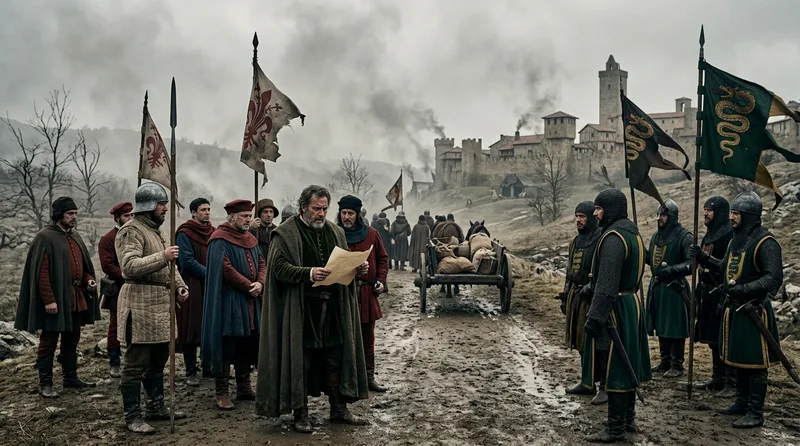
Coluccio Salutati served as Florence’s chancellor from 1375 until his death in 1406, transforming diplomatic correspondence into psychological warfare so effective that Milan’s duke Giangaleazzo Visconti reportedly claimed Salutati’s letters were worth a thousand cavalry. He wrote over 6,000 state letters during his 31-year tenure, each crafted using Ciceronian rhetoric to inspire Florence’s allies, intimidate enemies, and justify Florentine actions in classical terms that made republicanism seem divinely ordained. His 1397 letter defending Florence against Milan cited 47 Roman historical precedents across 12 pages, turning a territorial dispute into a civilizational struggle between republican liberty and tyrannical despotism. Salutati recruited Petrarch’s student Manuel Chrysoloras to teach Greek in Florence in 1397, establishing the first formal Greek instruction in Western Europe in 700 years and training Leonardo Bruni and Poggio Bracciolini, who became the next generation’s leading humanists. He personally owned 102 manuscripts by 1406, including rare works he lent freely to students, and spent his salary acquiring classical texts that he’d copy himself when professional scribes were unavailable. His 1392 treatise De Tyranno argued that Julius Caesar’s assassins committed murder, not heroic tyrannicide, because Caesar’s rule brought peace and prosperity—a controversial position that sparked decades of republican political theory debates. Salutati convinced Florence’s government to hire humanists as chancellors and schoolteachers, establishing the model that spread across Italian city-states within one generation. He died of plague on May 4, 1406, and Florence closed all public offices for three days of mourning, unprecedented honor for someone not born into nobility.
Source: britannica.com
9. Leonardo Bruni Invented the Term ‘Dark Ages’ in the Mid-Fifteenth Century
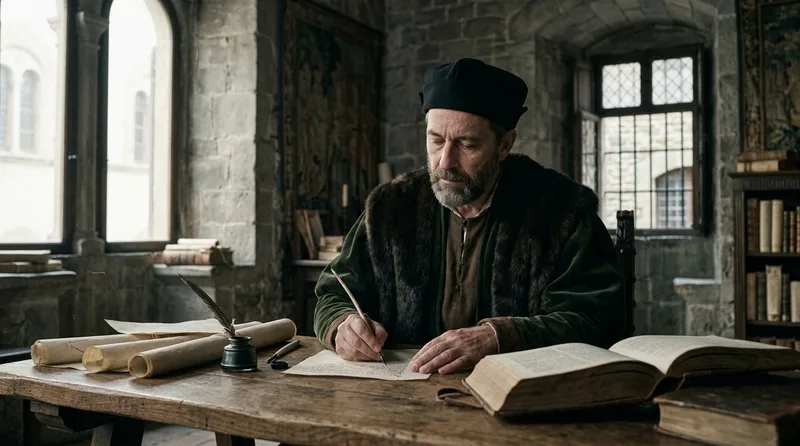
Leonardo Bruni completed his twelve-volume History of the Florentine People in 1442, creating the first work to divide history into ancient, medieval, and modern periods—the periodization we still use today. He coined the concept of the “Dark Ages” to describe the millennium between Rome’s fall in 476 CE and Petrarch’s revival of classical learning, arguing that culture collapsed when Christianity suppressed pagan literature and Latin deteriorated into corrupted medieval forms. Bruni served as Florence’s chancellor from 1427 until his death in 1444, succeeding Salutati’s model of the scholar-statesman who wielded rhetoric as state policy. His 1415 translation of Aristotle’s Ethics from Greek directly challenged medieval Scholastic interpretations by showing how Latin translations had inserted Christian concepts absent from Aristotle’s original text. He produced the first translations of Plato’s dialogues directly from Greek rather than Arabic intermediaries, completing six Platonic dialogues between 1405 and 1409 that revealed how medieval scholars had misunderstood Plato for centuries. Bruni’s 1428 work Concerning the Study of Literature created the first comprehensive humanist curriculum, outlining how students should master Latin and Greek grammar, read historians like Livy and Thucydides, study orators like Cicero and Demosthenes, and analyze poets like Virgil and Homer in that specific sequence. He argued that Florence was the legitimate heir to Roman republican values, creating the civic humanist tradition that saw classical education as training for political leadership rather than monastic contemplation. The Florentine government gave him a state funeral on March 9, 1444, and commissioned a marble tomb in Santa Croce showing him crowned with laurel—honors previously reserved for military heroes.
Source: britannica.com
10. Christine de Pizan Defended Women’s Learning in the Early Fifteenth Century

Christine de Pizan completed The Book of the City of Ladies in 1405, systematically refuting centuries of male scholarship claiming women were intellectually and morally inferior, using classical sources and historical examples to prove women’s equal capacity for learning, governance, and virtue. She catalogued 111 accomplished women from history, including 13 queens who ruled kingdoms, 9 women who invented sciences, and 23 Christian martyrs who demonstrated courage surpassing male saints, drawing her evidence from sources like Boccaccio and classical historians. Widowed at age 25 in 1390 with three children and no income, she became Europe’s first woman to support herself through writing, producing 41 works between 1393 and 1429 including poetry, military strategy manuals, and political treatises commissioned by French royalty. Her 1402 work The Book of Three Virtues created a practical education manual for women across all social classes, with specific advice for princesses managing courts, merchants’ wives running businesses, and peasant women organizing households. She directly challenged Jean de Meun’s Roman de la Rose, the medieval era’s most influential literary work, which portrayed women as naturally deceptive and lustful, sparking the Quarrel of the Rose debate that engaged France’s leading intellectuals from 1401 to 1405. Christine learned Latin, studied classical texts, and mastered rhetoric without university access—prohibited to women—assembling her own library of 100 volumes worth more than her annual income. She sent her son to university, taught her daughter classical learning, and maintained correspondence with Italian humanists including the Queen of Naples. Her final work in 1429 celebrated Joan of Arc’s military victories, linking female heroism across centuries. She retired to a convent around 1418 and died there in 1430, her works largely forgotten until feminist scholars rediscovered them in the late twentieth century.
Source: britannica.com
Did You Know?
The scholar who exposed the Church’s greatest forgery faced death threats but was protected by a king who wanted to use truth as a weapon against Rome. Meanwhile, the man who imagined religious tolerance and communism centuries before Marx ended up burning heretics and dying on Henry VIII’s scaffold. These contradictions reveal humanism’s uncomfortable truth—the same tools used to liberate minds could justify both sides of any conflict, making Renaissance scholarship not the triumph of reason over superstition, but the discovery that reason serves whoever wields it most skillfully.