
Beneath Egypt’s sands lie tombs so well hidden that even modern technology cannot find them. Ancient priests deliberately erased their locations, grave robbers destroyed their markers, and desert storms buried their entrances for millennia. These ten missing tombs haunt archaeologists who know the answers to history’s greatest mysteries lie just beneath their feet.
1. Nefertiti’s Hidden Chamber Behind Tutankhamun’s Wall
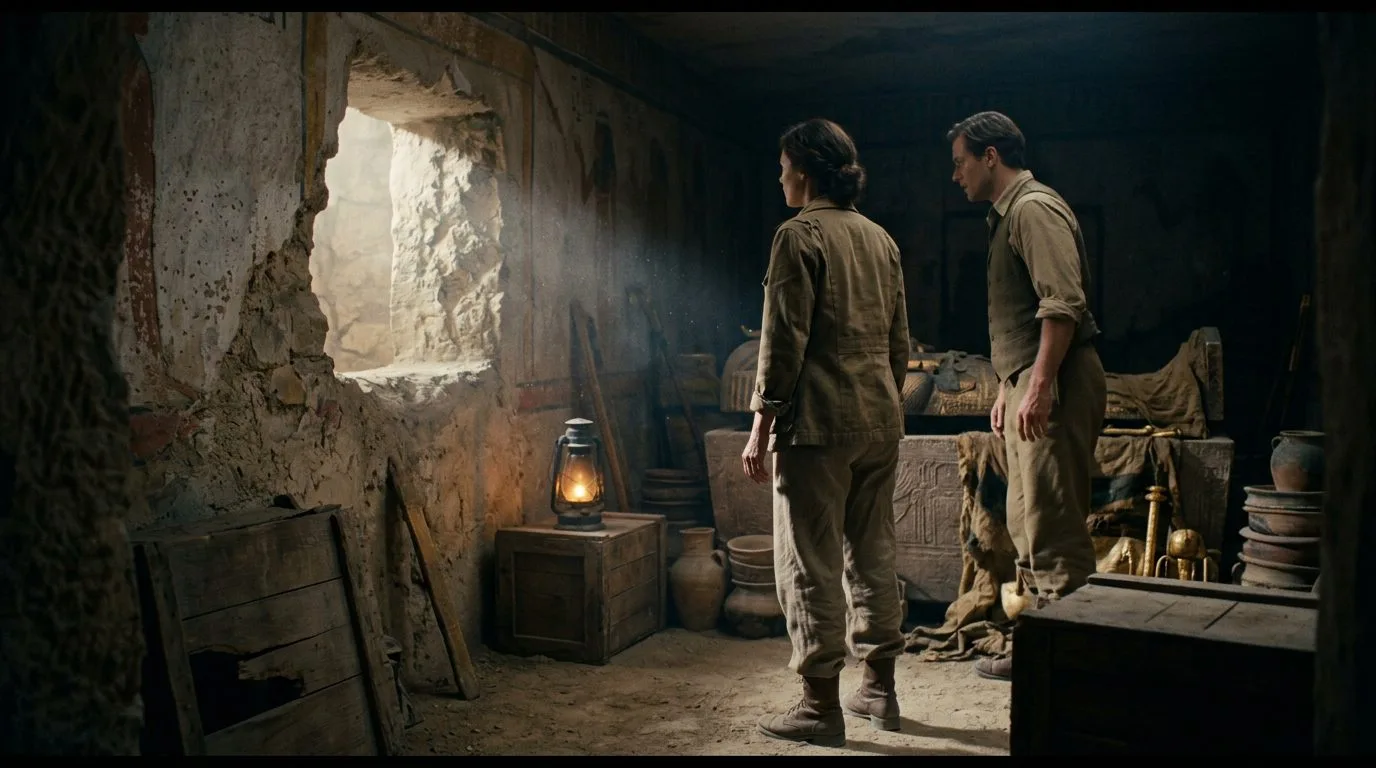
Archaeologists explore mysterious sealed chamber
Radar scans in recent decades revealed a mysterious void behind the north wall of Tutankhamun’s tomb in the Valley of the Kings, precisely where Egyptologist Nicholas Reeves predicted Nefertiti’s burial chamber would be. The beautiful queen vanished from historical records around 1336 BCE, three years before Tutankhamun’s death, leading some scholars to believe she ruled briefly as the male pharaoh Smenkhkare. Ground-penetrating radar detected organic and metallic materials consistent with a royal burial, yet Egyptian authorities halted excavation after conflicting scan results. If the chamber exists, it would contain the mummy of the most famous face in ancient history—a woman whose limestone bust captivated the world when discovered in the 19th century.
Source: smithsonianmag.com
2. Alexander the Great’s Tomb Beneath Alexandria’s Streets
Ancient burial chamber lost to time and sand.
When Alexander the Great died in Babylon in 323 BCE, his body became the ancient world’s most coveted relic—hijacked by Ptolemy I and displayed in a golden sarcophagus in Alexandria for nearly 600 years. Roman Emperor Augustus visited the tomb in 30 BCE and accidentally broke Alexander’s nose while paying respects, according to the historian Suetonius. By the 5th century CE, the tomb had vanished, possibly destroyed by tsunamis, religious zealots, or deliberately hidden by early Christians who repurposed the sarcophagus. Over 140 archaeological searches have failed to locate it, though the Shallalat Gardens district shows promising electromagnetic anomalies. Modern Alexandria sits 20 feet higher than the ancient city, burying potential evidence beneath homes, mosques, and a sewage system no one dares dismantle.
Source: britannica.com
3. Imhotep’s Tomb at Saqqara’s Labyrinthine Necropolis
Ancient stone passages honor Egypt’s greatest
Imhotep, the architect who designed Egypt’s first pyramid around 2650 BCE, was deified 2,000 years after his death, yet his tomb remains archaeology’s ultimate prize at Saqqara. Ancient pilgrims left millions of mummified ibises and bronze statuettes at his cult temples, creating a network of catacombs so vast that excavators have explored less than 30 percent of the site. British archaeologist Walter Emery spent 14 years searching Saqqara’s North side until his death in 1971, convinced he was within yards of discovery. The tomb likely lies beneath the Sacred Animal Necropolis, where tunnels collapse regularly and poisonous gases accumulate in sealed chambers. In recent decades, archaeologists discovered a previously unknown pyramid at Saqqara using infrared satellite imagery, proving that even obvious structures can hide in plain sight.
Source: britannica.com
4. Ankhesenamun’s Vanishing After Three Pharaohs’ Deaths
The queen’s mysterious disappearance from records.
Ankhesenamun, daughter of Akhenaten and wife of Tutankhamun, disappeared from history around 1323 BCE after witnessing her husband’s sudden death at age 19. Ancient letters reveal she desperately wrote to the Hittite king Suppiluliuma I, begging him to send a son for her to marry rather than accept Egypt’s elderly vizier Ay. The Hittite prince was murdered en route, and Ankhesenamun married Ay anyway, appearing beside him in temple reliefs before vanishing completely. Her tomb should logically be in the Valley of the Kings near Tutankhamun, yet no trace exists. Some scholars believe Ay had her killed and her burial erased, while others speculate she was buried in the abandoned city of Amarna. A single shabti figurine bearing her name surfaced in the antiquities market in recent centuries, offering no provenance clues.
Source: britannica.com
5. The Phantom Designation KV65 That Defies Detection
The Phantom Designation KV65 That Defies Detection
In the cataloging system of the Valley of the Kings, tomb numbers jump from KV64 to KV66, leaving KV65 as a tantalizing gap that represents either a clerical error or archaeology’s greatest tease. Ground-penetrating radar surveys in recent decades detected a significant void in the valley’s main wadi, precisely where tomb spacing suggests another entrance should exist. The Theban Mapping Project, led by Kent Weeks, documented suspicious depressions and tool marks on the cliff face between the tombs of Tausret and Seti II, dated to approximately 1190 BCE. Ancient quarry workers typically carved tombs in clusters, making the empty space architecturally anomalous. Nicholas Reeves proposed that KV65 might be the missing tomb of Ramesses VIII’s wife, deliberately hidden when his 2-year reign ended in chaos around 1130 BCE.
Source: britannica.com
6. Thutmose II’s Empty Sarcophagus and Missing Mummy
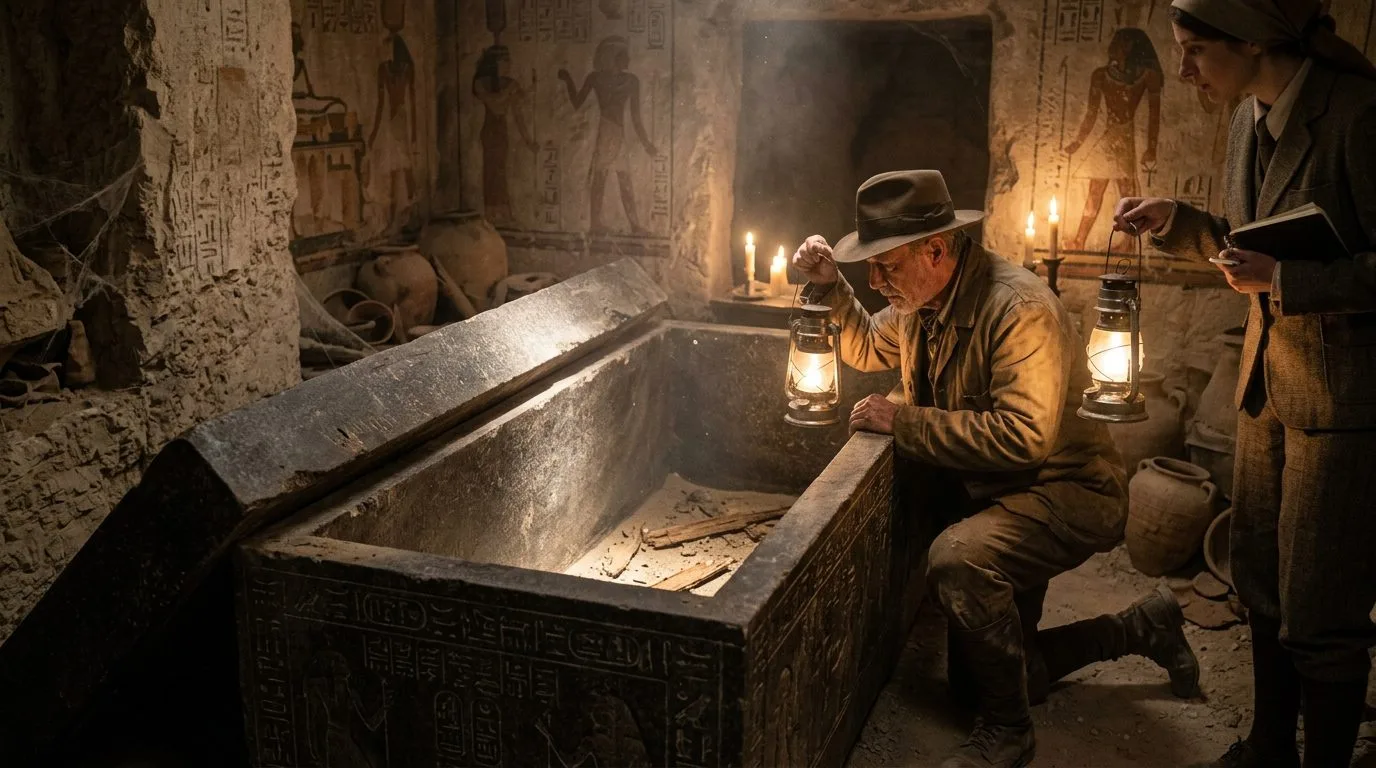
Thutmose II’s Empty Sarcophagus and Missing Mummy
When archaeologists discovered tomb KV42 in the Valley of the Kings in the 19th century, they found a sarcophagus labeled for Thutmose II but completely empty, with no sign of disturbance or robbery. The pharaoh who ruled around 1493 BCE had simply never been buried there, despite the tomb being prepared during his lifetime. His actual mummy appeared in the Deir el-Bahari cache in the 19th century, rewrapped and relabeled by 21st Dynasty priests, but with no information about his original burial location. The mummy’s poor preservation suggests it had been moved multiple times through damp conditions, unlike other royal mummies stored in dry tombs. Egyptologist Zahi Hawass believes Thutmose II was originally buried in a secret location by his powerful wife Hatshepsut, who later usurped his throne and may have hidden evidence of his reign.
Source: britannica.com
7. Cleopatra and Mark Antony’s Underwater Tomb at Taposiris Magna
Ancient ruins reveal secrets of lost love.
After their joint suicide in 30 BCE, Cleopatra VII and Mark Antony were reportedly buried together in a tomb near Alexandria, according to the Roman historian Plutarch, who described it as “lofty and beautiful.” Since the early 21st century, archaeologist Kathleen Martinez has excavated the Temple of Taposiris Magna, 28 miles west of Alexandria, uncovering 16 burials with Greco-Roman features and coins bearing Cleopatra’s face. Ancient documents describe how Cleopatra built a tomb overlooking the sea, and Taposiris sits on a limestone ridge now partially submerged by rising Mediterranean waters. Martinez discovered a network of tunnels beneath the temple in recent years, flooded and collapsed but containing alabaster busts and ceremonial pottery. Plutarch’s account specifies that Octavian allowed the burial “in splendid and regal fashion,” suggesting a monument substantial enough to survive—if it hasn’t already sunk beneath the waves.
Source: smithsonianmag.com
8. Herihor’s Tomb and the High Priest Who Became Pharaoh
Ancient Egyptian tomb entrance at Thebes.
Herihor seized control of Upper Egypt around 1080 BCE, declaring himself both High Priest of Amun and pharaoh while the legitimate king ruled only the north. His unprecedented power grab should have earned him a magnificent tomb at Thebes, yet no burial place has been identified despite his name appearing on countless temple inscriptions. His funerary papyrus, discovered in the 19th century, indicates he was buried “in the place of eternity in Western Thebes,” but the 400-acre necropolis offers millions of potential locations. The tomb likely escaped robbery because Herihor ruled during Egypt’s economic collapse, when elaborate burials became rare and tomb construction budgets vanished. Egyptologist Aidan Dodson suggests Herihor’s tomb might be hidden within the Medinet Habu temple complex, where he controlled the treasury and could secretly excavate beneath sacred ground.
Source: britannica.com
9. Ramesses VIII’s Missing Mummy and 2-Year Mystery Reign
Ramesses VIII’s elusive mummy remains lost.
Ramesses VIII ruled for barely 2 years around 1130 BCE, dying so abruptly that his tomb KV19 remained unfinished, with painted walls ending mid-scene and the sarcophagus chamber barely carved. When Victor Loret opened the tomb in the 19th century, he found it completely empty except for pottery fragments and a single ushabti figurine. Unlike other robbed tombs, KV19 showed no signs of forced entry or ransacking, suggesting the pharaoh was never buried there. The royal mummy caches at Deir el-Bahari and the tomb of Amenhotep II contained 50 other mummies but not Ramesses VIII, despite priests keeping meticulous reburial records. Some scholars believe he died during a civil war and his body was hidden by loyalists, while others speculate he was buried alive in a rock-cut tomb that collapsed, sealing him forever.
Source: britannica.com
10. The Royal Necropolis at Tanis Hinted in Papyrus Fragments
Ancient papyri reveal secrets of Tanis’s royal
Ancient papyri reference a “great place of burial” at Tanis in the Nile Delta, where 21st Dynasty pharaohs supposedly built an alternative necropolis around 1070 BCE to escape Theban tomb robbers. Pierre Montet discovered intact royal tombs at Tanis in the 20th century, including those of Psusennes I and Amenemope, but temple inscriptions describe “the tombs of the ancestors” in a separate location flooded by the Nile. The delta’s high water table means any undiscovered tombs now lie 15 feet below groundwater, requiring constant pumping to excavate. In recent decades, French archaeologists using electrical resistivity detected massive stone structures beneath Tanis’s eastern field, approximately 200 meters from Montet’s discoveries. These anomalies match the dimensions of royal burial complexes, yet excavation remains impossible without draining an area that would immediately refill and collapse.
Source: britannica.com
Did You Know?
Did You Know? The Egyptian government maintains a classified list of suspected tomb locations that archaeologists are forbidden to excavate—not for preservation, but because officials fear discovering another Tutankhamun-scale treasure would overwhelm their security capabilities. Ground-penetrating radar has identified over 3,000 unexplored voids beneath known archaeological sites, yet fewer than 10 receive excavation permission annually. The greatest irony: some lost tombs may have already been found and reburied by early archaeologists who lacked documentation skills, meaning modern teams might be searching for discoveries already made and forgotten a century ago.