
Every time you vote, question authority, or defend individual rights, you’re channeling ideas from thinkers who died millennia ago. These ten philosophers didn’t just write treatises—they rewired human civilization.
1. Confucius Created the Blueprint for Social Harmony in 551 BCE

Ancient Chinese philosopher Confucius shaped
Confucius revolutionized governance by arguing that moral education, not force, creates stable societies. Born in 551 BCE during China’s chaotic Spring and Autumn period, he taught that 5 fundamental relationships—ruler-subject, father-son, husband-wife, elder-younger, friend-friend—form civilization’s bedrock. His concept of ‘ren’ (humaneness) influenced over 2 billion people across East Asia. Modern China’s emphasis on education and filial piety traces directly to his Analects, compiled by disciples after his death in 479 BCE. Corporate hierarchies and respect-based management systems worldwide still mirror his relational framework.
Source: britannica.com
2. Socrates Invented Critical Thinking in Ancient Athens
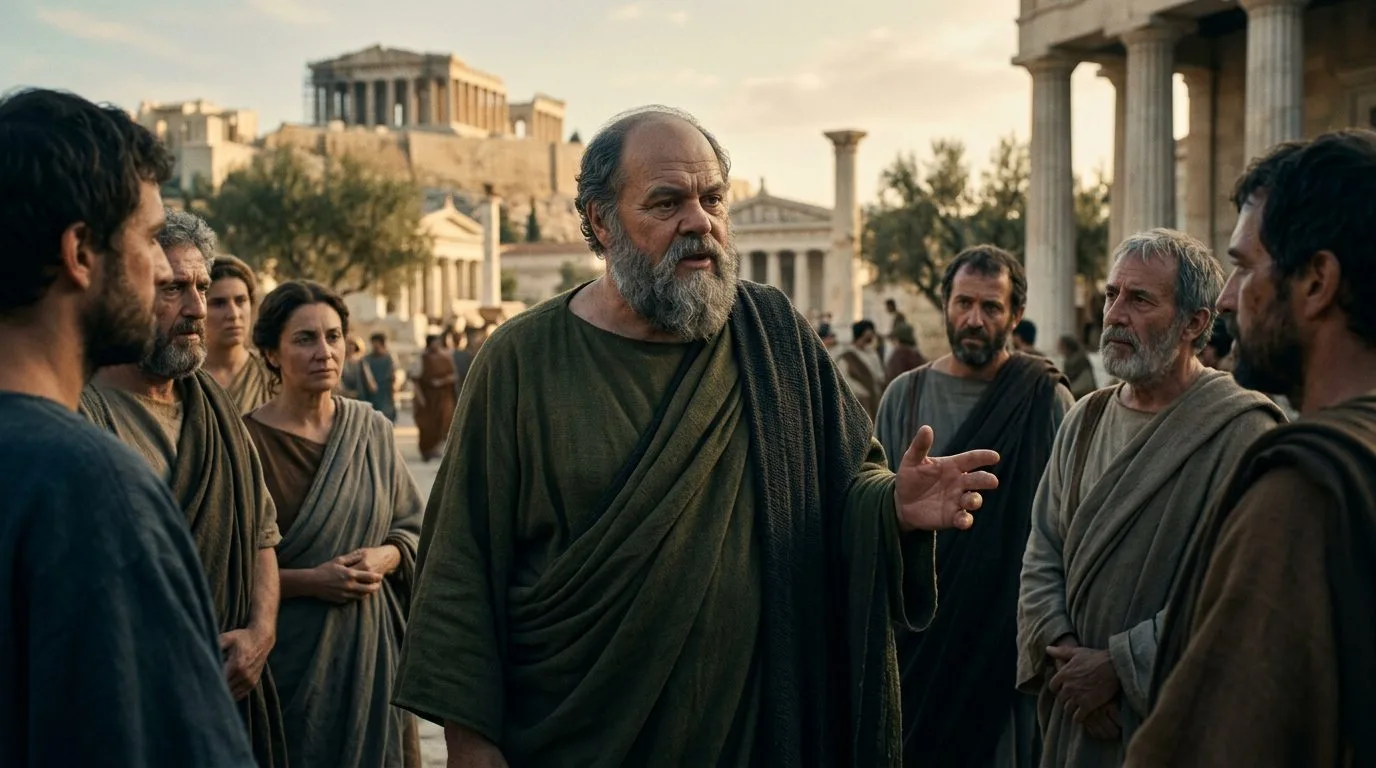
Socrates questions students in the Athenian agora.
Socrates never wrote a single word, yet his questioning method—the Socratic dialogue—became education’s foundation. Walking Athens’ agora around 430 BCE, he challenged citizens to define justice, virtue, and knowledge through relentless questioning. His most famous declaration, ‘I know that I know nothing,’ positioned humility as wisdom’s core. Athens executed him by hemlock in 399 BCE for corrupting youth and questioning gods. Today’s legal cross-examinations, scientific peer review, and classroom debates all stem from his insistence that unexamined beliefs are worthless. Every lawyer using cross-examination employs his 2,400-year-old technique.
Source: britannica.com
3. Plato’s Republic Defined Ideal Government 2,400 Years Ago
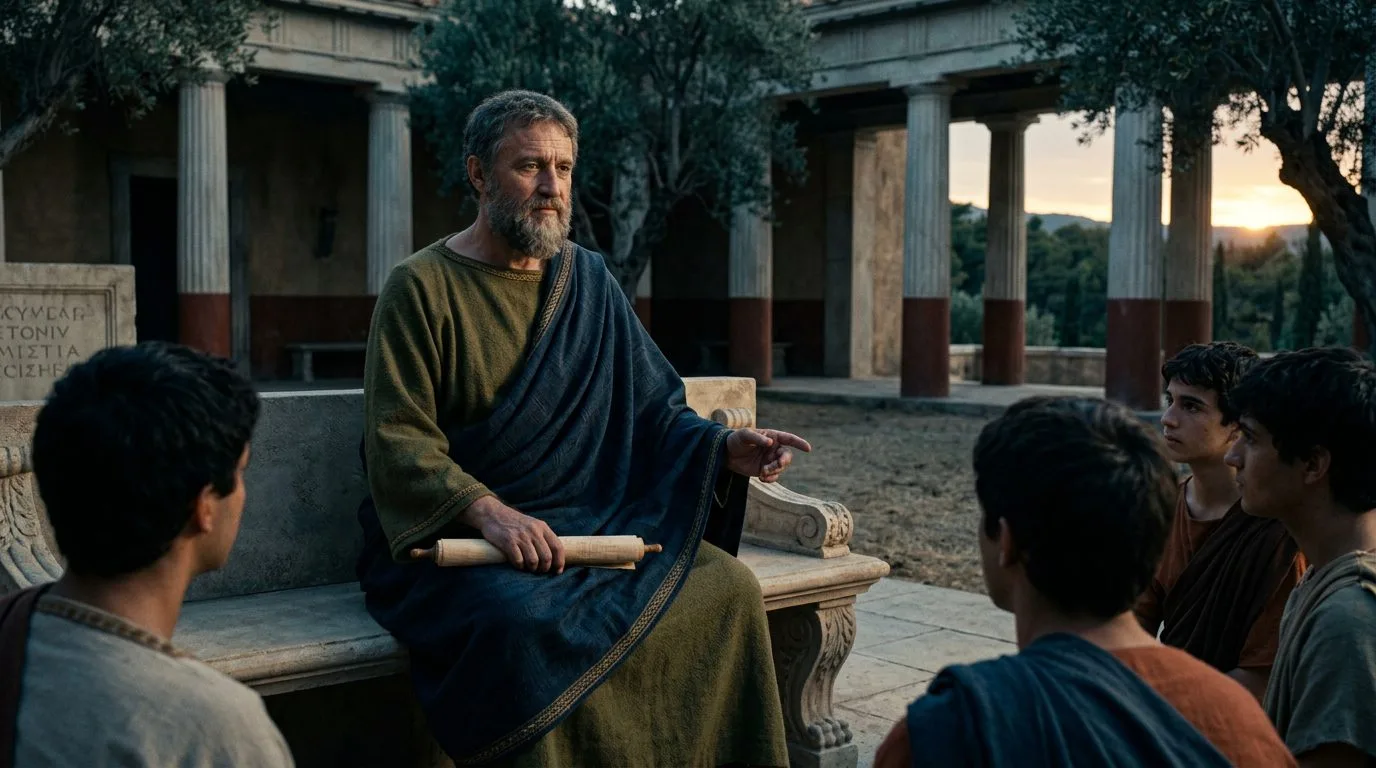
Plato’s Republic Defined Ideal Government 2
Plato founded the Academy in Athens around 387 BCE, creating Western civilization’s first university that operated for 900 years. His Republic outlined a shocking vision: philosopher-kings should rule because only wisdom, not wealth or popularity, qualifies leaders. His Theory of Forms argued that physical reality merely shadows perfect, eternal concepts—a revolutionary split between appearance and truth. Modern universities, with their specialized knowledge hierarchies, reflect his academic model. The notion that experts should guide policy, from climate scientists to medical professionals, echoes his core argument that knowledge trumps opinion in governance.
Source: britannica.com
4. Aristotle Systematized Logic and Science in 335 BCE

Aristotle established formal logic and scientific
Aristotle founded the Lyceum in Athens in 335 BCE and catalogued knowledge across 200 treatises covering everything from zoology to ethics. His syllogistic logic—‘All men are mortal; Socrates is a man; therefore Socrates is mortal’—gave humanity its first formal reasoning system. He dissected 50 animal species, establishing empirical observation as science’s foundation. His Golden Mean concept—virtue lies between extremes—still guides ethical decision-making. Modern biology’s classification systems, formal logic courses, and the scientific method’s emphasis on observation all descend from his systematic approach to understanding reality through reason and evidence.
Source: britannica.com
5. Laozi Founded Daoism with One Mysterious Text

Laozi Founded Daoism with One Mysterious Text
Laozi allegedly lived during the 6th century BCE, though historians debate whether one person wrote the Tao Te Ching or multiple authors compiled it. This 5,000-character text introduced ‘wu wei’—effortless action through alignment with nature’s flow—challenging Confucius’s rigid social structures. His concept that ’the dao that can be named is not the eternal Dao’ pioneered Eastern philosophy’s embrace of paradox and ineffability. Modern environmentalism, holistic medicine, and mindfulness practices channel his emphasis on balance over force. Martial arts like tai chi embody his principle that yielding defeats rigidity, influencing 1.4 billion practitioners of Daoist-influenced traditions.
Source: britannica.com
6. Marcus Aurelius Wrote Meditations While Commanding Rome’s Armies

Philosopher-emperor balances duty and wisdom.
Marcus Aurelius ruled Rome from 161 to 180 CE while fighting Germanic tribes along the Danube frontier, composing his Meditations in a military tent. His Stoic philosophy taught that virtue alone brings happiness, external events merely test character. His journal entry ‘You have power over your mind—not outside events’ became cognitive behavioral therapy’s foundation 1,800 years later. He faced plague, betrayal, and constant warfare, yet counseled acceptance of what cannot change. Modern resilience training, from Navy SEALs to corporate leadership, draws directly from his emphasis on controlling reactions rather than circumstances.
Source: britannica.com
7. Hypatia of Alexandria Championed Rational Thought Until 415 CE

Ancient mathematician and philosopher Hypatia.
Hypatia became head of Alexandria’s Neoplatonist school around 400 CE, teaching mathematics, astronomy, and philosophy to students across the Roman Empire. She perfected the astrolabe design and wrote commentaries on Diophantus’s algebra and Apollonius’s conic sections—works that preserved Greek mathematics through the Dark Ages. As a woman leading intellectual life in a male-dominated world, she symbolized reason’s universality. A Christian mob murdered her in 415 CE during religious conflicts, making her a martyr for rational inquiry. Her insistence that evidence, not dogma, reveals truth anticipated the scientific revolution by 12 centuries.
Source: britannica.com
8. Ibn Sina Revolutionized Medicine with The Canon in 1025 CE

Ibn Sina’s groundbreaking medical text.
Ibn Sina completed The Canon of Medicine in 1025 CE, a 1-million-word encyclopedia that became medical education’s standard text for 600 years across Europe and the Islamic world. Born in 980 CE near Bukhara, he mastered all Greek philosophy by age 18. He identified contagious disease transmission, described 760 drugs, and pioneered clinical trials—testing treatments systematically rather than relying on tradition. His philosophical works reconciled Aristotelian logic with Islamic theology, creating a rationalist framework that influenced Thomas Aquinas. Modern evidence-based medicine and the requirement for controlled drug testing directly descend from his empirical methodology.
Source: britannica.com
9. Thomas Aquinas Merged Faith and Reason in 1274 CE

Thomas Aquinas Merged Faith and Reason in 1274 CE
Thomas Aquinas died in 1274 CE, leaving his Summa Theologica unfinished—yet its 3,000 articles reshaped Western thought by proving faith and reason need not conflict. He argued that 5 logical proofs demonstrate God’s existence, making theology a science rather than mere belief. Drawing on Aristotle (banned by the Church when he started), he created synthesis: natural law discovered through reason complements divine revelation. His natural law theory—that universal moral principles exist independent of human decree—underlies modern human rights declarations. The 1948 Universal Declaration of Human Rights echoes his claim that dignity derives from rational nature, not government grant.
Source: britannica.com
10. Immanuel Kant Established Universal Ethics in 1785 CE

Kant’s groundbreaking moral framework.
Kant published Groundwork of the Metaphysics of Morals in 1785 CE, introducing the categorical imperative: act only according to principles you’d want as universal laws. Born in 1724 in Königsberg, Prussia, he never traveled more than 10 miles from his birthplace yet revolutionized ethics, epistemology, and aesthetics. His principle that humans are ends in themselves, never mere means, became modern human rights’ philosophical bedrock. He argued that reason alone, not religion or authority, reveals moral duty. The Nuremberg trials’ rejection of ‘just following orders’ defenses directly invoked his insistence that moral autonomy defines humanity.
Source: britannica.com
Did You Know?
Did You Know? The U.S. Constitution’s framers kept busts of ancient philosophers in Independence Hall—not as decoration, but as blueprints. When Thomas Jefferson wrote ‘all men are created equal,’ he channeled Kant’s categorical imperative through Aristotle’s natural law, filtered by Aquinas. The Socratic method you learned in school, the resilience training in your therapy sessions, even your yoga class’s emphasis on balance—all echo voices from thinkers who never imagined smartphones yet somehow predicted exactly which ideas humanity would need to navigate modernity’s chaos.