
Before gunpowder, conquering a walled city required wooden towers taller than ramparts and stone projectiles weighing 78 pounds. Ancient siege weapons didn’t just break walls—they shattered defender morale and changed warfare forever.
1. Greek Torsion Catapult Rained Stone Death from 300 Yards
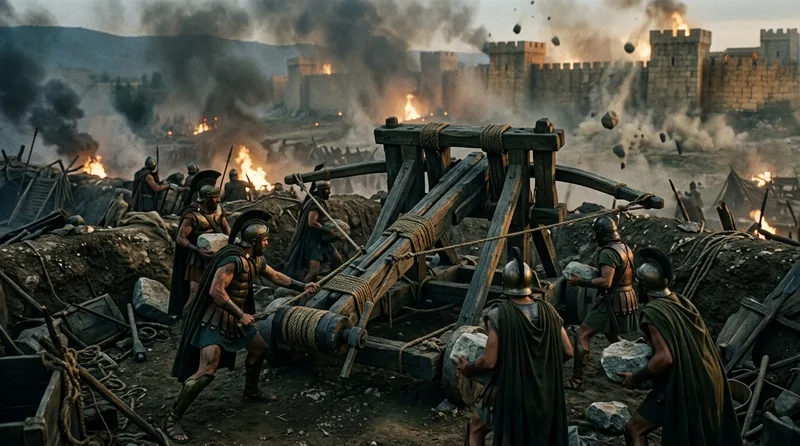
The lithobolos revolutionized siege warfare when Greek engineers perfected torsion spring technology around 340 BCE, enabling armies to hurl 26-pound stone projectiles over fortress walls from distances exceeding 300 yards. Developed by Philip II of Macedon’s craftsmen, this weapon employed twisted bundles of rope, sinew, or human hair as torsion springs, storing tremendous energy that released with devastating force. The Siege of Tyre in 332 BCE saw Alexander the Great deploy dozens of lithoboli against the island fortress, battering the supposedly impregnable walls for seven months until breaches appeared. Each machine required a crew of eight men to operate: four cranked the windlass to draw back the throwing arm, two loaded stones, and two aimed using calibrated sights. The psychological impact proved as lethal as the physical damage—defenders cowered behind battlements knowing death could strike randomly from the sky. This Greek innovation established artillery as the dominant siege weapon for the next two millennia, fundamentally shifting warfare from close combat to ranged destruction. Cities that had withstood years of traditional siege now fell in months once torsion catapults arrived, redrawing the political map of the Mediterranean world.
Source: britannica.com
2. Assyrian Siege Ramps Conquered the Unconquerable in 701 BCE
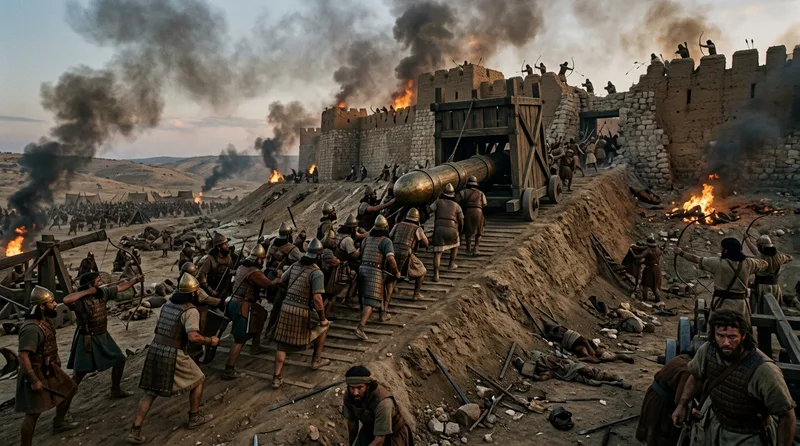
King Sennacherib’s engineers constructed massive earthen ramps reaching heights of 65 feet during the Siege of Lachish in 701 BCE, supporting bronze-capped battering rams that weighed over 15 tons and required 60 men to operate effectively. Assyrian reliefs from Nineveh depict these technological marvels in astonishing detail: workers hauled dirt in baskets while archers provided covering fire, building artificial hills that neutralized height advantages of defensive walls. The battering rams themselves featured armored housings protecting the operators from arrows and boiling oil, with suspended rams swinging on chains to concentrate force on single points. At Lachish, Sennacherib’s forces built at least four ramps simultaneously, forcing defenders to spread resources thin while rams pounded limestone walls around the clock. The noise alone terrorized inhabitants—the rhythmic thunder of bronze striking stone echoed for miles, signaling inevitable doom. Archaeological excavations at Lachish reveal ram impact craters in foundation stones and thousands of arrowheads from the desperate defense. This combination of ramp and ram proved so effective that Assyrian armies conquered 89 fortified cities during Sennacherib’s reign alone, establishing Assyria as the superpower of the ancient Near East for over two centuries.
Source: britannica.com
3. The Helepolis Terrified Rhodes with Its Nine-Story Height
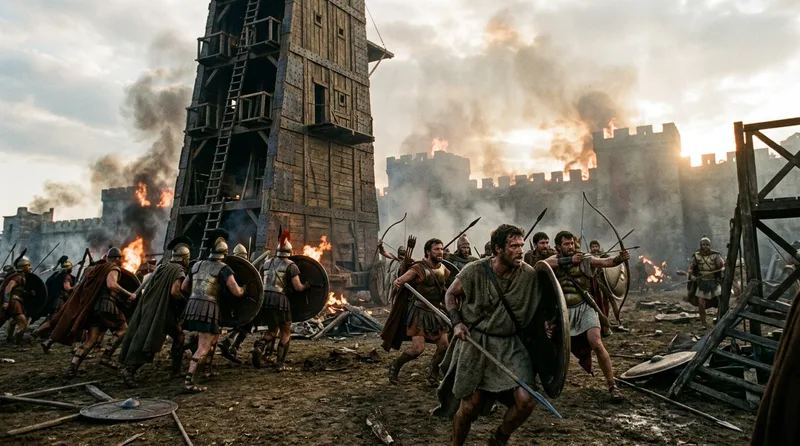
Demetrius Poliorcetes—literally “Demetrius the Besieger”—constructed the most fearsome siege tower in ancient history for the Siege of Rhodes in 305 BCE: a nine-story helepolis standing 135 feet tall, weighing approximately 160 tons, and requiring 3,400 men just to move it forward. This mobile fortress featured iron plating on three sides for protection, housed eight battering rams on different levels, and accommodated 200 soldiers who operated artillery and prepared to storm walls once positioned. Engineers mounted the structure on eight massive wheels, each reinforced with iron bands, while the entire tower moved on a base measuring 75 feet square for stability. The helepolis carried water tanks for extinguishing fire arrows, multiple drawbridges that could deploy at various heights, and catapults firing from the upper stories directly onto defender positions. Rhodian engineers countered by secretly undermining the ground in the tower’s path and flooding the approach with sewage, miring the colossus in mud after only partial wall damage. Though Rhodes survived this particular siege, the helepolis concept revolutionized warfare—proving that no wall was too high if engineering matched ambition. Later Hellenistic kings built similar towers, though none matched Demetrius’ original in scale or intimidation factor. The bronze and iron salvaged from this abandoned siege engine later funded construction of the Colossus of Rhodes.
Source: britannica.com
4. Roman Onagers Launched 60-Pound Stones Like Thunderbolts
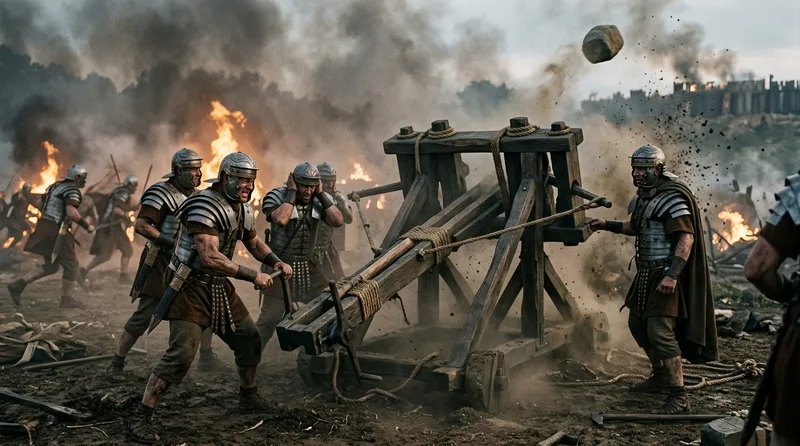
The onager earned its name—“wild donkey”—from the vicious kick it produced when releasing torsion-powered projectiles, capable of hurling 60-pound stones over 450 yards or sending clay pots filled with burning pitch into defended positions during the 3rd century CE. Roman engineers simplified earlier Greek designs into a single-armed throwing machine with a massive sling, reducing construction time from weeks to days while maintaining devastating effectiveness. Ammianus Marcellinus described onager crews at the Siege of Amida in 359 CE, where Persian defenders watched helplessly as Roman artillery “shook the earth with terrible crashes” and reduced tower battlements to rubble within hours. Each onager stood roughly 13 feet tall, used a wooden arm twisted into a rope bundle providing torsion force equivalent to modern hydraulic systems, and achieved such velocity that stones shattered into deadly shrapnel upon wall impact. Legionary engineers could assemble 12 onagers in a single day from prefabricated components carried in supply wagons, giving Roman armies unprecedented siege mobility. The weapon’s psychological impact multiplied its physical damage—defenders never knew when the next stone would obliterate their position, creating constant terror that eroded morale faster than walls crumbled. Onagers remained Rome’s primary siege artillery for over 400 years, contributing to the conquest and defense of territories spanning three continents.
Source: britannica.com
5. The Gastraphetes Made Every Greek Soldier a Precision Killer
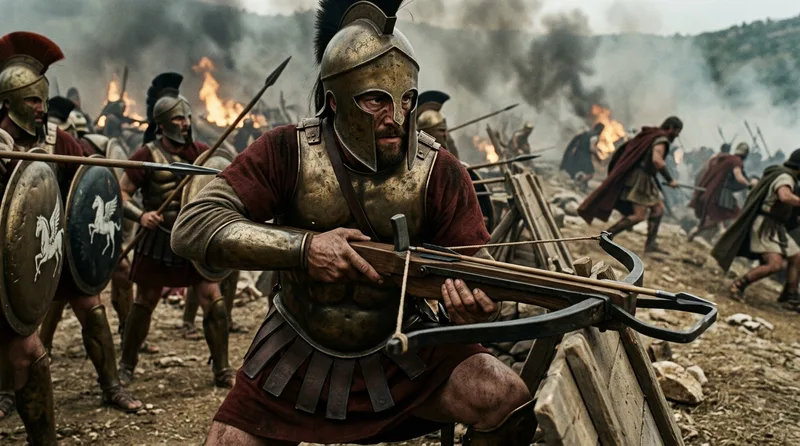
Greek engineers invented the gastraphetes—“belly-bow”—around 420 BCE, creating the world’s first mechanical crossbow that generated three times the power of hand bows by using the operator’s body weight to compress a composite spring mechanism. Soldiers braced the curved bronze end-piece against their stomachs, pushed forward with their entire body to draw the bowstring, then locked it in place with a trigger mechanism that allowed careful aiming before release. This revolutionary weapon fired 30-inch bronze-tipped bolts capable of penetrating three layers of linen armor at 100 yards, transforming infantry siege tactics by enabling precise targeting of defenders on battlements. Heron of Alexandria documented gastraphetes specifications in the 1st century CE, noting that skilled operators achieved accuracy within a six-inch circle at 75 yards—unprecedented precision for the era. The weapon proved especially effective during sieges when attackers needed to suppress defender archers without exposing themselves; one gastraphetes operator could neutralize an entire wall section by systematically eliminating anyone who appeared above the ramparts. Archaeological evidence from the Siege of Motya in 397 BCE reveals dozens of gastraphetes bolts embedded in defensive walls, suggesting Dionysius I of Syracuse equipped entire units with these weapons. This innovation directly led to larger torsion-powered ballistas, establishing the technological foundation for artillery development that dominated warfare for 2,000 years.
Source: britannica.com
6. Roman Ballistae Shot Bolts Through Three Men at Once
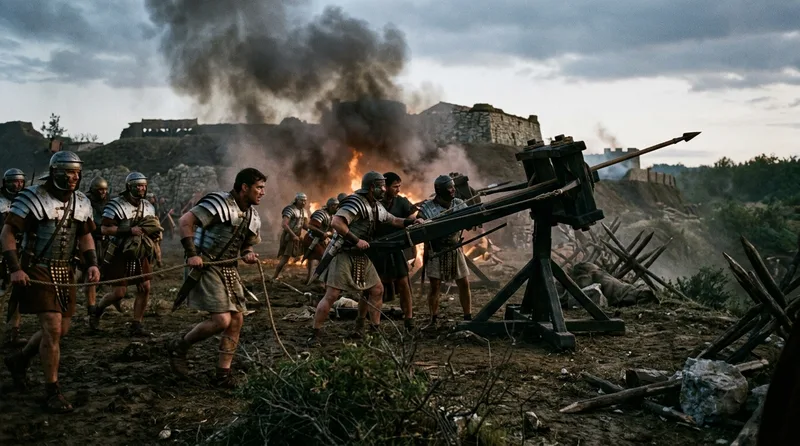
The ballista evolved from Greek designs into Rome’s most feared precision siege weapon by 100 BCE, firing four-foot iron-tipped bolts with such velocity that Vegetius recorded instances of single projectiles impaling three enemy soldiers standing in formation. These torsion-powered artillery pieces used wound sinew cords in two vertical springs, creating a double-armed throwing mechanism that achieved superior accuracy compared to single-arm designs, with effective ranges exceeding 500 yards. Julius Caesar deployed 60 ballistae during the Siege of Alesia in 52 BCE, positioning them to sweep Gallic relief forces attempting to break the encirclement while simultaneously suppressing defenders on fortress walls. Each machine required a crew of 11 specialists: eight men operated the windlass for drawing, one commanded firing sequences, and two maintained the torsion springs with animal fat to prevent rope degradation. The psychological warfare value exceeded physical damage—defenders heard the distinctive twang of release, had seconds to locate the incoming bolt, and watched helplessly as the projectile punched through shields, armor, and bodies with equal ease. Roman engineering standardized ballista components across the empire, enabling rapid field repairs and replacement, with some machines remaining operational for 50 years. These weapons transformed siege warfare from chaotic assaults into calculated engineering problems where Roman discipline and technology methodically dismantled any defense.
Source: britannica.com
7. Persian Mobile Towers Rolled Over Defenses at Tyre
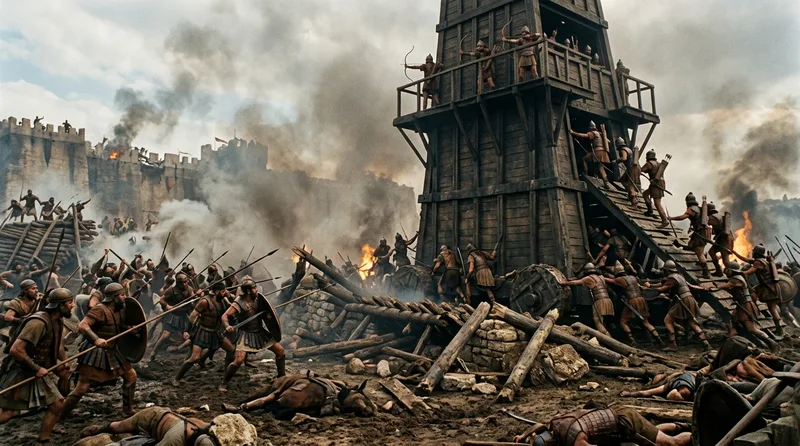
King Cambyses II perfected mobile siege towers during the Persian conquest of Egypt in 525 BCE, constructing wheeled fortresses that stood 80 feet tall and featured multiple levels of archers, though the most innovative Persian application came during their support of Alexander’s Siege of Tyre in 332 BCE. These engineering marvels featured wetted hide exteriors resistant to fire arrows, retractable bridges that deployed onto walls at multiple heights, and internal ramps allowing continuous troop rotation during assaults. Persian engineers innovated a critical improvement over earlier designs: they mounted towers on massive log rollers that distributed weight across soft ground, preventing the miring that had stopped previous siege engines. The towers accommodated 150 soldiers across six levels, with the bottom floors housing rams while upper levels provided archery platforms that dominated defensive positions through superior height advantage. During sieges, defenders watched these mobile fortresses inch forward daily, knowing their walls would eventually be matched in height and their positions exposed to direct assault from soldiers fighting on level ground. The Persians protected their towers with accompanying units carrying large shields and sandbags, creating mobile fortifications that advanced in coordinated waves. This combined-arms approach to siege warfare—integrating towers, rams, artillery, and infantry—established tactical doctrines that remained relevant until gunpowder artillery rendered height advantages obsolete. Persian tower designs influenced Hellenistic and Roman engineering for five centuries.
Source: britannica.com
8. Macedonian Torsion Artillery Shattered Theban Gates in Hours
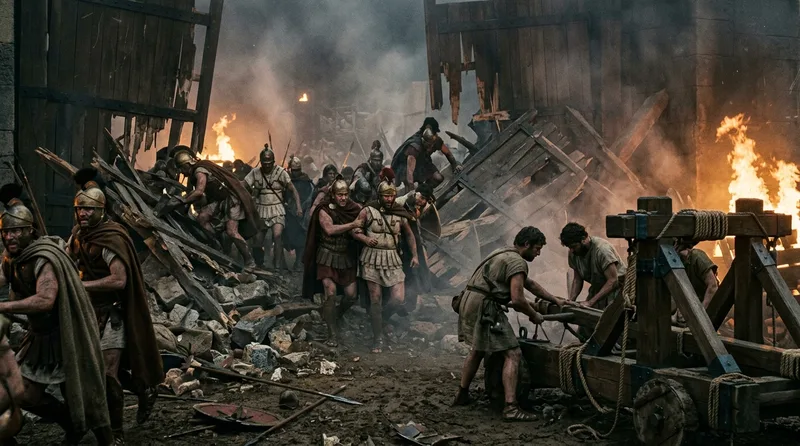
Philip II of Macedon revolutionized siege warfare around 350 BCE by creating the first dedicated artillery corps equipped with torsion-powered weapons, deploying concentrated batteries of stone-throwers and bolt-shooters that reduced the Siege of Olynthus in 348 BCE from an expected year-long campaign to just months. Macedonian engineers standardized calibers across their artillery fleet—creating interchangeable parts and projectiles—with stone-throwers sized for 5-pound, 10-pound, and 26-pound ammunition, while bolt-throwers fired standardized iron-tipped projectiles measuring 18, 24, or 36 inches. This systematization enabled rapid deployment of 40-piece artillery trains that accompanied Philip’s armies, transforming siege capability from specialized engineering projects into routine military operations. At the Siege of Byzantium in 340 BCE, Macedonian artillery crews achieved firing rates of six shots per hour per machine during daylight operations, maintaining suppressive fire that prevented wall repairs and exhausted defenders. The weapons’ modular bronze components allowed field repairs using standardized replacement parts carried in supply wagons, while specialized artillerist units trained for years to achieve precision targeting at maximum ranges. Philip’s son Alexander inherited this artillery advantage, using it to conquer 70 cities across three continents in just 13 years—a pace impossible without the siege-breaking capability Macedonian torsion weapons provided. This innovation shifted power balances across the Hellenistic world, making fortifications defensive liabilities rather than guarantees of safety.
Source: britannica.com
9. The Roman Corvus Turned Warships Into Floating Siege Towers
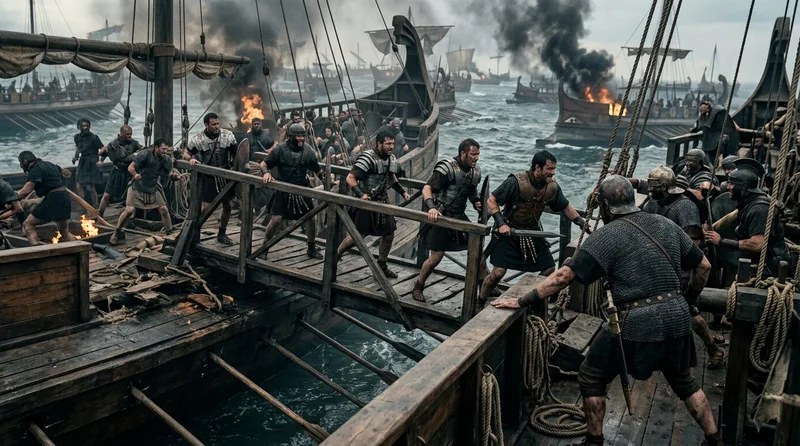
Roman engineers adapted siege warfare principles to naval combat around 260 BCE by inventing the corvus—“raven”—a 36-foot rotating boarding bridge with a heavy spike that crashed down onto enemy decks, transforming sea battles into land-style infantry assaults where Roman legionaries excelled. This revolutionary device consisted of a 12-foot-wide plank mounted on a pole at the bow, featuring a pulley system allowing operators to raise it 40 feet vertically before releasing it to crash down with devastating force onto any ship within range. The corvus weighed approximately 2.5 tons and required a crew of eight to operate, rotating 360 degrees to engage targets on either side or ahead of the Roman vessel. During the Battle of Mylae in 260 BCE, 120 Roman quinqueremes equipped with corvuses defeated the superior Carthaginian fleet by negating their naval experience advantage—once the spike penetrated enemy decks, 80 marines stormed across the bridge in tight formation. Carthaginian sailors, trained for ramming and maneuver warfare, found themselves fighting armored legionaries in close combat aboard their own ships, a scenario where Roman discipline proved decisive. This tactical innovation enabled Rome to win 30 naval battles during the First Punic War despite having virtually no maritime tradition, fundamentally shifting Mediterranean power from Carthage to Rome. The corvus demonstrated how siege warfare principles—creating direct access to defended positions—applied universally across combat domains.
Source: britannica.com
10. The Sambuca Combined Ship and Ladder to Scale Sea Walls
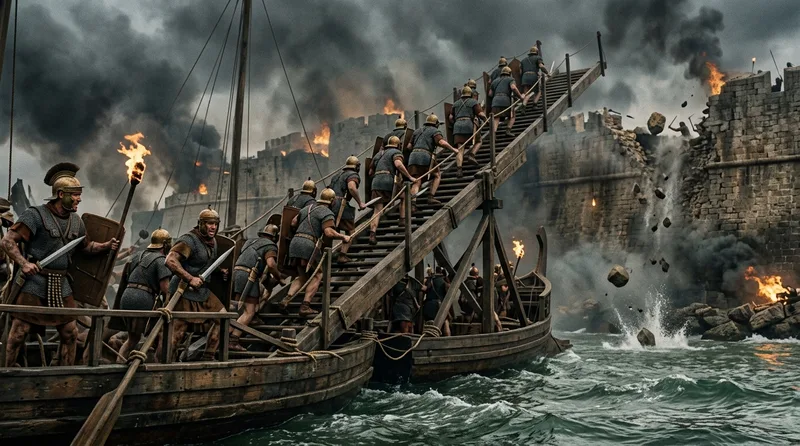
Marcus Claudius Marcellus deployed the sambuca during the Siege of Syracuse in 213 BCE, creating a hybrid siege weapon that combined ship mobility with scaling ladder functionality—a boarding bridge mounted between two ships that raised to 40 feet and dropped assault troops directly onto coastal fortress walls. This ingenious device consisted of a massive ladder 40 feet long and 4 feet wide, suspended between two quinqueremes lashed together for stability, with a protective wooden housing shielding four soldiers who rode the ladder upward to storm battlements. The sambuca’s name derived from its triangular shape resembling the ancient musical instrument, though defenders found nothing harmonious about watching this mechanical monster rise from the sea and deposit armed legionaries onto previously secure ramparts. Engineers designed the system with counterweights and pulleys allowing precise height adjustment, targeting specific wall sections or towers with surgical precision impossible for land-based siege equipment. At Syracuse, Archimedes countered with his famous defensive innovations—including giant grappling hooks that capsized the sambuca ships—marking history’s first recorded battle between siege engineers of comparable genius. Roman crews operating sambucas required extraordinary coordination; the slightest imbalance between the two vessels caused catastrophic failure, drowning heavily armored marines in seconds. Despite mechanical challenges, the sambuca concept proved that no fortress was safe if coastline provided access, forcing cities to extend walls into the sea—a massive construction expense that bankrupted many Greek city-states. This weapon demonstrated how combining existing technologies—ships plus ladders—created entirely new tactical possibilities that redefined siege warfare parameters.
Source: britannica.com
Did You Know?
Did You Know? The most successful siege weapon in ancient history wasn’t the largest or most powerful—it was the simple battering ram, which conquered more fortresses than all artillery combined because defenders could destroy catapults from distance but had no effective counter once rams reached their gates. Ironically, the defensive innovation that finally stopped these mechanical marvels wasn’t better walls or countermeasures, but diplomatic surrender—as cities calculated that negotiating terms before siege weapons arrived cost less than rebuilding after their inevitable deployment.