
When divers discovered a corroded bronze mechanism in a shipwreck off Antikythera in the early 20th century, they had no idea it was a 2,000-year-old computer. Greek mathematics wasn’t just abstract theory—it was embodied in physical instruments that measured stars, predicted eclipses, and calculated distances across continents.
1. Antikythera Mechanism: The World’s First Analog Computer
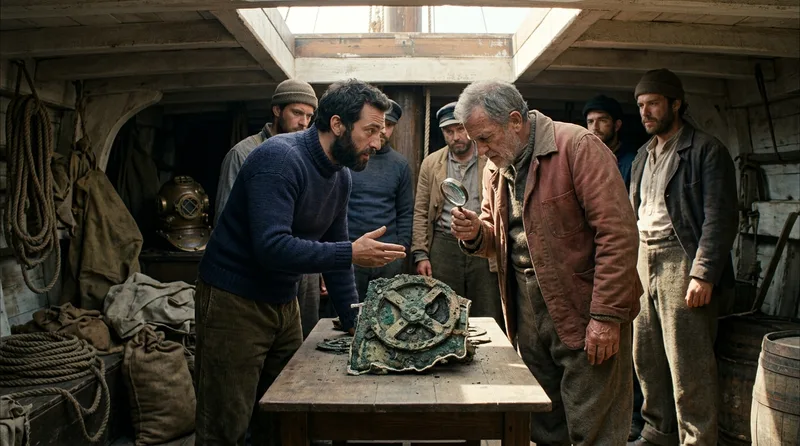
Recovered from a Roman-era shipwreck in the early 20th century, the Antikythera mechanism contained at least 30 bronze gears arranged in a complexity not seen again until 14th-century cathedral clocks. Built around 100 BCE, this device predicted solar eclipses, tracked the four-year Olympic cycle, and displayed the positions of the five known planets with startling accuracy. The mechanism used a differential gear—a technology historians believed wasn’t invented until the 18th century—to calculate lunar anomalies caused by the Moon’s elliptical orbit. X-ray imaging in the early 21st century revealed inscriptions functioning as an instruction manual, with over 3,000 characters explaining astronomical phenomena. The device’s eclipse prediction dial operated on the 223-month Saros cycle, known to Babylonian astronomers but engineered into mechanical form only by Greek craftsmen. One gear tooth represents approximately 5 days of celestial motion, allowing users to turn a crank and watch cosmic time unfold. The mechanism demonstrates that Greek mathematics wasn’t confined to papyrus scrolls—engineers translated Hipparchus’s astronomical tables into bronze hardware that anyone could operate. This single artifact forced historians to completely revise their understanding of Hellenistic technological capability and proves that ancient Greek scientific instruments achieved a sophistication that vanished for over a millennium.
Source: britannica.com
2. Dioptra: The Theodolite That Built Alexandria
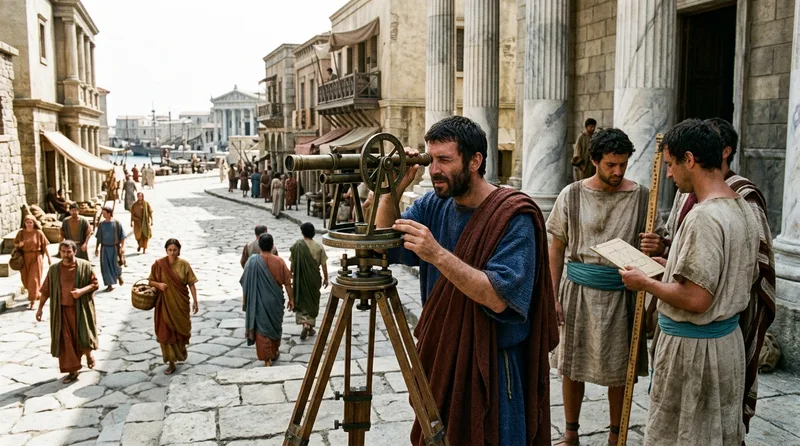
Invented by Hero of Alexandria around the 1st century CE, the dioptra functioned as an ancient theodolite, measuring both horizontal and vertical angles with remarkable precision. This bronze instrument featured a rotating sighting tube mounted on a calibrated circular base, allowing surveyors to calculate distances, determine elevations, and establish perfectly straight tunnels through mountains. Greek engineers used dioptrae to construct the Eupalinian aqueduct on Samos around 530 BCE—a tunnel boring through Mount Kastro from both ends that met in the middle with an error of less than 1 percent. The device incorporated a water level for establishing horizontal planes and a vertical staff with sighting marks for triangulation calculations. Engineers could measure the width of rivers without crossing them by establishing baseline measurements and applying geometric theorems. Hero’s technical manual described using the dioptra to calculate the height of distant buildings by measuring angles from two positions and solving right triangles—pure Euclidean geometry made practical. The instrument’s accuracy depended on precisely graduated bronze circles, typically divided into 360 degrees, demonstrating that Greek craftsmen could manufacture standardized measurement tools. Roman military engineers adopted the dioptra for fortress construction and road building, spreading Greek mathematical surveying techniques throughout the Mediterranean. Without this instrument, the massive construction projects of the Hellenistic period—from Alexandria’s harbor to the Colossus of Rhodes—would have been geometrically impossible.
Source: britannica.com
3. Scaphe Sundial: Measuring Time in Three Dimensions
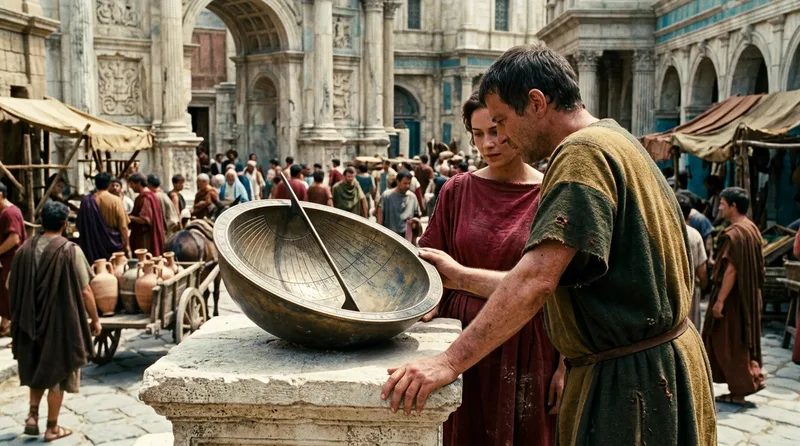
Unlike flat sundials, the scaphe was a hemispherical bowl invented around 300 BCE that transformed timekeeping into a three-dimensional mathematical problem. Aristarchus of Samos, the astronomer who first proposed a heliocentric solar system, refined the scaphe design to account for seasonal variations in the Sun’s path. A bronze gnomon (pointer) cast shadows onto curves etched inside the hemisphere, with different curves representing hours during summer solstice, winter solstice, and equinoxes. The mathematics required calculating the Sun’s declination angle for every day of the year and projecting these paths onto a hemispherical surface—a problem involving spherical geometry and trigonometric functions. One surviving example from Ai Khanoum in Afghanistan, dated to 250 BCE, shows 11 hour lines and 7 seasonal curves, all calculated for a latitude of 37 degrees north. The scaphe’s accuracy approached 15 minutes throughout the year, far superior to flat sundials whose error could exceed an hour during winter months. Greek astronomers used scaphes to verify their mathematical models of solar motion, creating a feedback loop where instruments tested theory and theory improved instruments. The device required understanding that Earth’s axial tilt causes seasonal variations—knowledge codified in Euclid’s Phaenomena around 300 BCE. Shadow lengths varied predictably with latitude, allowing travelers to determine their position north or south by comparing local noon shadows with calibrated markings. This single instrument united practical timekeeping with sophisticated astronomical mathematics.
Source: smithsonianmag.com
4. Ctesibius Water Clock: Hydraulic Computing Before Electronics
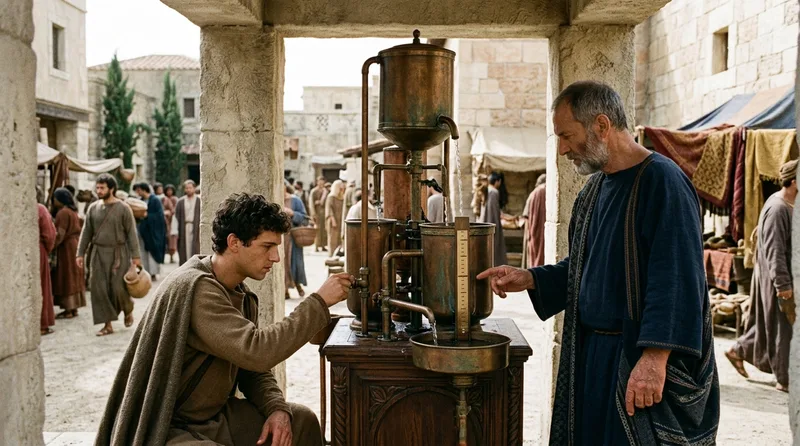
Around 250 BCE in Alexandria, Ctesibius invented the clepsydra—a water clock that maintained constant flow rate through ingenious hydraulic engineering and mathematical principles. Earlier water clocks simply measured time by water dripping from one vessel to another, but variations in water pressure as the source vessel emptied caused significant errors. Ctesibius solved this using a constant-pressure reservoir with an overflow valve, ensuring the source container maintained identical water level and therefore identical flow rate throughout the day. The mechanism incorporated a float connected to a gear train that rotated a drum marked with hours, essentially creating the first analog display. Advanced versions featured automata—mechanical figures that pointed to the hour or dropped pebbles to chime the time—driven entirely by water pressure and mechanical linkages. The mathematics involved calculating flow rates through orifices of specific diameters, a problem requiring understanding of fluid dynamics and geometric ratios. One model described by Vitruvius around the 1st century BCE used a column drum with 365 perforations, rotating once per year to account for seasonal variations in daylight hours. This meant the clock automatically adjusted for the fact that the first hour after sunrise lasted longer in summer than winter—a sophisticated accommodation of astronomical reality. Greek astronomers used these clocks to time celestial observations with precision previously impossible, allowing them to calculate planetary periods and stellar positions. The water clock’s gear mechanisms directly influenced later mechanical clock design, making it the ancestor of every timepiece in your home.
Source: britannica.com
5. Eratosthenes’ Gnomon: The Stick That Measured Earth
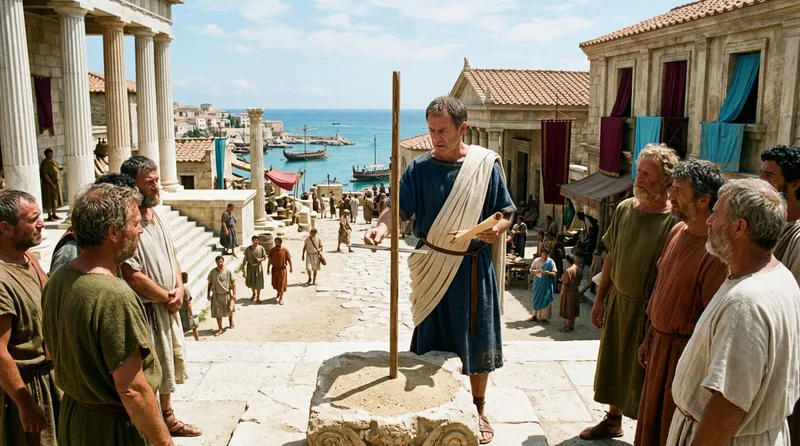
In 240 BCE, Eratosthenes used a simple vertical stick—a gnomon—to calculate Earth’s circumference with 99 percent accuracy, a measurement not improved upon for 1,700 years. He observed that at noon on the summer solstice in Syene (modern Aswan), the Sun stood directly overhead, casting no shadow, while simultaneously in Alexandria, a gnomon cast a shadow indicating the Sun was 7.2 degrees from vertical. Recognizing that this angular difference resulted from Earth’s curvature, he measured the distance between cities as 5,000 stadia (approximately 800 kilometers) and applied simple proportional reasoning: if 7.2 degrees equals 800 kilometers, then 360 degrees equals 40,000 kilometers. His calculated circumference of 250,000 stadia translates to approximately 39,375 kilometers—the actual polar circumference is 40,008 kilometers, an error of less than 2 percent. The mathematical elegance lay in recognizing that parallel sun rays striking a curved surface create measurable angular differences, transforming local geometry into cosmic measurement. Eratosthenes’ method required understanding that Earth is spherical, that the Sun is effectively at infinite distance (making rays parallel), and that geometric theorems about circles apply to three-dimensional spheres. His gnomon measurements also determined the tilt of Earth’s axis—23.5 degrees—by tracking the Sun’s noon altitude throughout the year. This single stick, combined with careful observation and geometric reasoning, proved that Greek mathematics could reach beyond human scale to measure the planet itself. The experiment required no advanced technology, only precise measurement and logical thinking.
Source: britannica.com
6. Archimedes’ Sphere: The Mechanical Cosmos in Bronze
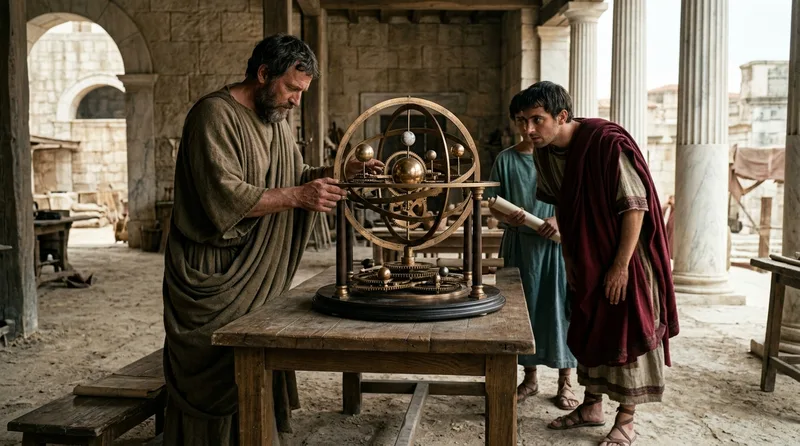
Archimedes constructed a mechanical planetarium around 220 BCE that reproduced the motions of the Sun, Moon, and five planets through an intricate system of bronze gears—a device so impressive that Roman general Marcellus salvaged it from Syracuse’s ruins in 212 BCE as his personal war trophy. Cicero, writing in the 1st century BCE, described witnessing this sphere demonstrate lunar eclipses, planetary retrogrades, and the varying speeds of celestial bodies with such accuracy that it seemed “genius had imitated nature.” The mechanism required calculating gear ratios that matched actual planetary periods: Mercury’s 88-day orbit, Venus’s 225 days, and Jupiter’s 12-year cycle all needed representation through bronze wheels turning at mathematically precise rates. Archimedes likely used epicyclic gearing—small gears rotating on the circumference of larger gears—to simulate the apparent backward motion of planets, a geometric solution to the astronomical problem that wouldn’t be mathematically formalized until Ptolemy’s Almagest in 150 CE. The device demonstrated that the same mathematical principles governing static geometry could model dynamic celestial mechanics when expressed through physical machinery. Contemporary accounts mention that turning a crank moved all celestial bodies in proper proportion, essentially creating an analog computer for astronomical calculation centuries before the Antikythera mechanism. The sphere’s construction required knowledge of planetary periods derived from Babylonian observations but engineered through Greek mathematical techniques. This fusion of observational astronomy and mechanical engineering proved that complex mathematical relationships could be embodied in tangible instruments, not just written in treatises.
Source: britannica.com
7. Greek Astrolabe: The Smartphone of Ancient Astronomy
Developed around 150 BCE, the astrolabe functioned as a handheld model of the cosmos, allowing users to solve dozens of astronomical problems by rotating engraved bronze plates against each other. The instrument consisted of a circular disk (the mater) with the observer’s latitude engraved as coordinate lines, a rotating star map (the rete) showing major constellations, and a sighting rule (alidade) for measuring celestial angles. Greek astronomers could determine the time of day or night by aligning known stars with the horizon line, calculate the rising and setting times of any celestial body, find their latitude by measuring noon Sun altitude, or determine the qibla direction for any location—all without performing a single written calculation. The mathematics embedded in the astrolabe’s design included stereographic projection, which mapped the three-dimensional celestial sphere onto a two-dimensional surface while preserving angular relationships—a geometric transformation described by Hipparchus around 150 BCE. Each astrolabe was custom-made for a specific latitude, with different plates allowing the same instrument to work at different locations when travelers moved north or south. The device incorporated knowledge of the ecliptic (the Sun’s annual path), the celestial equator, and the altitude-azimuth coordinate system. Users could predict planetary positions by consulting tables and setting the rete accordingly, transforming numerical data into visual representation. Islamic astronomers later refined the astrolabe, but the core geometric principles and stereographic projection formulas remained purely Greek innovations. This single instrument contained more mathematical knowledge than most university students learn in a semester of astronomy.
Source: britannica.com
8. Pantograph: Scaling Geometry with Mechanical Precision
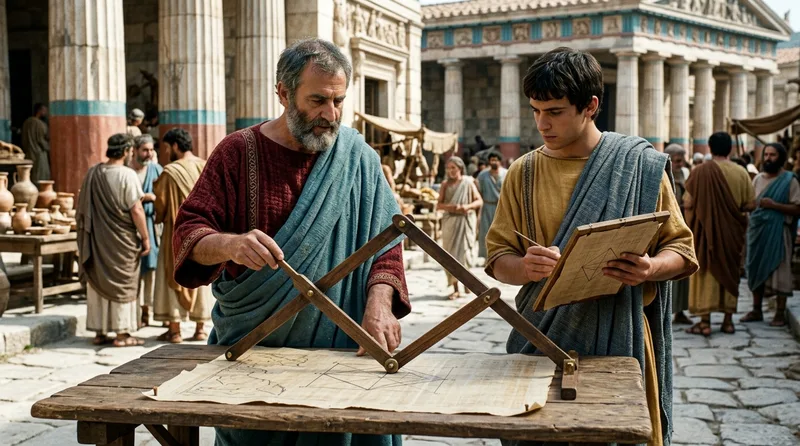
Greek mathematicians developed the pantograph as a parallelogram linkage system that could scale geometric figures up or down while maintaining perfect proportional relationships—turning abstract similarity theorems into practical drafting tools. The device consisted of four bars connected by pivot joints forming an adjustable parallelogram, with a tracing pointer on one end and a drawing stylus on the other. By adjusting the positions of fixed and moving points, craftsmen could create copies at any desired scale: 2:1, 3:1, or even fractional ratios like 2:3. The mathematics relied on similar triangles, a concept thoroughly explored in Euclid’s Elements around 300 BCE, specifically Book VI which addresses proportional magnitudes and scaling. Architects used pantographs to create construction plans from small drawings, maintaining exact proportions while enlarging designs to buildable scale—critical for the massive temples and civic structures of the Hellenistic period. The instrument proved that geometric theorems about ratios and proportions weren’t merely abstract concepts but could be mechanized into reliable tools. Hero of Alexandria described pantograph variations around the 1st century CE for reducing three-dimensional sculptures to portable models or enlarging small clay maquettes to monumental bronze statues. The linkage mechanism ensured that errors didn’t accumulate; the stylus mathematically had to trace a proportional path regardless of hand steadiness or drawing speed. Greek coin engravers used miniature pantographs to reduce master designs to the tiny scale required for currency, maintaining artistic detail while shrinking images by factors of 10 or more. This mechanical embodiment of mathematical similarity made precise scaling accessible to craftsmen who might never have read Euclid.
Source: britannica.com
9. Euclidean Compass and Straightedge: The Tools That Defined Mathematical Possibility
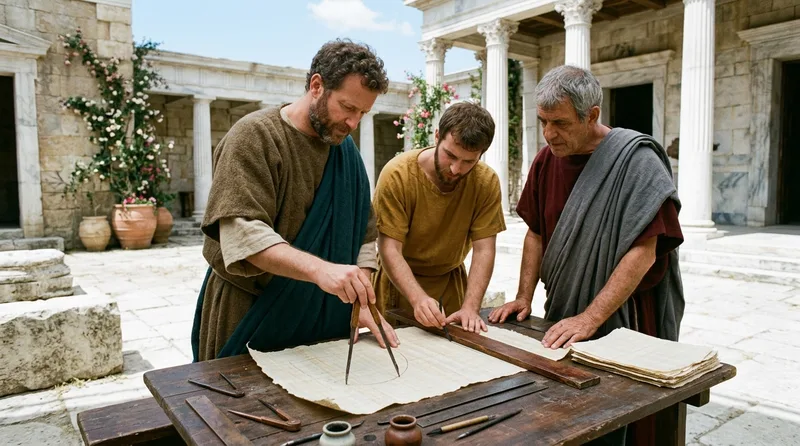
Around 300 BCE, Euclid formalized geometry around two simple tools—the compass for drawing circles and the straightedge for drawing lines—establishing constraints that defined mathematical possibility for 2,000 years. These weren’t arbitrary choices; Euclid recognized that compass and straightedge constructions represent the purest geometric operations: finding equidistant points (circles) and establishing shortest paths (straight lines). Greek craftsmen manufactured precision bronze compasses with adjustable legs, often incorporating measurement marks along the arms for transferring distances, while straightedges featured perfectly flat edges ground and polished to tolerances of less than 0.1 millimeters. The five postulates opening Euclid’s Elements assume these tools: drawing lines between points, extending lines indefinitely, and drawing circles with any center and radius. Greek mathematicians discovered dozens of elegant constructions: bisecting angles, creating perpendiculars, dividing segments into equal parts, and constructing regular polygons up to 15 sides. The limitations proved equally important—the ancient problems of trisecting arbitrary angles, doubling the cube, and squaring the circle all proved impossible with compass and straightedge alone, though Greek mathematicians didn’t definitively prove this impossibility until many centuries later. These tools embodied the Greek philosophical preference for pure reasoning over empirical approximation; constructions had to be exact, not merely accurate to measurement precision. Craftsmen used proportional compasses—instruments with two pivot points creating fixed ratios—to scale designs while maintaining geometric relationships. The simplicity of these tools paradoxically enabled complex mathematical achievements, from the Pythagorean theorem’s geometric proof to the construction of the five Platonic solids.
Source: britannica.com
10. Hero’s Aeolipile: Steam Power Meets Mathematical Mechanics
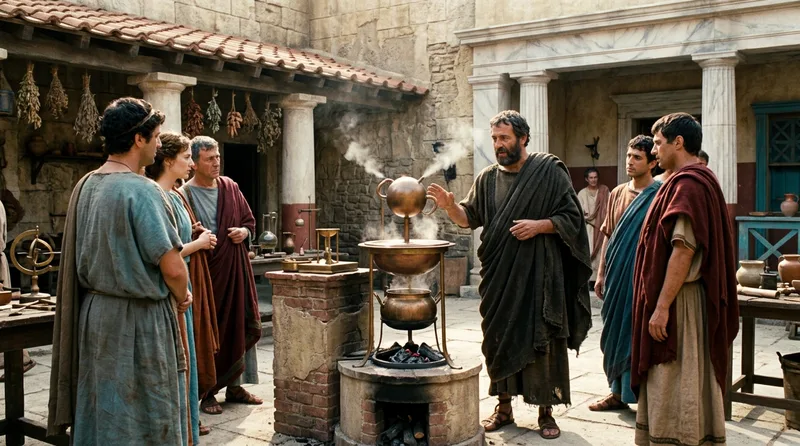
Hero of Alexandria created the aeolipile around the 1st century CE—a hollow bronze sphere mounted on a swiveling axis with two bent exhaust tubes that rotated the sphere when steam escaped, demonstrating the mathematical principles of action and reaction 1,600 years before Newton formalized them. Water boiled in a sealed caldron generated steam that traveled through pipes into the hollow sphere; as steam escaped through the bent tubes, reactive force spun the sphere at speeds exceeding 1,500 rotations per minute. This device embodied mathematical relationships between pressure, force, and rotational motion, proving that abstract mechanical principles could generate continuous circular movement from linear steam pressure. Hero’s writings calculated the sphere’s rotational velocity based on steam pressure and tube diameter, essentially deriving torque equations through geometric reasoning. The aeolipile demonstrated that curved surfaces (the bent tubes) could transform linear force into rotational motion—a principle Greek mathematicians explored in theoretical works on mechanics and spirals, particularly Archimedes’ treatment of the screw around 250 BCE. While often dismissed as a mere toy, the aeolipile proved that Greeks understood steam could perform work and that the mathematics of force transformation applied to dynamic systems, not just static problems. Hero described using similar principles to design temple doors that opened automatically when priests lit altar fires, with heated air expanding in sealed chambers to pull cables attached to hinges—practical applications of thermodynamic geometry. The device required understanding that gases expand when heated (a principle not formally stated until centuries later) and that quantitative relationships governed this expansion. Hero’s mathematical analysis of the aeolipile included calculations of the work performed against air resistance and bearing friction, treating rotational motion as a solvable geometric problem involving tangent forces and circular paths.
Source: britannica.com
Did You Know?
Did You Know? The Antikythera mechanism’s gear ratios were so precise that modern reconstruction required computer modeling to understand how Bronze Age craftsmen achieved tolerances measured in fractions of a millimeter—without magnification, micrometers, or even standardized measurement systems. Greek instrument makers accomplished what seemed mathematically impossible: they transformed pure geometry into physical machines that calculated, measured, and predicted with accuracy that vanished from Europe until the Renaissance, proving that ancient scientific instruments weren’t primitive ancestors of modern tools but rather a lost technological peak that took humanity 1,500 years to rediscover.