
The Pantheon’s dome has stood for 1,900 years without steel reinforcement while modern concrete highways crack after 50. Roman engineers possessed concrete formulas we’re only now beginning to understand—mixing volcanic ash, seawater, and mystery ingredients that created self-healing structures.
1. Opus Caementicium: The Volcanic Ash Revolution
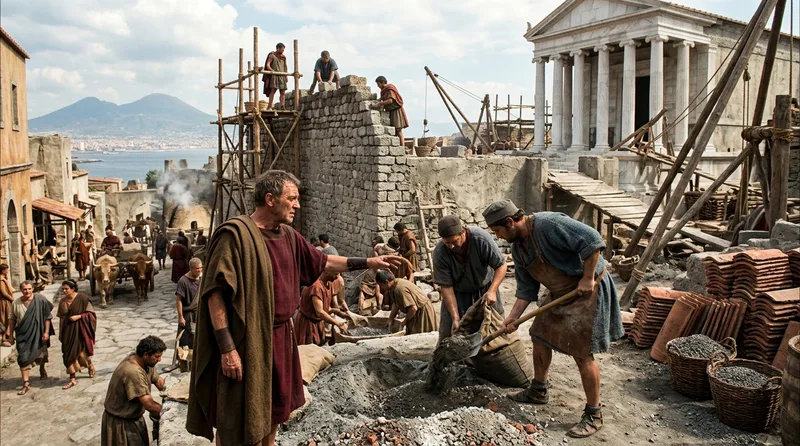
Roman builders discovered around 150 BCE that mixing pozzolana volcanic ash from Pozzuoli near Mount Vesuvius with lime mortar created a revolutionary building material. This opus caementicium contained silica and alumina compounds that reacted chemically with calcium hydroxide, producing a binding matrix far superior to anything used before. The Romans quarried approximately 380,000 cubic meters of pozzolana annually during the empire’s peak construction period. Unlike modern Portland cement that weakens over time, this volcanic ash concrete actually grew stronger through centuries of exposure to moisture. The formula required precise ratios: three parts pozzolana to one part lime, mixed with water and aggregate stones called caementa. Engineers at building sites across the empire from Britannia to Syria replicated this formula with local volcanic materials, adapting the mixture to regional conditions. The Baths of Caracalla, completed in 216 CE, used over 6,000 tons of this concrete in walls that still stand today. Modern analysis reveals the volcanic ash created a dense, impermeable structure at the molecular level that prevented water infiltration and chemical degradation. When Rome fell in 476 CE, the systematic knowledge of volcanic ash ratios and sourcing disappeared, leaving medieval builders unable to replicate structures of comparable scale for over a thousand years.
Source: smithsonianmag.com
2. Seawater Concrete: The Mediterranean Mystery Formula
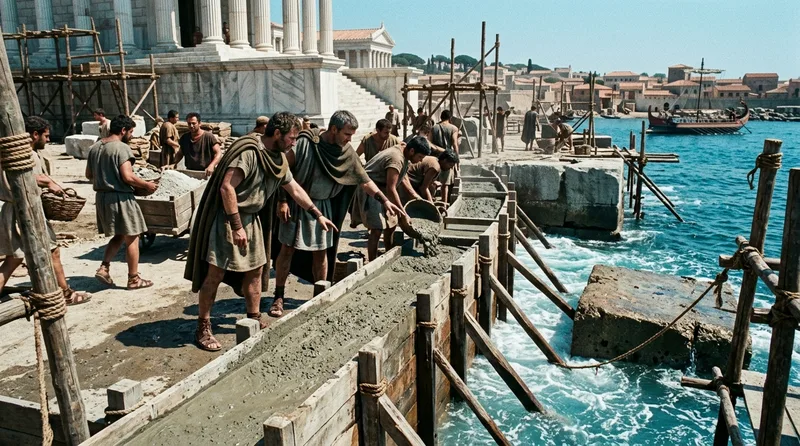
Roman engineers invented a concrete formula around 200 BCE specifically designed to set and strengthen underwater, defying everything modern chemistry predicted about seawater’s corrosive effects. The harbor at Caesarea Maritima, built by Herod the Great between 22 and 15 BCE, used massive concrete blocks weighing up to 50 tons that grew harder over 2,000 years of wave action. The secret involved substituting volcanic ash from the Campi Flegrei region with seawater instead of freshwater, creating a chemical reaction that produced aluminum tobermorite crystals. These crystals formed through a process called pozzolanic reaction, where seawater’s sodium and magnesium ions interacted with volcanic minerals to create an interlocking crystalline structure. Scientists analyzing core samples in recent centuries discovered that these crystals continued forming for centuries after the initial pour, essentially making the concrete self-reinforcing. The Romans built over 4,500 kilometers of harbor facilities throughout the Mediterranean using variations of this seawater formula. At Portus near Rome, completed under Emperor Trajan in 112 CE, underwater concrete foundations supported a hexagonal harbor basin covering 32 hectares. Modern concrete exposed to seawater typically fails within 50 years as chloride ions corrode steel reinforcement and saltwater chemically attacks the cement matrix. The Roman maritime formula contained no steel and actually welcomed seawater infiltration, turning what destroys modern concrete into a strengthening agent that built crystalline armor against the ocean itself.
Source: britannica.com
3. Self-Healing Crystalline Networks That Repair Cracks
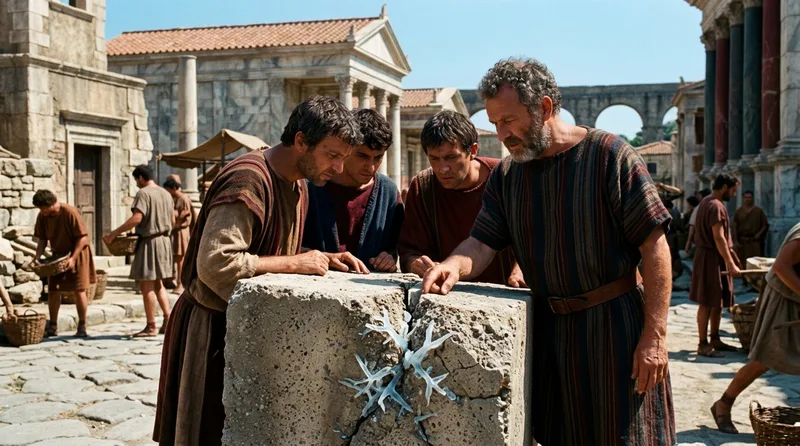
The most remarkable property of Roman concrete emerged from its ability to heal its own fractures through ongoing chemical reactions that modern engineers lost track of for two millennia. When hairline cracks formed in structures like the Markets of Trajan, built in 110 CE across six levels of shops and offices, calcium-rich pore water seeped into the gaps and reacted with volcanic ash compounds to precipitate new calcium-aluminum-silicate-hydrate crystals. This crystallization process, which scientists at Berkeley Laboratory confirmed through electron microscopy in recent decades, effectively sealed cracks from the inside out. The Pantheon’s massive dome, spanning 43.3 meters and poured in 126 CE under Emperor Hadrian, contains an estimated 4,535 cubic meters of concrete that has self-repaired countless stress fractures over 19 centuries. The healing mechanism required specific lime clasts—small chunks of quicklime mixed into the aggregate that dissolved slowly when exposed to moisture infiltrating cracks. Roman engineers apparently added these lime clasts deliberately, creating a reservoir of reactive material throughout the concrete matrix. Modern concrete lacks this self-repair capability because Portland cement formulas prioritize rapid curing over long-term chemical activity. The Aqua Claudia aqueduct, completed in 52 CE, transported water across 69 kilometers using concrete channels that sealed their own micro-fractures automatically for over 400 years of continuous operation. This self-healing property meant Roman structures required virtually no maintenance while growing stronger through weathering, stress, and time.
Source: smithsonianmag.com
4. Lime Mortar Techniques for Breathable Walls
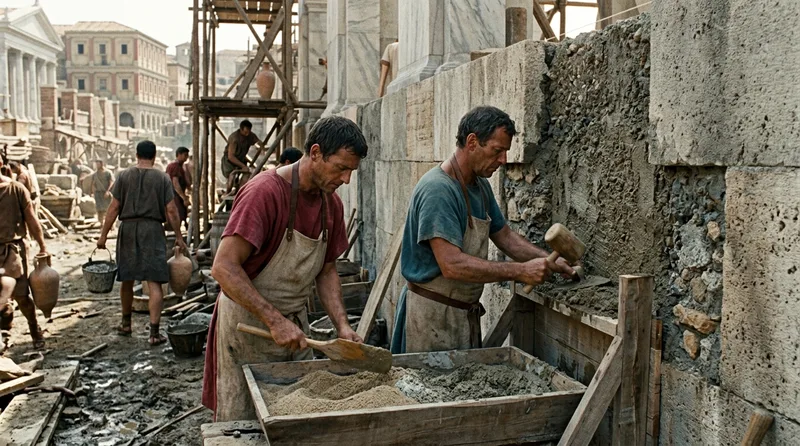
Roman builders developed sophisticated lime mortar formulas between 100 BCE and 100 CE that allowed massive concrete walls to breathe moisture while maintaining structural integrity for centuries. The technique involved slaking quicklime in water for extended periods—sometimes aging the lime putty for up to three years before mixing with volcanic ash and aggregates. The Aurelian Walls, constructed starting in 271 CE to defend Rome, used 19 kilometers of concrete walls averaging 3.5 meters thick that incorporated this breathable lime mortar technology. Unlike modern concrete that traps moisture and spalls when water freezes, Roman lime mortar created microporous structures that allowed water vapor to pass through without causing damage. Engineers mixed the slaked lime with specific ratios of volcanic sand: typically two parts sand to one part lime for structural walls, adjusted to three-to-one for less critical applications. The Basilica of Maxentius, completed in 312 CE, demonstrates this technology in walls reaching 35 meters high that have survived countless freeze-thaw cycles without modern sealants. The breathable quality came from lime mortar’s ability to carbonate slowly over decades, absorbing atmospheric carbon dioxide to gradually harden into limestone while maintaining microscopic channels for vapor transmission. Roman architects understood that trapped moisture destroyed buildings, so they engineered walls as permeable systems rather than impervious barriers. This lime technology disappeared after 500 CE when Germanic tribes and medieval builders reverted to simpler mud mortars. The rediscovery of hydraulic lime formulas centuries later could not replicate the precise aging and mixing protocols that made Roman walls simultaneously waterproof and breathable.
Source: britannica.com
5. Strategic Aggregate Selection for Load-Bearing Capacity
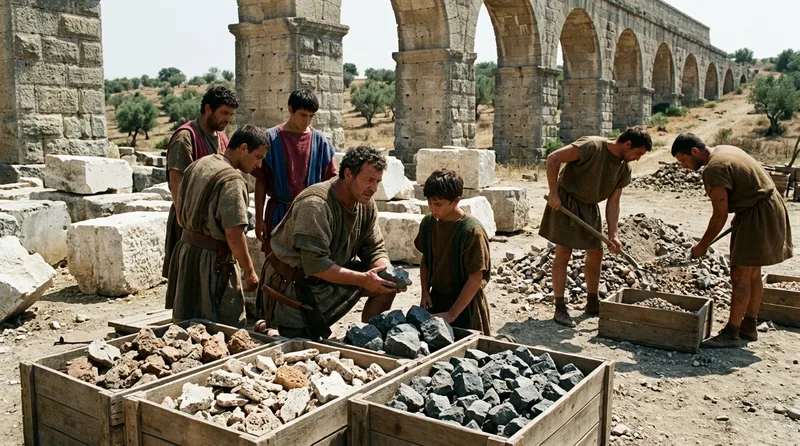
Roman engineers developed a systematic approach to selecting aggregate materials based on structural requirements, varying stone types and sizes to optimize strength, weight, and durability across different building elements. For the Colosseum’s foundations, laid between 70 and 72 CE, builders used dense travertine limestone chunks up to 30 centimeters in diameter to support the estimated 100,000-ton structure. The upper levels incorporated progressively lighter aggregates: tufa stone in the second tier, pumice in the third, and hollow ceramic pots embedded in the fourth-level concrete. This graduated system reduced weight while maintaining strength, preventing foundation settlement under the massive load of 50,000 spectators. The Baths of Diocletian, completed in 306 CE as the largest public bath complex covering 13 hectares, used basalt aggregate in floor concrete to resist wear from millions of footsteps over centuries. Engineers specified aggregate particle size distributions with remarkable precision—large stones for core structural mass, medium gravel to fill voids, and fine sand to bind the matrix. The Pont du Gard aqueduct bridge in southern Gaul, built around 50 CE, incorporated local limestone aggregate that chemically bonded with the volcanic ash mortar to create monolithic piers standing 49 meters tall. Roman specifications required washing aggregates to remove clay and organic matter that would weaken bonds, a quality control step modern analyses have confirmed through microscopic examination. Different quarries supplied specialized aggregates: Anio Valley volcanic scoria for lightweight applications, Apennine limestone for foundations, Alban Hills leucitite for fire-resistant structures. This knowledge of material properties and strategic application vanished when centralized Roman engineering training collapsed, leaving medieval builders with trial-and-error approaches that could not match the sophistication of aggregate science.
Source: smithsonianmag.com
6. Hot-Mixing Protocols That Transformed Chemical Bonding
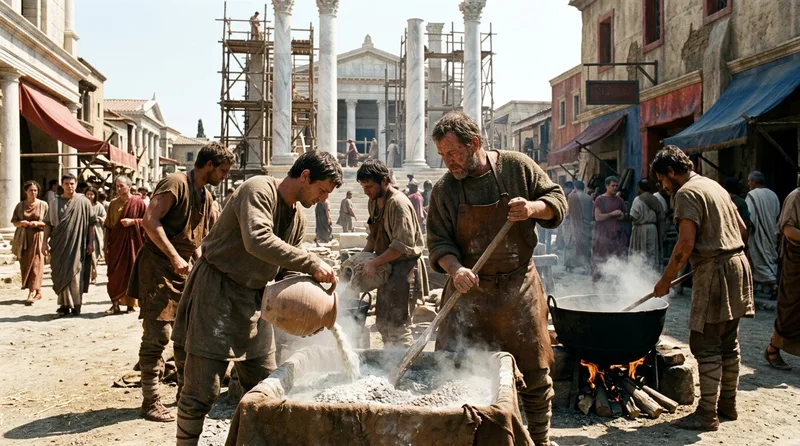
Recent analysis of concrete samples from archaeological sites revealed that Romans employed a hot-mixing technique around 100 BCE that fundamentally altered the chemical structure of their building material in ways modern cold-mixing methods cannot replicate. The process involved mixing quicklime directly with volcanic ash and aggregate at temperatures exceeding 300 degrees Celsius, triggering immediate chemical reactions that formed calcium-silicate crystals different from those in standard concrete. At archaeological sites near Rome, researchers identified nanocrystals of calcium carbonate within lime clasts that could only form under high-temperature conditions, suggesting Romans deliberately heated their concrete mixtures. The Temple of Venus and Roma, reconstructed by Emperor Hadrian between 121 and 141 CE, used hot-mixed concrete in foundations supporting columns 1.5 meters in diameter and 17 meters tall. This elevated-temperature mixing created what scientists now call C-A-S-H gel (calcium-aluminum-silicate-hydrate) with a different molecular structure than modern concrete’s C-S-H gel, providing superior bonding and durability. The thermal process required careful control—too hot and the lime would become inert, too cool and the beneficial reactions would not occur. Engineers achieved these temperatures by adding quicklime to pre-heated volcanic ash, using the exothermic slaking reaction itself to maintain mixing temperatures. The Basilica Ulpia in Trajan’s Forum, dedicated in 112 CE, incorporated approximately 8,000 cubic meters of hot-mixed concrete in walls and vaults that remain structurally sound. Modern concrete production prioritizes energy efficiency and rapid curing through cold-mixing with Portland cement, sacrificing the superior long-term performance that Romans achieved through energy-intensive hot-mixing. This thermally-activated chemistry disappeared from construction practice after 500 CE when the empire’s industrial-scale quicklime production capacity collapsed.
Source: smithsonianmag.com
7. Layered Construction for Massive Unreinforced Domes
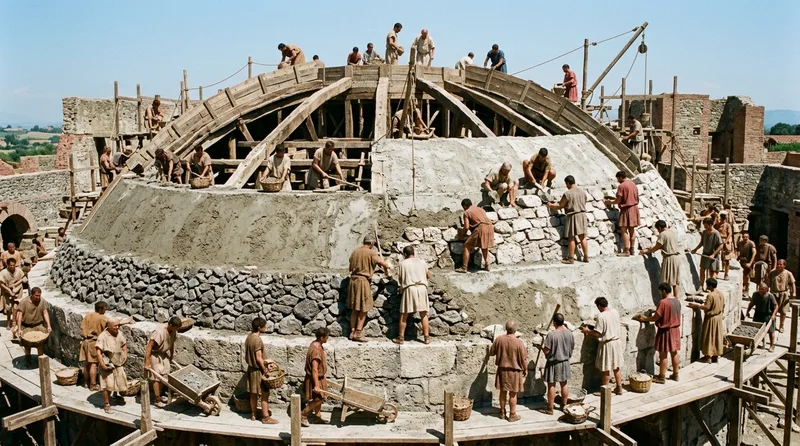
Roman architects developed a sophisticated layered concrete technique for constructing enormous domes and vaults without steel reinforcement, varying aggregate density and concrete composition in horizontal layers to manage structural stress. The Pantheon dome, completed in 126 CE, employed five distinct concrete layers: the lowest layer near the drum used heavy basalt aggregate, then progressively lighter materials—tufa, brick fragments, pumice, and finally hollow ceramic tubes at the crown. This graduated density reduced the dome’s weight from an estimated 9,000 kilograms per cubic meter at the base to just 1,350 kilograms per cubic meter at the oculus, the circular 9-meter opening at the top. Engineers calculated these proportions to direct compressive forces downward through the structure, preventing the tensile stresses that cause unreinforced domes to crack and collapse. The concrete layers were poured in horizontal rings over massive wooden centering frames, with each ring allowed to partially cure before adding the next layer above. The Baths of Caracalla used similar layered techniques in vaults spanning 25 meters, incorporating brick relieving arches within the concrete mass to redirect stress away from weak points. Each layer had slightly different volcanic ash compositions: pozzolana from different volcanic sources had varying reactivity, allowing engineers to fine-tune setting times and ultimate strength. The Temple of Mercury at Baiae, built around 100 BCE, contains one of the earliest examples of layered dome construction with a 21.5-meter span that predated the Pantheon by over two centuries. Roman engineering treatises like Vitruvius’s De Architectura, written around 15 BCE, mentioned aggregate selection but did not fully document the sophisticated layering systems, leaving medieval builders unable to construct large-span domes. The technology remained lost until several centuries later when dome construction was reinvented for Florence Cathedral, though even then without understanding the chemical engineering that made Roman versions superior.
Source: britannica.com
8. Harbor Concrete That Conquered Saltwater Corrosion
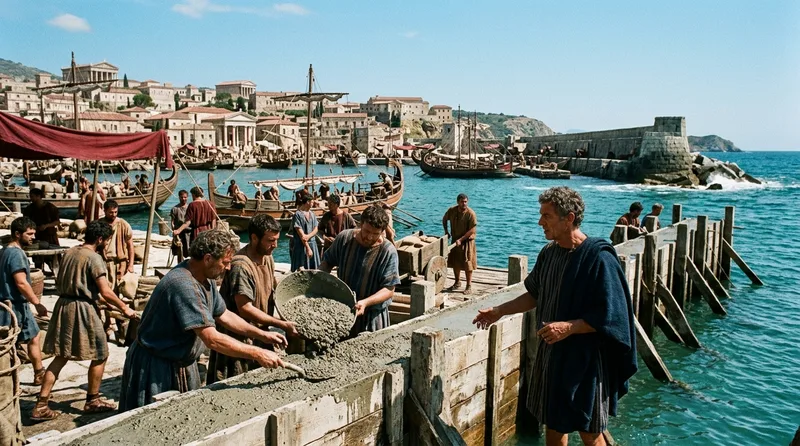
Romans engineered specialized harbor concrete formulas between 200 BCE and 100 CE that not only resisted saltwater corrosion but actually grew stronger through chemical reactions with seawater, creating structures that have outlasted modern reinforced concrete by millennia. The breakwaters at [Portus** Cosanus](https://en.wikipedia.org/wiki/Cosa)**, constructed around 140 BCE on the Tuscan coast, used concrete piers that have withstood 2,160 years of wave action with minimal deterioration. Analysis revealed the secret: volcanic ash from Bacoli near Naples contained crystalline leucite and analcime that reacted with seawater to form Al-tobermorite, an extremely rare mineral that binds the concrete matrix with exceptional strength. The harbor at Brindisi, expanded under Emperor Trajan around 110 CE, incorporated 15,000 cubic meters of marine concrete in a 300-meter-long mole that created the empire’s main embarkation point for the eastern Mediterranean. Engineers mixed their maritime formula at a ratio of one part lime to three parts volcanic ash from Campi Flegrei, adding broken pottery pieces as aggregate that also contributed beneficial aluminum compounds. The concrete was placed underwater using wooden forms lowered into position, with workers tamping the mixture to eliminate air pockets that would create weaknesses. At Caesarea Maritima, massive concrete blocks 15 meters long formed an artificial harbor where none existed naturally, with breakwaters creating 16 hectares of protected anchorage beginning in 22 BCE. Modern maritime concrete requires steel reinforcement that corrodes in saltwater within decades, expensive coatings that eventually fail, and constant maintenance that Roman harbors never needed. The Portus harbor at Ostia operated for over 500 years with concrete foundations that required no repairs, supporting grain ships carrying 150,000 tons of wheat annually to feed Rome’s million inhabitants. When the Western Roman Empire collapsed in 476 CE, the chemical knowledge of marine-grade concrete formulas disappeared, forcing medieval ports to rely on cut stone construction that could not create the massive protected harbors Romans built routinely across the Mediterranean.
Source: smithsonianmag.com
9. Lightweight Pumice Concrete for Soaring Vaults
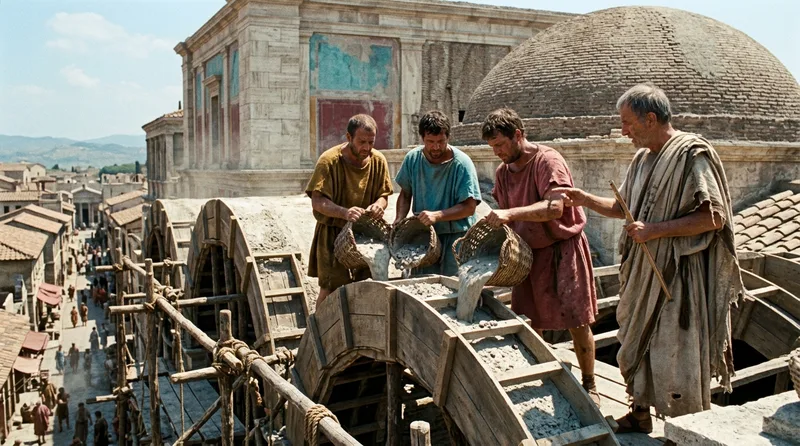
Roman engineers developed ultra-lightweight concrete using pumice aggregate from volcanic regions, enabling them to construct soaring vaults and upper-story architecture that would have collapsed under the weight of conventional concrete. The Basilica of Maxentius, completed in 312 CE, used pumice concrete in groin vaults reaching 39 meters above the floor, with each vault segment weighing approximately 60 percent less than equivalent stone construction. Pumice from quarries near Mount Vesuvius provided an ideal aggregate—porous volcanic rock with a density of just 640 kilograms per cubic meter compared to 2,700 kilograms for typical limestone aggregate. The Romans discovered that pumice’s countless air pockets did not weaken concrete if the pozzolanic mortar properly coated each piece, creating a strong matrix binding the lightweight aggregate. The upper levels of the Colosseum, constructed between 72 and 80 CE, incorporated pumice concrete to reduce dead load on the structure, allowing four stories totaling 48 meters in height. Engineers calculated that pumice concrete’s reduced weight allowed them to build approximately 40 percent higher than possible with conventional materials. The Theater of Marcellus, completed in 11 BCE with a capacity of 20,500 spectators, used pumice concrete in the upper arcade’s semicircular vaults spanning 8 meters. This lightweight formula required different mixing ratios—Romans used extra volcanic ash mortar to compensate for pumice’s high surface area, typically employing a 1:2 ratio of lime to volcanic ash rather than the standard 1:3. The Baths of Trajan, built between 104 and 109 CE, contained massive cross-vaulted halls with pumice concrete reducing the structural load on walls by an estimated 18,000 tons. Medieval builders who rediscovered pumice as aggregate centuries later lacked the volcanic ash chemistry knowledge needed to bind it properly, resulting in weak concrete that crumbled. The complete Roman formula for pumice concrete—including specific volcanic ash sources, mixing protocols, and placement techniques—remained lost until modern engineers began analyzing standing structures in recent centuries.
Source: britannica.com
10. Earthquake-Resistant Temple Foundations
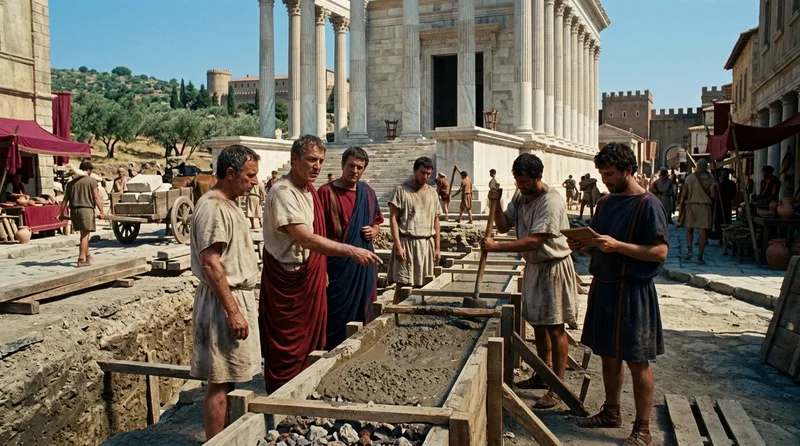
Roman engineers in seismically active regions developed specialized concrete formulas for temple foundations between 100 BCE and 200 CE that incorporated flexibility and energy dissipation principles remarkably similar to modern earthquake engineering. The Temple of Apollo at Pompeii, reconstructed around 120 BCE after earthquake damage, featured concrete foundations with alternating layers of different aggregate sizes that allowed differential movement without structural failure. These foundations extended 3 meters below grade with a base layer of large limestone blocks set in highly plastic lime-pozzolana mortar that could deform during ground shaking. Engineers discovered that adding specific ratios of brick dust to the concrete mix—approximately 15 percent by volume—increased ductility while maintaining compressive strength exceeding 10 megapascals. The Temple of Vesta in Rome’s Forum, rebuilt in 191 CE after fire, used deep concrete foundations with fiber reinforcement—animal hair and plant materials mixed into the mortar that provided tensile strength modern engineers recognize as crack control. In the eastern provinces prone to seismic activity, Roman builders employed concrete foundations with horizontal wooden beams embedded at regular intervals, creating what modern engineers call base isolation that prevented earthquake forces from transmitting fully into the structure. The Sanctuary of Fortuna Primigenia at Praeneste, terraced into a hillside around 100 BCE, used concrete retaining walls with drainage channels and flexible joints that have survived numerous earthquakes over 21 centuries. Analysis of the Temple of Castor and Pollux foundations, rebuilt in 6 CE, revealed concrete with unusually high lime content that created a more elastic matrix capable of absorbing seismic energy. Romans apparently understood that rigid structures fail in earthquakes while flexible foundations survive, a principle that modern building codes rediscovered only after major earthquakes in recent centuries. The exact formulas for these seismic-resistant concrete mixtures—including fiber types, lime ratios, and layering sequences—disappeared when the empire’s engineering schools closed, leaving Byzantine and medieval builders unable to construct earthquake-resistant temples and churches of comparable durability.
Source: smithsonianmag.com
Did You Know?
Did You Know? The Romans never viewed concrete as a temporary material requiring replacement—they engineered it as permanent infrastructure that would outlast their civilization itself. Modern analysis shows their harbor concrete continues growing stronger after 2,000 years while contemporary marine structures fail within decades, proving ancient engineers achieved chemical immortality we’re still struggling to recreate with modern materials science.