
The Joseon dynasty maintained power through elaborate Confucian rituals that transformed daily governance into sacred performance. These weren’t symbolic gestures—they were legally binding ceremonies that determined succession, appeased gods, and legitimized royal authority.
1. Jongmyo Jerye: The Royal Ancestral Rites That Validated Kingship
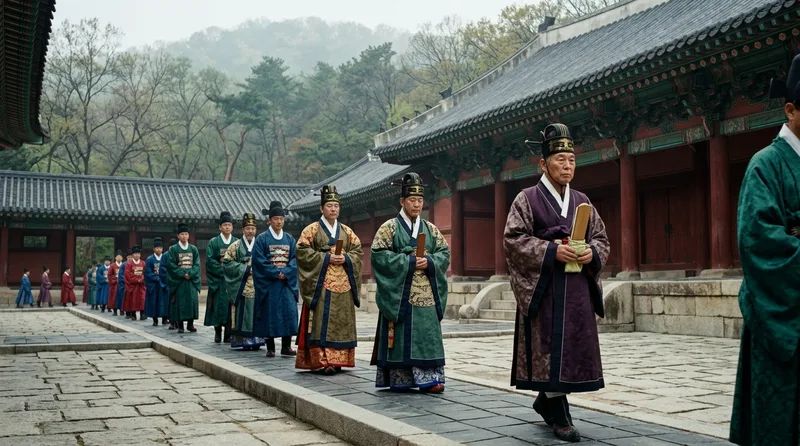
Every spring and autumn, the Joseon court performed Jongmyo Jerye, a meticulously choreographed ritual honoring deceased kings and queens at the Jongmyo Shrine in Seoul. Established in 1395 by King Taejo, this ceremony required the reigning monarch to personally offer food, wine, and prayers to spirit tablets representing 19 royal chambers housing 49 kings and 30 queens. The ritual began at dawn and lasted 6 hours, involving 64 specific musical pieces, 8 rows of dancers performing precisely synchronized movements, and offerings of 27 different dishes arranged in exact configurations. Missing a single gesture could delegitimize the king’s mandate from heaven. Court musicians played instruments crafted according to specifications in the early 15th century text “Akhak Gwebeom,” while officials wearing 9-tiered ceremonial hats prostrated themselves 4 times in succession. The ceremony wasn’t optional—skipping it implied the king rejected his ancestors’ authority, potentially triggering succession crises. When King Yeonsangun attempted to shorten the ritual in the early 16th century, senior officials cited it as evidence of his unworthiness, contributing to his eventual deposition. The ritual reinforced Neo-Confucian ideology that living rulers derived legitimacy from ancestral approval, making Jongmyo Jerye the cornerstone of Joseon political theology.
Source: britannica.com
2. Gwageo: The Brutal Examination System That Created Korea’s Elite
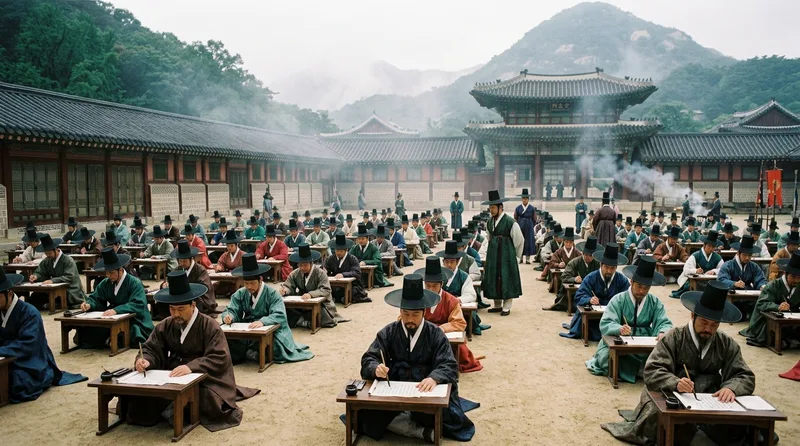
The Gwageo civil service examination, instituted in 1392 and held triennially, determined who could enter the ruling class through a punishing three-stage ordeal. Candidates spent decades memorizing the Four Books and Five Classics—approximately 431,286 Chinese characters of Confucian texts. The preliminary Sogwa examination tested 240 candidates over 3 days on classical interpretation, poetry composition, and historical analysis, with a mere 33 candidates advancing. The Daegwa final examination occurred in the royal palace courtyard, where King Sejong personally observed the 33 finalists write policy essays for 12 consecutive hours without food or water breaks. Between 1392 and the late 19th century, only 14,620 men passed all stages—an average of 29 per examination cycle. Success meant appointments to the Saheonbu (Censorate) or Hongmungwan (Royal Academy), positions controlling policy and historical records. Failure often meant generational poverty, as families bankrupted themselves funding decades of study. Early in the 16th century, one examination saw candidate Yu Ja-gwang collapse and die at his desk after 11 hours of writing, yet officials continued grading his incomplete essay. The system created a hyper-educated bureaucracy that valued textual orthodoxy over practical governance, contributing to technological stagnation but ensuring ideological uniformity.
Source: britannica.com
3. Sajikdan Sacrifices: Feeding the Gods to Prevent Famine
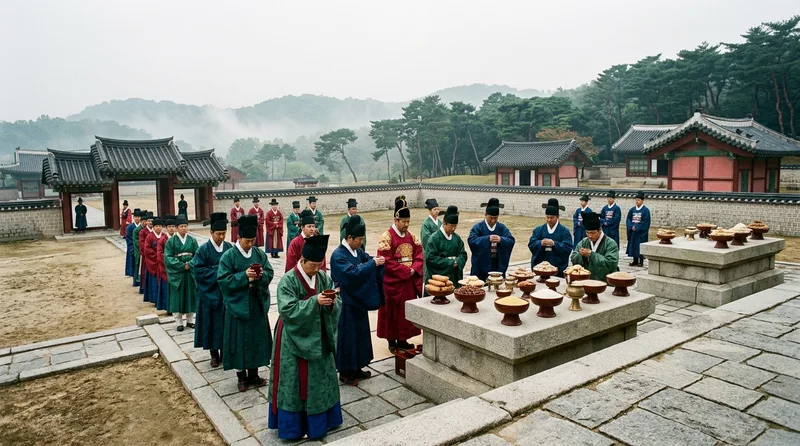
At the Sajikdan altar complex built in 1395 west of Seoul’s Gyeongbokgung Palace, kings performed biannual sacrifices to the gods of earth and grain that literally fed the kingdom. These February and August ceremonies involved offering a freshly slaughtered ox, 1 pig, 3 sheep, and precisely measured quantities of millet, rice, and sorghum to stone altars representing soil from Korea’s 8 provinces. The ritual required the king to wear a crimson robe embroidered with 12 imperial symbols and perform 9 prostrations while 36 court officials chanted prayers from the “Gukjo Oryeui” ceremonial manual compiled in the mid-15th century. Failure to perform correctly was believed to cause crop failures—when King Jungjong postponed the spring sacrifice in the early 16th century due to illness, that year’s harvest yielded 40% below normal, and officials demanded the ritual be repeated. The ceremony reinforced the Confucian principle that natural disasters reflected moral failures in leadership. During droughts, the king would personally plow 3 ceremonial furrows at the altar while barefoot, symbolically humbling himself before agricultural deities. The Sajikdan rites transformed agriculture from practical farming into sacred duty, with the monarch serving as chief mediator between celestial forces and human survival.
Source: britannica.com
4. Gije Rain Ceremonies: When Drought Became Political Crisis
During droughts, Joseon kings performed escalating Gije rain prayer ceremonies that grew more desperate as crops withered, sometimes reaching 7 ritual stages over 100 days. The first-stage ritual involved the king abstaining from meat for 7 days while officials prayed at Buddhist temples and Confucian shrines simultaneously—a rare moment of doctrinal flexibility. If rain didn’t fall within 10 days, the king would move to stage two: releasing prisoners, reducing taxes, and personally inspecting irrigation systems while wearing plain white robes signaling mourning. By stage five, reached during the catastrophic drought in the mid-17th century under King Hyeonjong, the king would kneel for 6 hours daily in the palace courtyard under direct sunlight, refusing water or shade until rainfall began. Court records from the mid-17th century document that when King Hyojong performed rain prayers during a 94-day drought, palace officials secretly dampened the courtyard stones before dawn to create morning dew, desperately trying to show divine response. These rituals carried genuine political risk—when rain still didn’t fall after stage seven ceremonies, officials could cite it as proof the king had lost heaven’s mandate. A drought in the early 18th century prompted 145 separate rain ceremonies over 8 months, nearly bankrupting the treasury through ritual expenses and contributing to peasant rebellions when taxes couldn’t be reduced.
Source: britannica.com
5. Chaekbong: The Crown Prince Investiture That Determined Succession
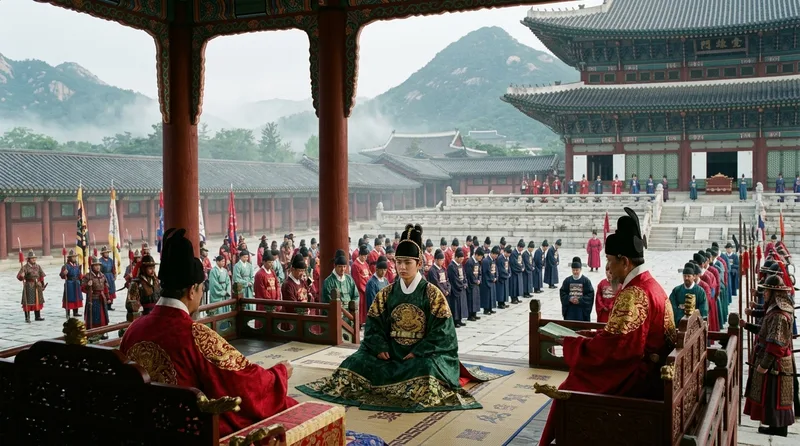
The Chaekbong investiture ceremony, which designated the official crown prince, was a 3-day ritual so politically charged that 8 crown princes were invested and later deposed between 1392 and the early 19th century. The ceremony required approval from Ming China’s emperor until the mid-17th century, meaning Korean succession depended on Beijing’s diplomatic response time of 4-6 months. King Seonjo’s investiture of Prince Gwanghae in the late 16th century required crafting a gold seal weighing 2.3 kilograms, embroidering ceremonial robes with 5,000 gold threads, and commissioning 12 court scholars to compose investiture documents in perfect classical Chinese calligraphy. The prince received his jade tablet, official seal, and ceremonial sword in three separate presentations, each requiring him to perform 12 prostrations before his father and ancestral tablets. The ritual’s political significance became tragically clear in the early 17th century when Crown Prince Sohyeon was secretly poisoned just months after his investiture, likely by court factions opposing his diplomatic relationship with Qing China. Queen Munjeong in the mid-16th century forced the premature investiture of her 9-year-old son against senior officials’ objections, using the ritual’s finality to secure her regency. Once performed, the Chaekbong ceremony was nearly irreversible—deposing an invested crown prince required either the king’s death, treason charges, or intervention from Chinese emperors.
Source: britannica.com
6. Garye: Royal Weddings as International Diplomatic Theater
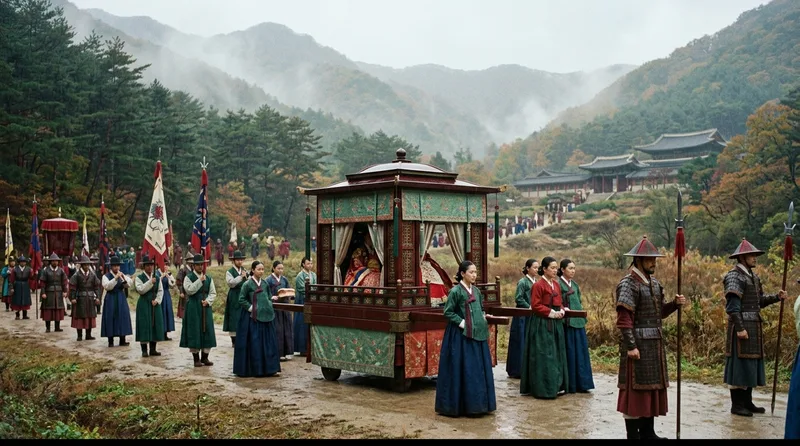
Joseon royal weddings stretched across 6 months and 15 separate ceremonies, beginning with geomancy experts selecting an auspicious date and ending with the queen’s formal presentation to ancestral spirits. When King Sejo married Queen Jeonghui in the mid-15th century, the preliminary courtship rituals alone required 37 diplomatic exchanges between the bride’s family and palace officials, each message carried by envoys traveling in processions of 50-100 officials. The actual wedding day involved the groom approaching the bride’s temporary palace exactly 3 times, being symbolically refused twice before being admitted on the third approach—a ritual testing his persistence that took 7 hours to complete. The bride wore a ceremonial dress weighing 23 kilograms, adorned with 2,847 jewels and requiring 4 court ladies to help her move. King Yeongjo’s wedding to Queen Jeongsun in the mid-18th century, who was 15 while he was 65, required constructing a temporary shrine costing 150,000 nyang (equivalent to 2 years of national military budget) to house the ceremonial procession. The post-wedding ritual of presenting the queen to Jongmyo Shrine’s ancestral tablets occurred exactly 90 days after consummation, certified by palace physicians who monitored the couple’s private quarters. These weddings weren’t romantic unions but political contracts binding elite families to the throne, with every gesture scrutinized for proper Confucian propriety.
Source: britannica.com
7. Gukjang: State Funerals That Consumed National Resources
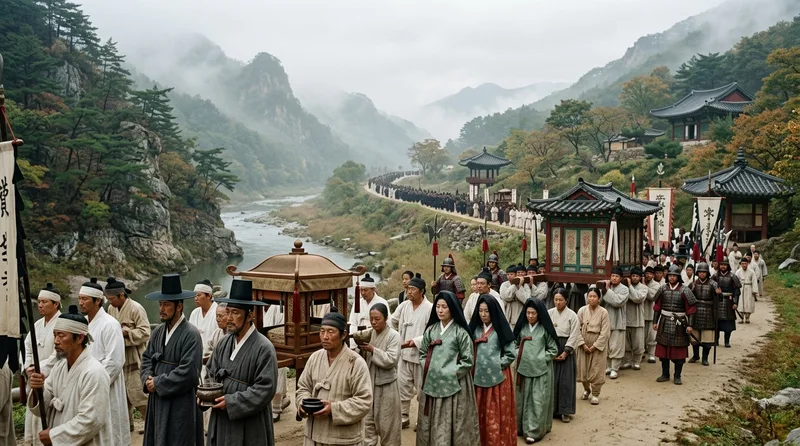
Joseon state funerals for kings and queens followed protocols specified in 324 pages of the “Gukjo Sangye Bopyeon” manual, requiring 5 months of preparation and mourning periods lasting 3 years. When King Injo died in the mid-17th century, constructing his tomb required 150,000 laborers working 43 days to move 85,000 cubic meters of earth and install stone guardian figures weighing 4.7 tons each. The funeral procession stretched 2 kilometers and moved at exactly 60 steps per minute, taking 11 hours to cover the 40 kilometers from Seoul to the burial site. Court officials wore hemp mourning robes for 3 years, during which they couldn’t marry, attend celebrations, or eat meat—restrictions so severe that 127 officials requested exemptions during King Hyojong’s funeral in the mid-17th century. The coffin itself required 94 layers of lacquer applied over 180 days and weighed 890 kilograms without the body. During King Sukjong’s funeral in the early 18th century, the cost of ceremonial paper offerings burned at the gravesite consumed 67 tons of mulberry paper, equivalent to 15% of the national paper production for that year. The crown prince was required to sleep in a mourning hut beside the tomb for 100 days, eating only rice gruel and water. These elaborate protocols occasionally backfired—in the late 18th century, officials spent so much on King Yeongjo’s funeral that they had to postpone his grandson’s coronation ceremonies by 8 months due to treasury depletion.
Source: britannica.com
8. Jongmyo Jeryeak: Sacred Music That Defined Korean Sound
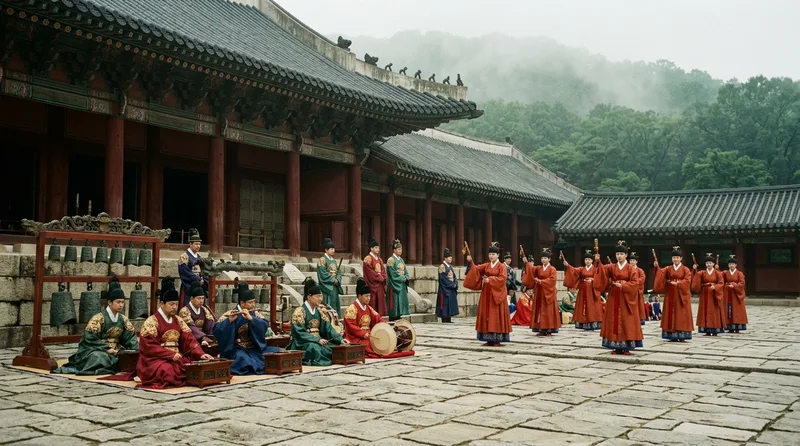
The Jongmyo Jeryeak court music performed during ancestral rites consisted of 11 musical movements using 37 different instrument types, creating soundscapes that had remained unchanged since their composition in the mid-15th century under [King Sejong](https://www.britannica.com/biography/Sejong). Each instrument had symbolic meaning: the pyeonjong bronze bells represented heaven’s voice, the pyeongyeong stone chimes symbolized earth’s resonance, and the wooden tiger-shaped eo represented the ending of each sacred phrase. The musicians underwent 7 years of training to master the complex rhythmic patterns, which operated on a time signature of 16 beats per measure—virtually unknown in other musical traditions. During performances, 64 dancers holding pheasant-feather plumes moved in 8 rows while vocalists chanted lyrics praising ancestral virtue, with each syllable extended over 4-8 seconds to match the ritual’s meditative pace. King Sejo’s mid-15th century revision added 3 new dance formations requiring geometrically precise spacing—dancers maintained exactly 2.5 meters between each position, verified by court geometers before each performance. The music’s preservation became a matter of political orthodoxy; when Japanese colonial authorities tried to modernize the tempo in the early 20th century, Korean musicians successfully argued for international protection. The ritual’s glacial pace meant a single 11-movement performance consumed 90 minutes, testing both musicians’ endurance and the king’s ability to remain motionless throughout.
Source: britannica.com
9. Seonnongje: When Kings Became Ceremonial Farmers
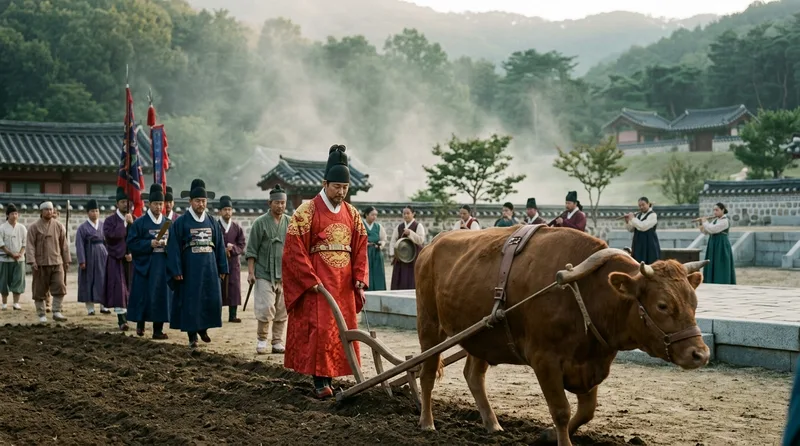
Each spring at the Seonnongdan altar established in 1401, Joseon kings personally plowed ceremonial furrows in a ritual demonstrating that even monarchs served agriculture’s primacy. King Taejong’s early 15th century performance of Seonnongje required him to guide an ox-drawn plow through exactly 3 furrows measuring 42 meters each, while court officials and farmers watched in mandated attendance numbering 2,400 people. The king wore a yellow ceremonial farming robe and a simple horsehair hat instead of his crown, symbolically demoting himself to common farmer status for the ritual’s 4-hour duration. Senior officials then took turns plowing 5 additional furrows, with their agricultural technique scrutinized by actual farmers who could theoretically correct improper form—one of the rare moments when commoners held authority over aristocrats. Seeds planted during the ceremony came from grain specifically harvested from the previous year’s ritual plot and stored in ceremonial containers; using regular seeds would invalidate the entire performance. When King Sejong introduced new farming techniques in the early 15th century, he first demonstrated them during Seonnongje before mandating their adoption nationally. The ritual reinforced Confucian ideology that agricultural productivity was the foundation of state power, with the king serving as chief farmer-in-chief. Harvest from the ceremonial plot was used exclusively for ancestral offerings at Jongmyo Shrine, creating a closed loop where royal farming fed royal worship.
Source: britannica.com
10. Jogang: Morning Court Assemblies That Governed Through Ritual Debate
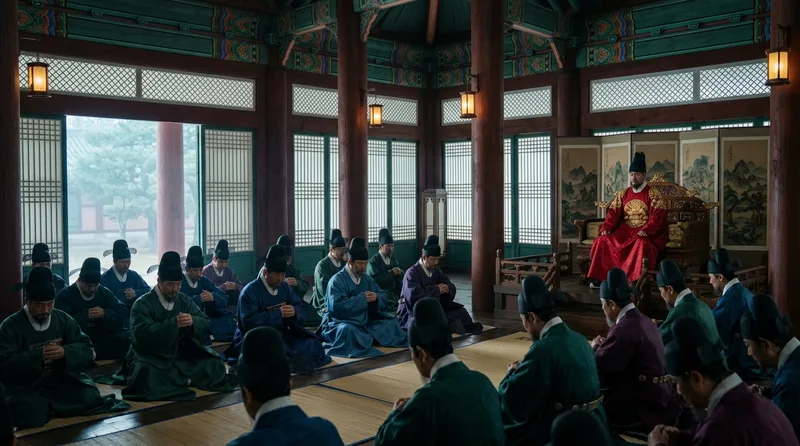
The Jogang morning court assembly, held at 5 AM daily in Gyeongbokgung Palace’s throne room, was where Joseon governance actually occurred through highly ritualized debate between king and bureaucrats. King Sejong’s reign saw 7,482 recorded morning assemblies between the early 15th century and mid-15th century—an average of 234 per year, missing only 19 days due to illness. Each assembly followed rigid protocol: officials entered in order of rank, performed 4-fold prostrations, then stood in positions determined by their office, with the top 3 state councilors positioned exactly 12 paces from the throne. The king could not begin discussions until exactly 27 senior officials were present; missing this quorum meant canceling the assembly entirely, which happened only 8 times during Sejong’s 32-year reign. Debate topics ranged from tax policy to astronomical observations, with officials expected to cite classical texts from memory to support arguments. King Yeongjo’s mid-18th century assemblies saw debates lasting 9 consecutive hours over flood relief policies, during which no one could eat, drink, or relieve themselves—endurance itself became political performance. The ritual’s power lay in its publicity: secretaries recorded every word in the “Joseon Wangjo Sillok” (Annals of the Joseon Dynasty), creating 1,893 volumes documenting 472 years of governance. This transparency meant kings couldn’t easily ignore official consensus without creating permanent historical record of their arbitrary decisions, making Jogang assemblies a check on royal absolutism disguised as ceremonial deference.
Source: britannica.com
Did You Know?
Did You Know? The Joseon dynasty’s obsessive ritual documentation created one of world history’s most complete governmental records—1,893 volumes covering 472 years—yet these same ceremonies became so resource-intensive that by the 19th century, the cost of performing state rituals consumed 23% of the annual budget. Ironically, the very Confucian orthodoxy that legitimized royal power through elaborate ceremony also constrained it, as kings who deviated from protocol faced deposition while those who followed it bankrupted the state.