
When you write ‘0’ or use decimal notation, you’re employing innovations from ancient Indian mathematicians who developed concepts between 500 BCE and 1500 CE that wouldn’t reach Europe for centuries—some still powering modern computers and space exploration.
1. Zero: The Revolutionary Number That Changed Mathematics Forever

In 628 CE, mathematician Brahmagupta wrote the Brahmasphutasiddhanta in Ujjain, defining zero not merely as an empty placeholder but as an actual number with mathematical properties. He established rules for arithmetic operations involving zero, writing that zero minus zero equals zero and that a positive number minus zero remains positive. Before this groundbreaking work, civilizations like the Babylonians and Mayans used placeholder symbols, but none treated zero as a number that could be added, subtracted, or manipulated in equations. Brahmagupta’s rules stated that any number multiplied by zero equals zero—a concept so fundamental we take it for granted today. The Bakhshali manuscript, carbon-dated to between the 3rd and 4th centuries CE, contains the earliest known use of a dot symbol representing zero in India. This intellectual leap enabled the development of algebra, calculus, and eventually computer science. Without zero as a number, binary code—the foundation of all digital technology—would be impossible. The concept traveled through Islamic scholars to Europe by the 12th century, fundamentally transforming Western mathematics and enabling the scientific revolution that followed.
Source: britannica.com
2. The Decimal Place-Value System That Revolutionized Calculation

Aryabhata’s Aryabhatiya, composed in 499 CE when he was just 23 years old, systematized the decimal place-value system that Indians had been developing for centuries. This treatise used Sanskrit alphabetic notation to express numbers up to 10 to the power of 18, an astronomical figure the Romans couldn’t even conceive with their cumbersome numeral system. The system’s brilliance lay in positional notation—the same digit could represent different values depending on its position, making 3 in the hundreds place worth one hundred times more than 3 in the tens place. Earlier Indian inscriptions from the Gupta period, specifically a 595 CE inscription at Sankheda in Gujarat, show the numeral system in use. Before this innovation, adding large numbers required complex manipulation of counters or abacuses. The place-value system meant that anyone literate in the notation could perform calculations with just ink and paper. When Islamic scholars encountered this system in the 8th century, Al-Khwarizmi wrote a treatise explaining it—the Latin translation of his work gave us the word ‘algorithm.’ The system reached Europe by the 13th century through Fibonacci’s Liber Abaci, though church authorities initially resisted it as ‘infidel knowledge.’ Today, every calculator, spreadsheet, and computer program owes its computational efficiency to this ancient Indian innovation.
Source: britannica.com
3. Negative Numbers: The Debts That Became Mathematical Tools

While Chinese mathematicians had used red and black counting rods to represent positive and negative numbers, Brahmagupta’s 628 CE treatise was the first to establish systematic rules for negative number operations. He described negative numbers as ‘debts’ and positive numbers as ‘fortunes,’ then outlined how to add, subtract, multiply, and divide them. His rules stated that the product of two negative numbers equals a positive number—a concept European mathematicians wouldn’t accept until the 17th century, nearly one thousand years later. Brahmagupta wrote that a debt minus zero is a debt, and a fortune minus zero is a fortune, establishing zero’s unique position in arithmetic. The Bakhshali manuscript also contains negative numbers used to solve quadratic equations, showing they weren’t merely theoretical curiosities but practical tools. European mathematicians like Cardano and Descartes initially rejected negative solutions to equations as ‘fictitious’ or ‘absurd,’ calling them numeri absurdi. Indian astronomers used negative numbers to calculate past positions of celestial bodies and model astronomical phenomena that occurred before their reference epoch. This acceptance of negative quantities enabled more sophisticated algebraic thinking and laid groundwork for coordinate geometry. Modern financial systems, temperature scales, and vector mathematics all rely on operations with negative numbers that ancient Indians normalized more than 1,300 years ago.
Source: smithsonianmag.com
4. Trigonometric Functions: Measuring the Unmeasurable

Aryabhata defined the sine function in 499 CE with remarkable precision, creating a table of sine values for angles from 0 to 90 degrees in increments of 3.75 degrees. He called this function jya-ardha (chord-half), which later became jiva in Arabic, then sinus in Latin—giving us the modern word ‘sine.’ His calculations were accurate to four decimal places, an extraordinary achievement for the 5th century. The Surya Siddhanta, an astronomical text from approximately 400 CE, contains earlier trigonometric concepts used to calculate the positions of planets and predict eclipses. Varahamihira refined these functions in his 505 CE work Pancasiddhantika, which synthesized five different astronomical traditions. Indian mathematicians understood that trigonometric functions represented ratios of sides in right triangles, not merely geometric curiosities. They used these functions to solve practical problems: measuring the height of mountains, calculating distances across rivers, and determining the Earth’s circumference. Bhaskara II expanded the trigonometric toolkit in 1150 CE with his Siddhanta Shiromani, developing the versine function and sophisticated interpolation formulas. These functions reached Islamic scholars through translations at the House of Wisdom in Baghdad during the 9th century. European mathematicians didn’t systematically develop trigonometry until the 15th century, nearly one thousand years after Aryabhata’s foundational work.
Source: britannica.com
5. Infinite Series: The Kerala School’s Pre-Calculus Revolution

Between 1350 and 1550 CE, mathematicians of the Kerala school developed infinite series expansions for trigonometric functions—concepts Europe wouldn’t discover until Newton and Leibniz in the 1660s. Madhava of Sangamagrama, working around 1400 CE, created the infinite series for sine, cosine, and arctangent functions, expressing these as sums of infinitely many terms. His series for pi calculated the value to 11 decimal places: 3.14159265359, far exceeding any previous approximation. Nilakantha Somayaji’s Tantrasangraha, completed in 1500 CE, presented these series with rigorous proofs and correction terms to improve convergence rates. The Kerala mathematicians understood concepts of limits, derivatives, and integration—the fundamental operations of calculus—though they didn’t formalize them into a unified system. Jyesthadeva’s Yuktibhasa, written in Malayalam around 1530 CE, provided detailed proofs and explanations making these advanced concepts accessible to students. These works circulated through manuscripts in Kerala’s temple libraries and scholarly networks, but never reached Europe through normal transmission routes. Historians debate whether Jesuit missionaries might have carried these ideas to Europe, potentially influencing later developments. The Kerala school’s work demonstrates that calculus wasn’t a singular European invention but an intellectual destination that multiple cultures approached independently. Modern numerical analysis and computer algorithms for calculating trigonometric functions still use methods remarkably similar to those Madhava developed 600 years ago.
Source: britannica.com
6. Algebraic Notation: From Words to Universal Symbols

Brahmagupta’s 628 CE Brahmasphutasiddhanta contained systematic solutions to quadratic equations using algebraic methods expressed in Sanskrit verse. He provided the quadratic formula in verbal form: multiply the square of half the coefficient of the unknown by itself, add the absolute term, take the square root, and adjust by half the coefficient. This method produces the same results as the modern formula x = [-b ± √(b² - 4ac)] / 2a, though expressed entirely in words. Bhaskara II’s 1150 CE Bijaganita (Seed Arithmetic) advanced algebraic notation further, using abbreviations and symbols to represent unknowns and mathematical operations. He solved indeterminate equations of the second degree, work that wouldn’t be matched in Europe until Fermat in the 17th century—500 years later. The Sanskrit word bija (seed) came to mean ‘unknown quantity’ or ‘variable,’ the fundamental concept of algebra. Brahmagupta also solved the general quadratic indeterminate equation now called Pell’s equation, though it should properly be called Brahmagupta’s equation since he solved it one thousand years before Pell. Indian algebraists worked with multiple unknowns simultaneously, using different colored beads or syllables to represent different variables. This abstraction from specific numbers to general principles transformed mathematics from calculation to symbolic manipulation. European algebra developed independently through Islamic transmission, but Indian algebraic methods were often more sophisticated and general than contemporary work elsewhere.
Source: britannica.com
7. Binary System Foundations: The Ancient Roots of Computer Code

Around 200 BCE, the mathematician and musicologist Pingala wrote the Chandahshastra, a treatise on Sanskrit prosody that contained the first known description of a binary numeral system. Pingala needed to catalog the 256 possible patterns of long and short syllables in Vedic poetry meters, and he developed a system using light (laghu) and heavy (guru) syllables—essentially ones and zeros—to represent these patterns systematically. His method counted from 1 to 2^n using binary notation, though he worked in reverse order from modern convention. The Chandahshastra described an algorithm called meru-prastara, which generates what we now call Pascal’s triangle, displaying binomial coefficients in a geometric pattern. This algorithm inherently uses binary operations, showing that ancient Indians understood the mathematical properties of base-2 systems. In the 6th century CE, Virahanka expanded on Pingala’s work, discovering the Fibonacci sequence while analyzing prosodic patterns—115 years before Fibonacci himself. The binary system’s full potential remained dormant for nearly 2,000 years until Leibniz developed modern binary arithmetic in 1679 CE. When computer scientists in the 20th century needed an efficient system for electronic circuits with on/off states, they independently rediscovered what Pingala had intuited in ancient India. Every digital device today—from smartphones to supercomputers—operates on binary code, making Pingala’s prosodic analysis one of history’s most consequential literary studies.
Source: britannica.com
8. Astronomical Calculations: Mapping the Cosmos With Mathematics

Aryabhata’s 499 CE Aryabhatiya calculated Earth’s circumference as 39,968 kilometers—remarkably close to the modern measurement of 40,075 kilometers, an error of merely 0.2 percent. He proposed that Earth rotates on its axis daily, explaining the apparent motion of stars, a heliocentric insight that Europe wouldn’t accept for another 1,100 years. His astronomical model used epicycles and eccentric circles to predict planetary positions with stunning accuracy. The Surya Siddhanta, composed around 400 CE, calculated the solar year as 365.2563627 days, differing from the modern value by only 1.4 seconds. These calculations required sophisticated trigonometry, understanding of spherical geometry, and precise observational data collected over centuries. Varahamihira’s 505 CE Pancasiddhantika synthesized five different astronomical systems, comparing their predictions and analyzing their strengths and weaknesses with scientific rigor. Indian astronomers calculated the precise timing of eclipses, planetary conjunctions, and the precession of equinoxes—the slow wobble in Earth’s axis that takes 26,000 years to complete one cycle. They understood that the Moon’s orbit was elliptical, not circular, centuries before Kepler announced this as a revolutionary discovery in 1609 CE. These mathematical models enabled accurate calendar systems, navigation techniques, and agricultural planning. The astronomical siddhanthas were practical tools used by navigators sailing the Indian Ocean and by farmers timing monsoon planting seasons across the subcontinent.
Source: smithsonianmag.com
9. Pi Approximations: Calculating the Infinite With Finite Methods
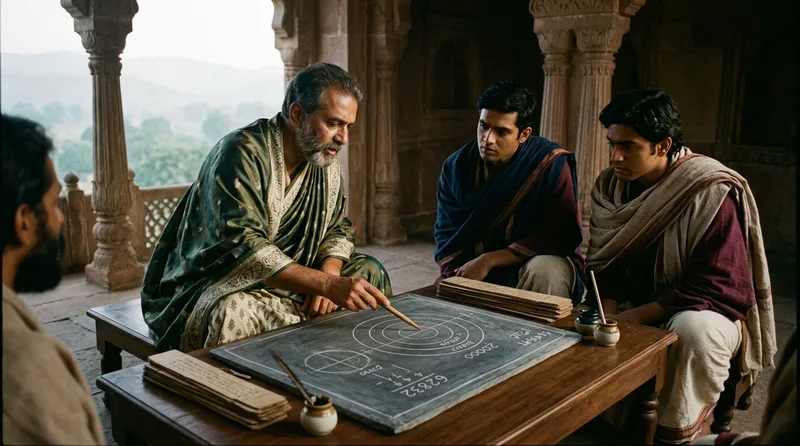
Aryabhata stated in 499 CE that the circumference of a circle with diameter 20,000 equals 62,832, giving a pi value of 3.1416—accurate to four decimal places and surpassing all previous approximations. He explicitly stated this was approximate, showing awareness of pi’s irrational nature. The Sulba Sutras, dating from 800 to 500 BCE, contained earlier approximations used for constructing precise fire altars with circular and square geometries, giving pi as approximately 3.088. Madhava of Sangamagrama around 1400 CE developed an infinite series that could calculate pi to any desired accuracy, achieving 11 decimal places: 3.14159265359. His series expressed pi/4 as the infinite sum 1 - 1/3 + 1/5 - 1/7 + 1/9… continuing forever, a formula Europe wouldn’t discover until Leibniz in 1676 CE—276 years later. Madhava also developed correction terms to make this slowly converging series more practical, accelerating calculations significantly. He understood that pi was transcendental—it couldn’t be expressed as a finite fraction or as the root of any polynomial equation—a fact European mathematicians wouldn’t prove until 1882 CE. These calculations weren’t merely theoretical exercises; they enabled precise construction of circular structures, accurate astronomical predictions, and sophisticated geometric proofs. The Kerala school’s algorithms for calculating pi influenced modern computational methods. When programmers calculate pi to trillions of digits using supercomputers, they employ series expansions conceptually identical to Madhava’s ancient methods.
Source: britannica.com
10. Combinatorics: Counting the Uncountable in Poetry and Mathematics

Ancient Indian mathematicians developed sophisticated combinatorics—the mathematics of counting arrangements and combinations—to analyze Sanskrit poetry meters. Pingala’s 200 BCE Chandahshastra calculated that there are exactly 256 distinct patterns possible in an eight-syllable meter, arriving at 2^8 through systematic enumeration. He developed formulas for permutations and combinations without replacement, essential for determining how many distinct poems could be composed within specific metrical constraints. The Jain mathematician Mahavira, in his 850 CE Ganita Sara Samgraha, provided formulas for calculating permutations of objects, combinations of selections, and arrangements with repetition allowed. He solved problems like determining how many necklaces can be made from beads of different colors or how many seating arrangements are possible for guests at a feast—practical applications of abstract mathematical principles. By the 12th century CE, Bhaskara II’s Lilavati presented 20 different combinatorial problems with general solution methods. The text asked questions like: ‘In how many ways can couples sit in a row with men and women alternating?’ and provided algorithmic solutions applicable to any similar problem. These formulas calculated factorials for large numbers, understanding that 10! (ten factorial) equals 3,628,800—the number of ways to arrange ten objects in order. Indian combinatorics arose from linguistic and religious needs: cataloging Vedic chants, analyzing poetic meters, and calculating ritual variations. Modern applications of these ancient formulas include cryptography, probability theory, and computer science algorithms for data sorting and optimization.
Source: britannica.com
Did You Know?
Did You Know? The mathematical symbol ∞ for infinity wasn’t invented until 1655 CE by English mathematician John Wallis, yet Indian mathematicians were calculating with infinite series and discussing the concept of infinity in Sanskrit texts more than 1,200 years earlier. Ironically, while European scholars initially dismissed Indian mathematics as mystical speculation unworthy of serious study, their own scientific revolution became possible only after adopting the very numerical systems and concepts those ancient scholars had perfected centuries before Columbus even sailed.