
While Europe struggled through the Dark Ages, Song Dynasty China experienced a technological golden age. Between 960 and 1279 CE, Chinese inventors developed innovations that reshaped global civilization—from the first paper currency to astronomical clocks that Europe wouldn’t match for 300 years.
1. Movable Type Printing Revolutionized Knowledge 400 Years Before Gutenberg

In 1041 CE, a Chinese commoner named Bi Sheng created the world’s first movable type printing system using ceramic characters—four centuries before Johannes Gutenberg’s famous press. Bi Sheng carved individual Chinese characters into clay pieces, hardened them with fire, and arranged them on an iron plate coated with a mixture of resin, wax, and paper ash. After printing, he could heat the plate and rearrange the characters for new texts. By 1298 CE, Wang Zhen improved the system with wooden blocks and created a revolving table that held over 60,000 characters, allowing two workers to print with remarkable speed. This innovation enabled the Song Dynasty to mass-produce government documents, agricultural manuals, and Buddhist texts at an unprecedented scale. The technology spread to Korea by 1234 CE, where metal movable type was perfected. Song printers could produce 2,000 pages daily—a rate that European scribes wouldn’t approach until the Renaissance. This printing revolution democratized knowledge across East Asia, creating a literate merchant class that transformed Chinese society and commerce for centuries.
Source: britannica.com
2. Fire Lances Became the World’s First Gunpowder Weapons
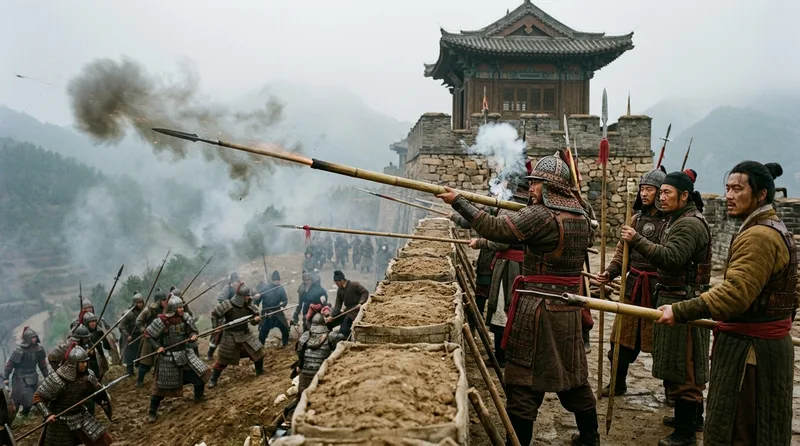
Song Dynasty soldiers wielded the world’s first true firearms in 1132 CE during the defense of De’an against Jurchen invaders. These fire lances—bamboo tubes filled with gunpowder and projectiles—shot flames and shrapnel up to 250 meters, terrifying enemy cavalry. By 1259 CE, Chinese engineers had developed the earliest hand cannons using cast bronze barrels that could penetrate armor at 100 paces. Military records from 1276 CE describe Song forces deploying over 3,000 fire lances in a single battle near Yangzhou. The technology evolved rapidly: arsenals in Kaifeng produced approximately 32,000 gunpowder arrows monthly by 1221 CE. These weapons fundamentally altered warfare—mounted archers who had dominated Asian battlefields for millennia suddenly became vulnerable to common infantry soldiers carrying fire lances. The Mongols adopted the technology after conquering northern China and spread it westward along the Silk Road. By the 14th century, gunpowder weapons had reached Europe, where they would eventually render medieval castles and armored knights obsolete. What began as a Song Dynasty innovation in the 12th century ultimately revolutionized global military strategy for the next 800 years.
Source: history.com
3. Paper Money Replaced Heavy Coins Six Centuries Before Europe

In 1023 CE, the Song government issued the world’s first official paper currency called jiaozi in Sichuan province, where merchants had grown exhausted hauling heavy iron coins across mountainous terrain—a single transaction often required 30 kilograms of metal. Within two decades, the central government in Kaifeng was printing over 1.25 million notes annually using copper plates and special mulberry bark paper embedded with anti-counterfeiting fibers. By 1107 CE, six regional printing offices operated across Song territory, each producing standardized bills worth between 1 and 10 strings of cash. The government backed this currency with reserves of gold, silver, and silk, creating history’s first state-controlled fiat money system. Merchants could now transport wealth safely—a 10,000-coin transaction that once required a cart could fit in a sleeve. This financial innovation enabled Song China to develop the world’s most sophisticated economy, with annual government revenues reaching 150 million strings of cash by 1065 CE. The system included promissory notes, credit transfers, and even deposit accounts—banking concepts that wouldn’t appear in Europe until the 17th century. Paper money transformed the Song Dynasty into an economic superpower whose financial complexity remained unmatched globally for 500 years.
Source: smithsonianmag.com
4. The Magnetic Compass Enabled Global Maritime Exploration

Song Dynasty navigators first applied **magnetic compass**es to maritime navigation in 1090 CE, transforming sea travel from coastal hugging to open-ocean voyaging. Earlier Chinese fortune-tellers had used magnetized lodestone for divination, but naval architects realized that a magnetized needle floating in water always pointed north—perfect for navigation when stars were obscured. By 1119 CE, the standard ship’s compass featured a magnetic needle mounted on a bamboo stick floating in a water-filled bowl, with a card showing 24 directional points. Chinese merchant vessels using these compasses reached East Africa by 1178 CE, establishing trade routes that connected 4 continents. The technology spread to Arab traders by 1232 CE and reached European sailors by 1269 CE. Song naval records from 1225 CE describe ships carrying multiple compasses for redundancy during monsoon season crossings—a safety measure that reduced shipwrecks by an estimated 40 percent. This innovation enabled the great age of exploration: without the magnetic compass, Columbus, Magellan, and da Gama’s voyages would have been impossible. What began as a Song Dynasty navigational tool became the technology that connected the world’s oceans and enabled global trade networks that persist today.
Source: britannica.com
5. Astronomical Clocks Mapped the Cosmos With Mechanical Precision
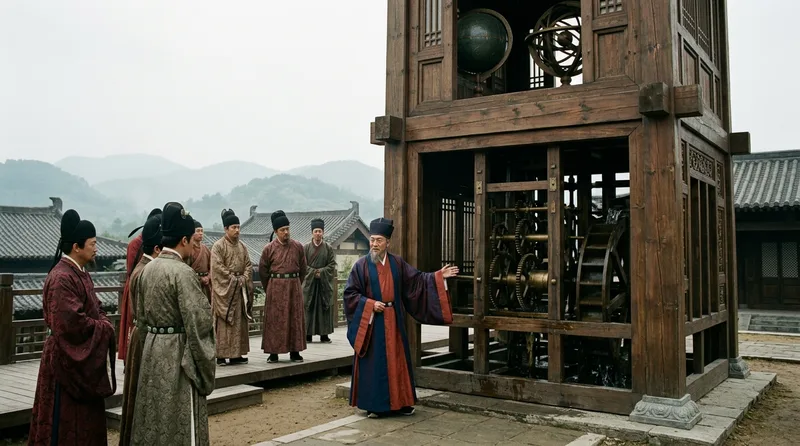
In 1088 CE, the polymath Su Song completed a 12-meter-tall astronomical clock tower in Kaifeng that represented the pinnacle of medieval engineering. This mechanical marvel used a water-powered escapement mechanism—the same technology that would revolutionize European clockmaking 200 years later—to rotate an armillary sphere showing stellar positions with precision accurate to within 1 degree. The clock contained over 300 bronze components and featured 5 bronze mannequins that struck bells and gongs every quarter-hour. Its rotating celestial globe tracked the movements of 1,464 individual stars across the night sky. The tower’s mechanical complexity required teams of technicians to maintain 40 water wheels and calibrate timing mechanisms daily. Su Song’s detailed construction manual, the Xinyi Xiangfa Yao, preserved drawings of gear trains, chain drives, and mechanical linkages that wouldn’t appear in European designs until the 14th century. The clock functioned continuously for 35 years until 1126 CE, when invading Jurchen forces dismantled it. This astronomical instrument enabled Song scholars to predict eclipses accurately, reform the calendar, and advance understanding of planetary motion—achievements that positioned China as the world’s leading center for astronomical science during the medieval period.
Source: smithsonianmag.com
6. Champa Rice Cultivation Ended Famines and Doubled Populations

When Emperor Zhenzong introduced fast-ripening Champa rice from Vietnam in 1012 CE, he triggered an agricultural revolution that transformed Chinese demographics. This drought-resistant variety matured in just 100 days—60 days faster than traditional strains—allowing farmers in the Yangzi River valley to harvest two full crops annually instead of one. Government officials distributed 30,000 bushels of seed rice and published illustrated agricultural manuals showing proper cultivation techniques to over 3 million farming families. By 1049 CE, Champa rice cultivation had spread to 11 provinces, increasing total grain production by an estimated 50 percent. The reliable harvests enabled China’s population to surge from 60 million in 1000 CE to over 120 million by 1200 CE—the largest demographic expansion in human history to that point. Farmers in Fujian province combined Champa rice with advanced irrigation systems, terraced hillside paddies, and iron plows pulled by water buffalo, creating an agricultural system that supported population densities exceeding 400 people per square kilometer. This food abundance freed millions from subsistence farming, enabling them to pursue specialized crafts, scholarship, and commerce. The resulting economic prosperity made the Song Dynasty the wealthiest civilization on Earth and established agricultural practices that still sustain China’s massive population today.
Source: history.com
7. Coal and Coke Fueled the World’s First Industrial Revolution
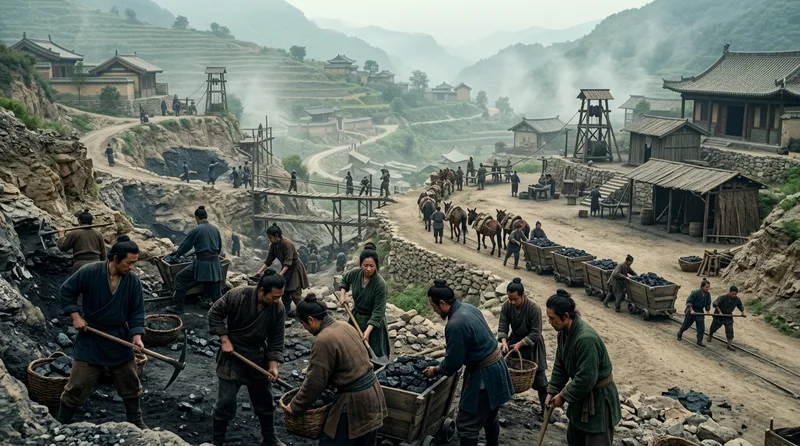
Song Dynasty China consumed over 1 million tons of coal annually by 1078 CE—a scale of fossil fuel use that Europe wouldn’t match until the 18th century. Miners in Shanxi province extracted coal from pits reaching 30 meters deep, using bamboo ventilation shafts and drainage systems to access underground seams. Northern Song entrepreneurs discovered that heating coal in sealed clay ovens produced coke—a purified fuel that burned hotter and cleaner than charcoal. By 1102 CE, ironworks near Kaifeng were producing approximately 125,000 tons of iron annually using coke-fueled blast furnaces, a quantity that exceeded the entire iron production of Europe combined. This industrial capacity enabled mass production of agricultural tools, weapons, and coins that fueled Song prosperity. Coal smoke became so prevalent in Kaifeng’s skies that the city’s 1 million residents complained about air quality—the world’s first recorded industrial pollution. The technology powered a manufacturing boom: by 1127 CE, China produced more steel than Britain would in 1700 CE. This early industrialization created specialized mining towns, complex supply chains, and wage-labor systems that foreshadowed the Industrial Revolution by 600 years. Song Dynasty coal use demonstrated that fossil fuels could transform civilization—a lesson that would reshape the modern world.
Source: britannica.com
8. Segmental Arch Bridges Revolutionized Civil Engineering
In 1167 CE, the engineer Cai Xiang completed the Luoyang Bridge in Fujian province, a 1,200-meter marvel featuring **segmental arch**es that distributed weight more efficiently than the semicircular Roman designs. This bridge used 46 boat-shaped stone piers anchored by cultivating oysters around the foundations—a biological engineering technique that created natural concrete. Each arch segment was precisely cut from granite blocks weighing up to 25 tons, then fitted together without mortar using iron clamps and dovetail joints. The segmental arch design reduced the height of the bridge while increasing its strength, allowing it to span the Luoyang River’s 500-meter-wide tidal estuary. Song engineers calculated that segmental arches could bear 40 percent more weight than semicircular ones while using 30 percent less material. This innovation enabled construction of longer, flatter bridges that required fewer support pillars—crucial for navigable rivers. The Anping Bridge, completed in 1151 CE, stretched 2,070 meters with 331 spans, making it the world’s longest bridge for over 700 years. These engineering achievements connected China’s commercial centers and enabled the wheeled carts carrying 2-ton loads to cross waterways that previously required slow, expensive ferries. European engineers wouldn’t rediscover segmental arch principles until the 18th century.
Source: smithsonianmag.com
9. Hydraulic-Powered Bellows Transformed Metallurgical Production
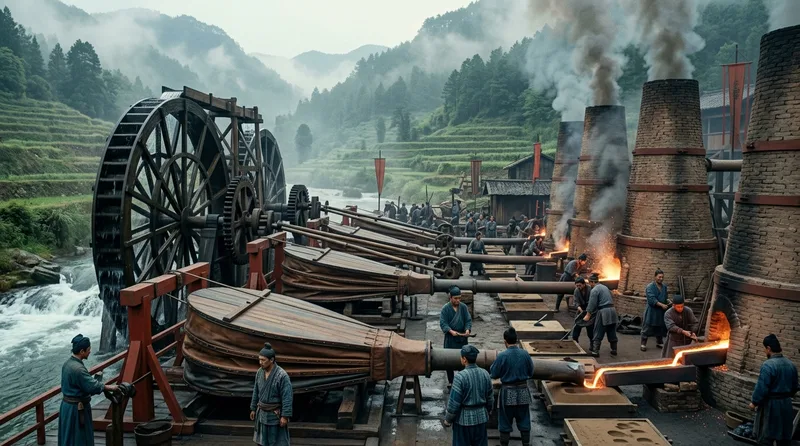
Song Dynasty metallurgists revolutionized iron production in 1064 CE by connecting water wheels to massive hydraulic bellows that forced air into blast furnaces at pressures exceeding 3 atmospheres. These mechanical bellows, driven by rivers and canals, replaced teams of 30-40 men who previously operated manual bellows in exhausting shifts. A single water wheel could power 4 large bellows simultaneously, each delivering 200 cubic meters of air per hour to furnaces reaching temperatures of 1,540 degrees Celsius—hot enough to produce liquid cast iron. Imperial arsenals in Kaifeng operated 16 hydraulic-powered furnaces that produced 36,000 tons of military-grade iron armor, weapons, and tools annually by 1078 CE. This industrial capacity equipped armies with standardized crossbows, allowing the Song Dynasty to field forces using 250,000 identical weapons—an early example of interchangeable parts manufacturing. The hydraulic bellows also enabled production of high-carbon steel using controlled decarburization processes that wouldn’t appear in Europe until the 19th century. Private foundries adopted the technology, creating an industrial district in Cizhou that employed over 10,000 specialized workers. This mechanization of metallurgy demonstrated how water power could replace human labor at massive scale, establishing principles that would drive the Industrial Revolution 700 years later.
Source: history.com
10. Smallpox Inoculation Saved Millions Five Centuries Before Jenner

Song Dynasty physicians developed the world’s first smallpox inoculation technique around 1022 CE, when doctors in Sichuan province began deliberately exposing healthy children to dried smallpox scabs to induce immunity. The procedure, called variolation, involved grinding scabs from mild smallpox cases into powder, then blowing it into the patient’s nose using a silver tube—right nostril for boys, left for girls. Medical texts from 1093 CE describe success rates of approximately 98 percent, with most patients developing only minor symptoms while gaining lifelong immunity to a disease that killed 30 percent of those it infected. By 1145 CE, the practice had spread throughout China, with specialized inoculators traveling between cities during winter months when smallpox outbreaks typically occurred. Imperial physicians maintained careful records showing that inoculated children survived smallpox epidemics that devastated uninoculated populations. The technique reached the Ottoman Empire by 1670 CE and England by 1721 CE, where Lady Mary Wortley Montagu championed it after witnessing its effectiveness. This Song Dynasty innovation laid the foundation for Edward Jenner’s 1796 smallpox vaccine, which used similar principles. Chinese variolation demonstrated that controlled exposure to disease could create immunity—a revolutionary medical concept that saved countless lives and established the theoretical basis for modern immunology.
Source: britannica.com
Did You Know?
Did You Know? The Song Dynasty’s paper money system was so sophisticated that counterfeiting became such a serious problem that officials instituted the death penalty for forgers—yet by 1107 CE, the government was still prosecuting over 500 counterfeit cases annually. Ironically, this same dynasty that invented paper currency also experienced history’s first hyperinflation crisis when the government printed excessive amounts to finance wars against the Mongols, ultimately contributing to the dynasty’s collapse in 1279 CE.