
When William Marshal earned his fortune unseating rivals in tournament melees, there were no safety rails, no referees, and no mercy. By the early fourteenth century, elaborate rule systems had transformed these deadly free-for-all combats into regulated pageantry that shaped chivalric culture and economics.
1. The Melee Ban: From Battlefield Chaos to Controlled Combat
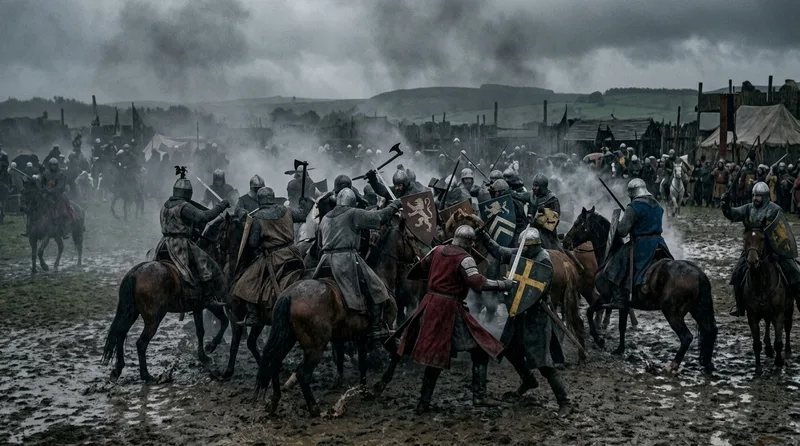
King Henry III of England fundamentally altered tournament culture in 1242 when he banned the traditional melee—mass cavalry battles involving dozens of knights fighting simultaneously across open countryside. These sprawling conflicts had killed numerous participants, including Geoffrey de Mandeville, Earl of Essex, who died in a 1216 tournament when his helm was struck repeatedly. The new regulations confined combat to smaller, supervised encounters between individual knights or small teams within marked boundaries. This shift responded to mounting pressure from the Church, which had condemned tournaments since the Council of Clermont in 1130, and from monarchs who lost valuable military commanders to sporting accidents. By mid-thirteenth century, most major European kingdoms had adopted similar restrictions, though enforcement varied wildly. The prohibition didn’t eliminate melees entirely—they continued at unsanctioned events—but it created a new tournament economy favoring wealthy knights who could afford specialized jousting equipment. The change elevated individual prowess over cavalry tactics, making tournaments showcases for personal skill rather than military training exercises. This regulatory watershed established the joust as chivalry’s defining spectacle, transforming medieval combat sports from battlefield rehearsals into theatrical demonstrations of aristocratic virtue.
Source: britannica.com
2. Peace-Bonded Swords: The Blunted Weapons Revolution
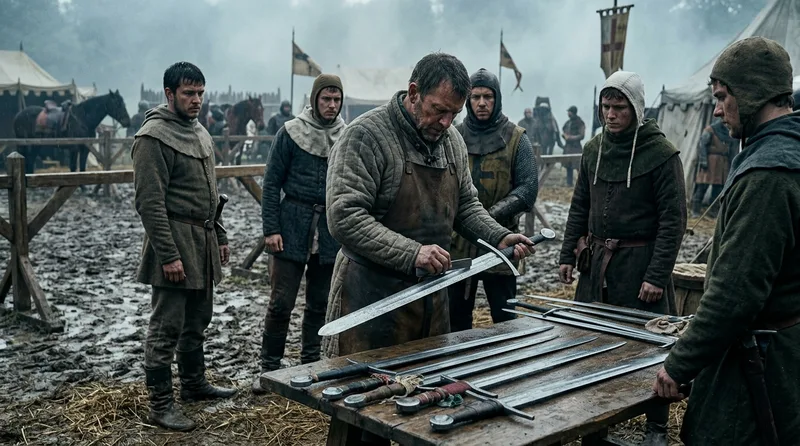
Tournament regulations introduced during the reign of Edward I of England between 1272 and 1307 mandated that all swords used in combat be blunted or “rebated,” with edges ground down to three-millimeter thickness and points flattened. Knights caught using sharpened weapons faced immediate expulsion, forfeiture of their horses, and substantial fines reaching 20 marks—equivalent to a skilled craftsman’s annual wages. The German tournament societies, particularly the Gesellschaft mit dem Esel founded in 1381, enforced even stricter standards, requiring inspectors to verify weapon modifications before each bout. Lances received special attention: regulations specified they be constructed from soft woods like pine or poplar, with tips fitted with three-pronged coronels designed to distribute impact force. Despite these precautions, tournaments remained dangerous—notable fatalities occurred when lances shattered during jousts, though the sport became progressively safer through the medieval period. The peace-bonding system created specialized craftsmen called “armourers of the lists” who maintained tournament weapons and could identify illegal modifications. These regulations paradoxically made tournaments more commercially viable by reducing noble fatalities while maintaining enough danger to satisfy audiences craving authentic martial spectacle.
Source: britannica.com
3. Heraldic Gatekeepers: The Coat of Arms Verification System
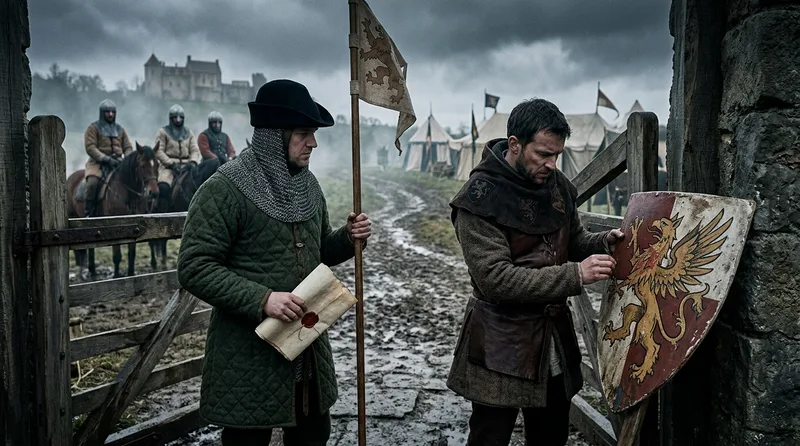
By 1290, major tournaments employed heralds—specialized officials who maintained genealogical records and verified noble lineage—to screen participants at tournament gates. The Statute of Arms proclaimed by Edward I in 1292 formalized this practice, requiring every knight to display registered heraldic devices on shield, surcoat, and horse trapper. Heralds examined these emblems against their rolls of arms, manuscript compilations like the Falkirk Roll documenting legitimate bearings. Knights lacking proper heraldic credentials faced rejection regardless of combat skill, as tournaments became exclusive clubs reinforcing aristocratic boundaries. The College of Arms in London, established in the late fifteenth century, eventually systematized this verification process across England. German tournament societies implemented even stricter standards, demanding proof of sixteen noble quarterings—documented noble ancestry on both sides extending back four generations. This requirement, called the Turnierfähigkeit, effectively barred newly ennobled families from prestigious events. Heraldic regulations created an entire professional class: heralds earned substantial fees for tournament service, typically 10 shillings per event plus gifts from participants. The system also spawned forgery scandals, with ambitious knights commissioning fraudulent genealogies or claiming extinct families’ arms to gain tournament access.
Source: britannica.com
4. Three Strikes and Victory: Standardizing Joust Scoring
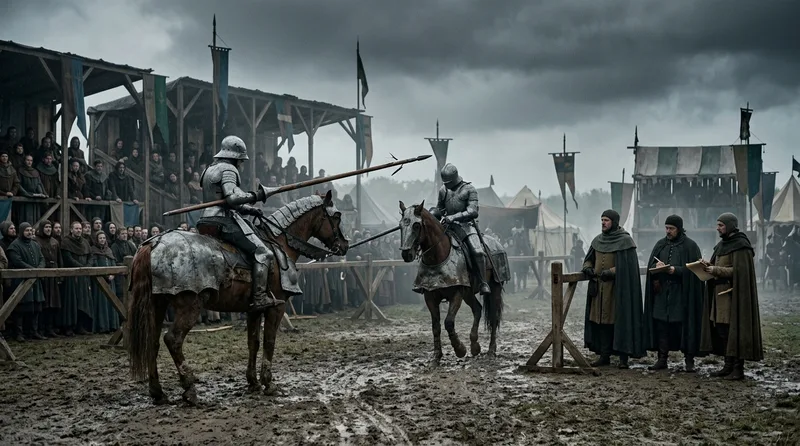
The three-course joust system emerged in France during the 1320s, establishing that a knight must successfully strike his opponent three times with his lance to claim victory. René of Anjou’s tournament manual, written in the mid-fifteenth century, codified the elaborate scoring that developed from this basic rule: five points for striking the opponent’s helm, four points for breaking a lance on his body, three points for striking his shield, and one point merely for touching him with lance tip. Unhorsing an opponent earned immediate victory regardless of prior score. Tournament judges, usually three senior knights positioned in elevated stands, verified each strike and maintained running tallies using counting boards with colored tokens. Disputes over scoring triggered formal protests called “appeals to the marshal,” with tournament organizers reviewing witness testimony to render final judgments. The standardization reduced ambiguity in determining winners, making tournaments more suitable for spectators wagering on outcomes. By the early fifteenth century, most European courts had adopted variations of this scoring system, though Italian city-states preferred five-course jousts and some Spanish tournaments required seven successful strikes. The regulations transformed jousting from raw martial contest into a precisely measured sport, creating the statistical framework that made champion knights like Jacques de Lalaing quantifiable celebrities.
Source: britannica.com
5. The Ransom Economy: Rules Governing Captured Knights
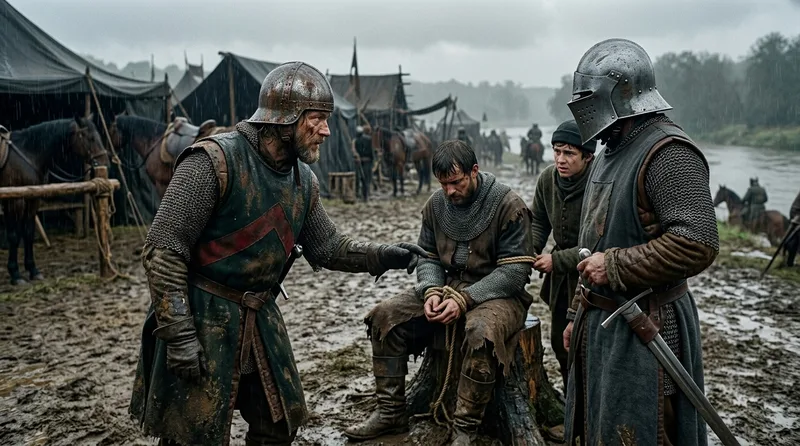
Tournament ransom customs established between 1150 and 1250 created formalized economic relationships between victors and defeated knights. William Marshal, who participated in over 500 tournaments during his career, earned approximately 10,000 marks through ransom payments, making him one of medieval England’s wealthiest men despite his landless youth. Standard ransom rates developed through custom: a defeated knight typically owed his conqueror his destrier warhorse (valued at 30-80 marks), complete armor set (20-40 marks), and a monetary payment equal to six months of his landed income. These obligations were recorded by tournament clerks who maintained official registers of captures. Knights could negotiate installment plans, with defeated nobles often requiring months or years to fulfill ransom obligations. The Statutes of Arms issued by Edward III in the mid-fourteenth century prohibited victors from demanding ransoms exceeding fair market value, responding to complaints about extortionate practices. Some tournaments adopted “courtesy rules” where victors symbolically returned captured equipment after receiving token payments, demonstrating magnanimity that enhanced social prestige. The ransom system occasionally backfired spectacularly: Ulrich von Liechtenstein, competing across Europe in the early thirteenth century, reportedly lost more in ransoms than he collected, financing his tournament career through selling family estates.
Source: britannica.com
6. The Lists: Architectural Boundaries of Honorable Combat
Tournament regulations mandated enclosed combat areas called “lists”—rectangular fields typically measuring 80 by 40 yards, surrounded by wooden barriers standing five feet high. Richard I of England codified lists dimensions in 1194, establishing minimum standards for officially sanctioned tournaments throughout his realm. These barriers served multiple functions: preventing mounted knights from fleeing combat, protecting spectators from charging warhorses weighing over 1,200 pounds, and defining clear boundaries that judges could monitor. Breaking through the lists barriers or forcing an opponent outside them resulted in immediate disqualification and forfeiture. Complex entrance protocols governed access, with knights entering through designated gates at opposite ends after formal trumpet fanfares announced their arrival. The Smithfield tournament grounds in London, used continuously from the mid-fourteenth century through the fifteenth century, featured permanent stone foundations for wooden lists that could be erected for major events. Regulations specified that lists surfaces be cleared of rocks, leveled to prevent uneven footing, and covered with sand or sawdust to reduce dust clouds that obscured combat. Some tournaments added inner barriers creating multiple lanes for simultaneous jousts, accommodating up to four pairs of knights competing at once. The architectural standardization of lists transformed tournaments from improvised rural gatherings into predictable urban spectacles suitable for international diplomatic events.
Source: britannica.com
7. Pas d’Armes Protocols: The Formalized Challenge System
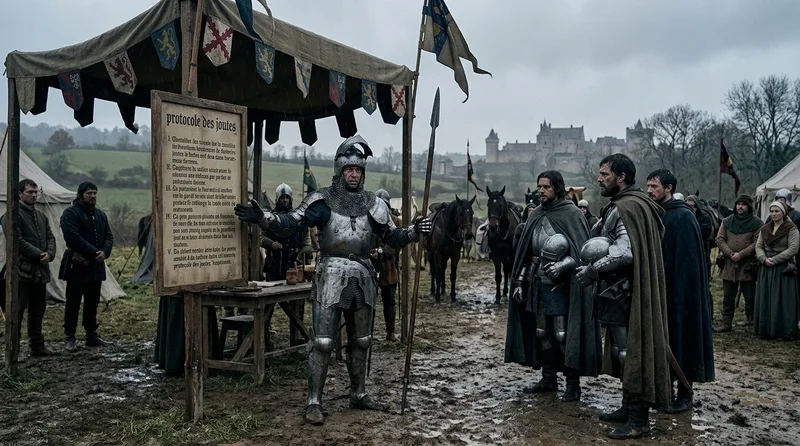
The pas d’armes—literally “passage of arms”—emerged in Burgundy during the 1430s as a highly ritualized challenge format governed by elaborate rules. A knight or group of knights declared themselves “holders” of a specific location, typically a bridge, crossroads, or castle gate, pledging to defend it against all challengers for a set period, usually 30 to 40 days. Jean II Le Meingre, called Boucicaut, famously held a pas d’armes at Saint-Inglevert in the late fourteenth century for 30 consecutive days, facing 36 foreign challengers. Formal protocols required challengers to touch painted shields hung at the challenge site: touching the shield with a sword indicated they wished to fight with sharp weapons, touching with a lance signaled preference for blunted tournament arms. Heralds recorded each challenge in official registers, scheduling combat times to prevent overlapping matches. The pas d’armes of the Fountain of Tears, organized by René of Anjou in the mid-fifteenth century, introduced conditional rules allowing ladies to nominate champions and establishing different combat formats for various categories of knights. These events typically lasted from dawn until dusk, with breaks for midday meals and religious services. Holders who successfully defended their position for the full duration earned substantial prestige and often received prizes worth 100 gold crowns or more from sponsoring nobles.
Source: britannica.com
8. Squire Regulations: Controlling the Support Personnel
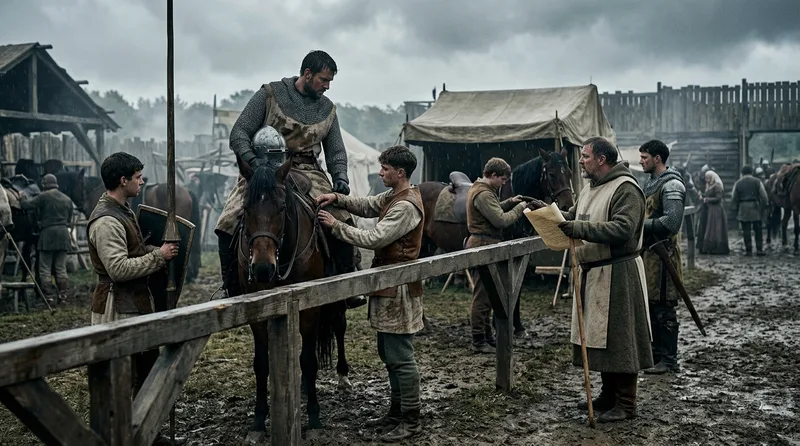
Tournament regulations developed between 1250 and 1350 strictly governed **squire**s—the support personnel assisting mounted knights. Rules limited each knight to exactly three squires within the lists during jousting events, with one holding the knight’s horse, one managing spare lances (typically 6-8 per joust), and one standing ready to assist if the knight fell. The Ordinances of Chivalry issued by Alfonso XI of Castile in 1330 prohibited squires from carrying weapons beyond short daggers, preventing them from intervening in combat. Squires caught assisting their masters during active fighting faced severe punishment: tournament organizers could brand them with hot irons or sever their right hands, though evidence suggests these extreme penalties were rarely enforced. German tournament societies required squires to post bonds of 10 marks guaranteeing good behavior, with the funds forfeited if they violated regulations. The mid-fifteenth-century Smithfield tournament regulations specified that squires must wear distinctive colored tabards identifying which knight they served, preventing confusion when multiple combats occurred simultaneously. Some events designated “squire marshals”—officials responsible for positioning support personnel and ensuring they remained outside marked boundary lines. These regulations acknowledged squires’ essential role while preventing tournaments from devolving into group brawls involving support staff, a common problem in early thirteenth-century events.
Source: britannica.com
9. The Tilt Barrier: Engineering Safety Into Speed
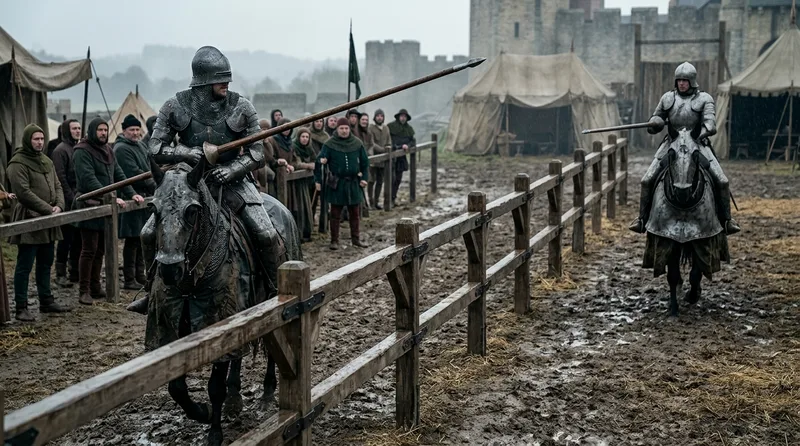
The tilt barrier revolutionized jousting safety when it appeared in French tournaments around 1420, though some historians trace prototypes to Castilian events in the late fourteenth century. This wooden divider, typically six feet high and running the full 80-yard length of the lists, separated charging knights and prevented their horses from colliding at combined speeds exceeding 35 miles per hour. Early regulations required tilts constructed from oak planks three inches thick, capable of withstanding lance impacts without splintering. The barrier forced knights to approach from their left sides—since lances were couched on the right—standardizing combat angles and eliminating the chaos of knights maneuvering for advantageous positions. The innovation dramatically reduced horse injuries, which had bankrupted numerous knights; a trained destrier warhorse represented a capital investment equivalent to 60 oxen. By the mid-fifteenth century, most major tournament grounds featured permanent tilt installations, with the Burgundian court of Philip the Good mandating their use at all ducal-sponsored events. The barrier’s introduction sparked debates about authentic chivalry, with conservative critics arguing it eliminated the skill of controlling mounts during charges. Nevertheless, practical benefits proved overwhelming: fatal accidents dropped by an estimated 70 percent at tournaments adopting tilts, according to chronicles from the period.
Source: britannica.com
10. Prize Distribution Rules: Standardizing Glory and Reward

Formal prize regulations emerged throughout the fourteenth century to prevent disputes over tournament rewards and honors. The Statutes for Tournaments issued by Edward III in the mid-fourteenth century established that first-place winners received a golden crown valued at 20 pounds, second-place earned a silver circlet worth 10 pounds, and third-place received a jeweled ring worth 5 pounds. These prizes were presented by noble ladies in elaborate ceremonies, with the practice of selecting a “Queen of Beauty” to award honors becoming standard by the late fourteenth century. René of Anjou’s tournament treatise specified that judges must unanimously agree on winners, with disputed outcomes requiring additional jousts to determine champions. Some tournaments adopted point systems allowing multiple category winners: best lance-breaker, most stylish rider, most courteous conduct, and most improved newcomer each received separate prizes. The Smithfield tournaments of the mid-fifteenth century distributed prizes totaling over 200 pounds annually—equivalent to the yearly income from a substantial manor estate. Regulations prohibited prize recipients from selling their awards within one year, ensuring honors retained symbolic value beyond monetary worth. Specialized prize protocols developed for team tournaments, where regulations dictated that victorious teams divide monetary rewards equally while the captain retained any physical prize objects like jeweled swords or ornamental helms.
Source: britannica.com
Did You Know?
Did you know that tournament regulations actually killed true military training? By the early fifteenth century, these elaborate rules had transformed combat sports into choreographed spectacles so divorced from battlefield reality that knights arriving at actual wars—like Agincourt in 1415—often lacked practical fighting experience. The very system designed to showcase chivalric virtue had inadvertently created a warrior class skilled at theatrical performance but dangerously unprepared for genuine warfare, contributing to medieval cavalry’s declining battlefield effectiveness.