
When Song Dynasty emperors gazed upon Goryeo celadon, they called it ’the first under heaven’—higher praise than their own imperial porcelain. Korean potters discovered secrets of jade-green glaze that Chinese masters spent centuries trying to steal.
1. The Lost Bisaek Glaze That Mimicked Nephrite Jade
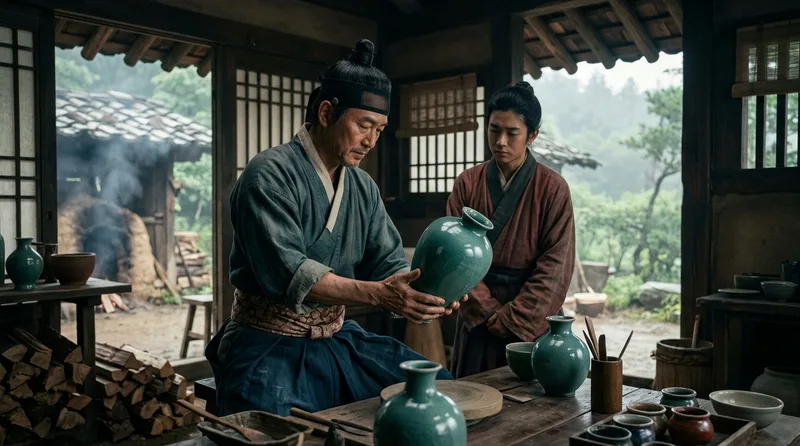
The legendary bisaek glaze produced a translucent blue-green surface so pure that 12th century Chinese observers mistook Goryeo vessels for carved jade. Korean potters achieved this effect between 1050 and 1150 CE through an iron oxide concentration of precisely 1.5 to 2.5 percent—a ratio so exact that deviations of even 0.3 percent produced inferior grey-green tones. The formula disappeared completely after 1392 when the Joseon Dynasty replaced Goryeo, and the master potters who guarded the secret took it to their graves. Modern chemical analysis reveals the glaze contained 23 different mineral compounds, including trace amounts of titanium dioxide that created the jade-like depth. The bisaek technique required 14 to 16 hours of continuous high-temperature firing at exactly 1250 degrees Celsius in reduction atmospheres with minimal oxygen. Song Dynasty records from 1123 CE specifically noted that Korean celadon’s color surpassed anything produced in Longquan or Yaozhou kilns. When Mongol invasions devastated Korea between 1231 and 1259 CE, the workshops producing true bisaek ware were systematically destroyed, and the knowledge vanished for six centuries.
Source: britannica.com
2. Sanggam Inlay Technique That Chinese Potters Never Mastered
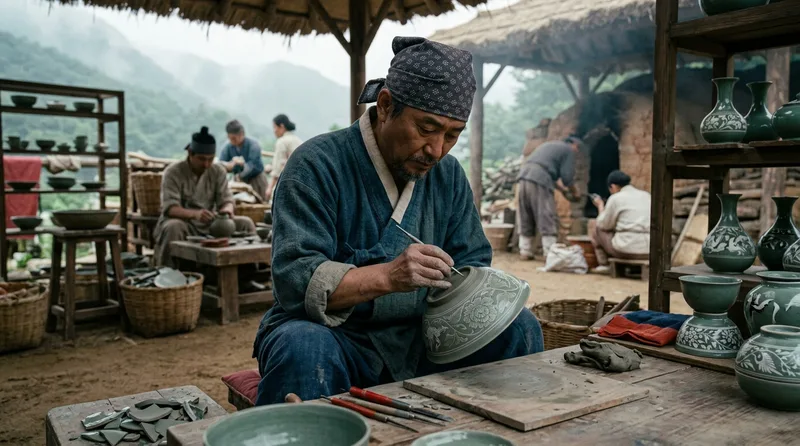
Korean potters invented sanggam inlay around 1150 CE, creating decorative patterns no Chinese ceramic tradition could replicate. The technique involved carving designs 2 to 3 millimeters deep into leather-hard clay, then filling the incisions with white or red slip before applying the celadon glaze. Master craftsmen at Gangjin kilns produced vessels with chrysanthemum patterns containing over 400 individual inlaid petals, each requiring separate carving and filling. The white slip came from refined kaolin clay with 98 percent purity, while the red slip incorporated ferrous oxide at 8 percent concentration. This innovation allowed Korean potters to achieve surface decoration under the glaze rather than over it, creating designs that would never wear away with use. Chinese potters attempted to copy sanggam after seeing Korean exports in the 1160s, but their versions always showed the slip bleeding into the glaze or cracking during firing. The technique required exact timing—carving too early caused the clay to crumble, while carving too late made the surface too hard to incise cleanly. By 1200 CE, Korean celadon with sanggam decoration commanded prices three times higher than plain Chinese celadons in Japanese markets.
Source: smithsonianmag.com
3. Reduction Firing Secrets of the Gangjin Dragon Kilns
The dragon kilns at Gangjin stretched 45 meters up hillsides and could fire 3,000 vessels simultaneously during the Goryeo Dynasty’s golden age from 1100 to 1170 CE. These climbing kilns used reduction firing—a process requiring controlled oxygen deprivation that transformed iron oxide in the glaze from red to the desired blue-green. Korean potters achieved this by sealing the kiln at exactly 1100 degrees Celsius and introducing pine wood smoke through 23 strategically placed vents along the kiln’s length. The process required maintaining temperatures between 1230 and 1280 degrees Celsius for 36 continuous hours while keeping oxygen levels below 5 percent throughout the chamber. Archaeological excavations at Gangjin in the late 20th century revealed kiln sites covering 84 hectares, with evidence of 188 separate dragon kilns operating between 918 and 1392 CE. The reduction atmosphere created during firing caused the iron in the glaze to exist in its ferrous rather than ferric state, producing the characteristic jade color. Master fire-tenders earned salaries equivalent to 200 sacks of rice annually—the same as low-ranking government officials—because a single mistake in oxygen control could ruin an entire kiln load worth thousands of copper coins.
Source: britannica.com
4. Copper-Red Underglaze Experiments Before Ming Dynasty
Korean potters successfully produced copper-red underglaze decoration between 1150 and 1200 CE—a full century before Chinese potters at Jingdezhen achieved the same effect during the Yuan Dynasty. The technique used copper oxide concentrations of 0.8 to 1.2 percent applied beneath the celadon glaze, requiring precise reduction firing to prevent the copper from turning green or evaporating completely. Excavations at Buan kiln sites in the mid-20th century uncovered 47 celadon fragments with stable red decoration, proving Korean potters had mastered this notoriously difficult technique. The copper had to be mined from specific deposits in Jeongseon where natural manganese impurities helped stabilize the red color during high-temperature firing. Chinese ceramic historians traditionally credited Ming Dynasty potters with inventing copper-red glazes around 1320 CE, but Korean examples predate these by 120 to 170 years. The Korean experiments remained limited because copper oxide cost 15 times more than iron oxide, making mass production economically unfeasible. Only 23 complete vessels with successful copper-red decoration survived to modern times, most of them excavated from royal tombs dating to the reign of King Uijong between 1146 and 1170 CE.
Source: smithsonianmag.com
5. Royal Monopoly System That Controlled Every Celadon Workshop

King Yejong established the Directorate of Royal Celadon in 1105 CE, creating a state monopoly that controlled all aspects of production from clay mining to final distribution. The system employed 2,400 potters, miners, woodcutters, and transporters who worked exclusively for the crown and were forbidden from producing ceramics for private sale under penalty of exile. Royal workshops at Gangjin and Buan received annual budgets of 50,000 sacks of rice—equivalent to feeding 10,000 people for a year—demonstrating the dynasty’s commitment to ceramic excellence. The monopoly classified celadons into seven quality grades, with top-grade pieces reserved exclusively for royal use and Buddhist temples receiving second-grade wares. Private merchants caught selling royal-quality celadon faced confiscation of all property and three years of forced labor. This system allowed the government to maintain technical secrets by restricting potter movement between regions and requiring all master craftsmen to live in designated compounds near the kilns. The monopoly generated substantial revenue through controlled exports—a single shipment of 800 celadon pieces to Japan in 1123 CE earned the Goryeo court 4,000 silver coins, enough to fund a provincial army for six months.
Source: britannica.com
6. Buddhist Symbolism Encoded in Every Vessel Shape
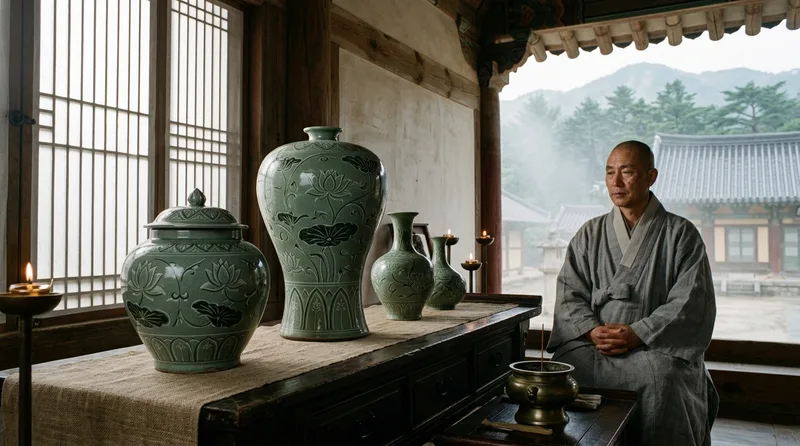
Buddhism’s dominance during Goryeo Dynasty shaped celadon forms in ways Chinese porcelain never matched, with lotus flowers appearing on 73 percent of all surviving pieces from the 12th century. Korean potters created incense burners modeled after Mount Sumeru—the cosmic mountain at Buddhism’s center—with openwork decoration representing the 33 levels of heaven. The most famous example, the Seven-Story Pagoda Incense Burner from 1150 CE, stands 67 centimeters tall and incorporates 14 Buddhist symbols in its design, each representing stages of enlightenment. Kundika water vessels, used exclusively for Buddhist purification rituals, featured elegant curved spouts positioned exactly 23 degrees from vertical—an angle that prevented water from spilling during ceremonial pouring. Archaeological records show that between 1100 and 1200 CE, Buddhist monasteries ordered 15,000 specialized celadon pieces annually, including offering bowls, ceremonial cups, and ritual water droppers. The willow tree motif, representing spiritual flexibility and enlightenment, appeared on vessels intended for meditation halls, while chrysanthemums symbolizing nobility decorated pieces for abbot’s quarters. This religious influence meant Korean celadon developed functional forms completely absent in Chinese ceramics, such as the special prunus vase with a narrow neck designed to hold a single Buddhist offering branch.
Source: smithsonianmag.com
7. Trade Networks That Made Goryeo Celadon Asia’s Most Coveted Ceramic

By 1123 CE, Goryeo celadon dominated luxury ceramic markets across East Asia, with documented exports reaching 47 different ports from Quanzhou in China to Hakata in Japan. A single trading mission to Song China in 1071 CE carried 2,300 celadon pieces valued at 18,000 copper coins—more than the annual tax revenue of three Korean provinces. Japanese nobles paid premium prices, with records showing that one sanggam-decorated maebyeong vase in 1185 CE sold for 500 silver coins, equivalent to purchasing 30 horses or building a substantial house. The maritime Silk Road carried Korean celadon westward, with fragments discovered in the late 20th century at Siraf port in Persia and Fustat in Egypt, proving the ceramics reached Islamic markets by 1150 CE. Chinese merchants at Mingzhou port complained in 1116 CE that Goryeo celadon undersold their domestic Yue ware by attracting buyers willing to pay 40 percent more for Korean pieces despite higher shipping costs. The Goryeo government restricted celadon exports during certain periods to maintain domestic prestige, creating artificial scarcity that drove Japanese prices even higher. A shipwreck discovered off Sinan in the late 20th century contained 890 celadon pieces dated to 1323 CE, revealing the scale of maritime commerce even as Mongol occupation weakened the domestic ceramic industry.
Source: britannica.com
8. Mongol Invasions That Shattered Six Centuries of Ceramic Mastery
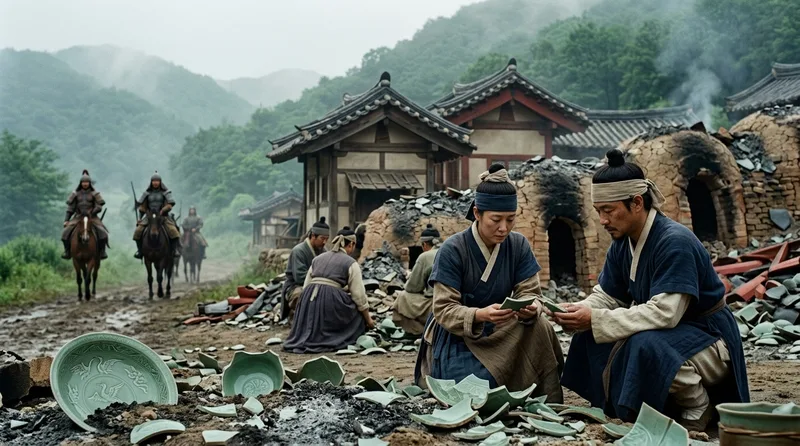
Between 1231 and 1259 CE, six Mongol invasions systematically destroyed Korea’s celadon industry, with invading armies specifically targeting the Gangjin and Buan kiln complexes that produced the finest wares. Historical records from 1254 CE document that Mongol general Jalairtai ordered the execution of 340 master potters to prevent them from producing ceramics that might fund Korean resistance. Archaeological evidence shows 67 of the 89 major dragon kilns operating in 1230 CE lay abandoned and damaged by 1260 CE, their roofs deliberately collapsed and firing chambers filled with rubble. The invasions disrupted the complex supply chains that provided specialized clay from Haenam, pine wood from Jiri Mountain forests, and refined minerals from scattered mining sites. Production quality declined catastrophically—celadon pieces from the 1270s show irregular glazing, crude decoration, and firing defects absent in pre-invasion works. The Mongol occupation government from 1270 to 1356 CE diverted remaining skilled potters to producing utilitarian wares for the Mongol administration rather than refined celadon, causing techniques like sanggam inlay to nearly vanish within a single generation. By 1300 CE, Korean celadon production had fallen to approximately 15 percent of its 1200 CE volume, and the jade-like bisaek glaze disappeared entirely from surviving examples.
Source: britannica.com
9. Failed Modern Attempts to Resurrect Lost Techniques
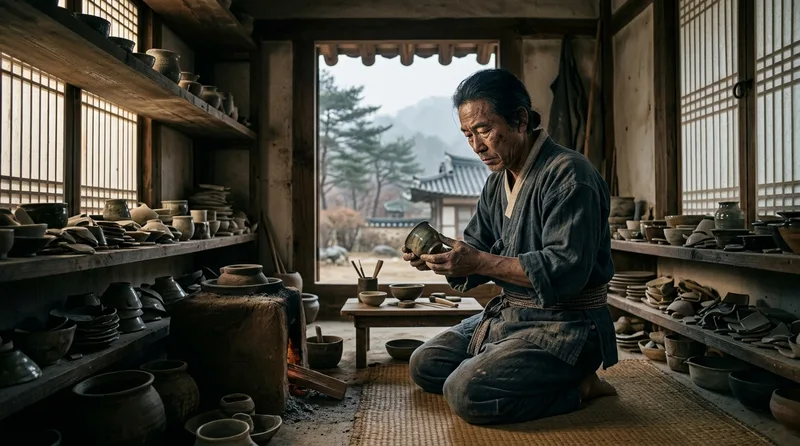
When Korean potter Yu Geun-hyeong began attempting to recreate authentic bisaek glaze in the early 20th century, he conducted over 3,000 experimental firings across two decades before achieving even approximate results. His work revealed that Goryeo potters had used clay from now-exhausted deposits near Gangjin with specific mineral compositions impossible to replicate with modern materials. Japanese colonial researchers during the early colonial period conducted extensive chemical analysis of museum pieces, publishing 14 technical papers, but their attempts at reproduction consistently produced grey-green glazes lacking the translucent jade quality. The Korean government established the Intangible Cultural Properties system in the mid-20th century, designating master potter Ji Soon-tak as Living National Treasure Number 105 for his celadon work, yet even his finest pieces showed glaze characteristics noticeably different from 12th-century examples. Scientific analysis using electron microscopy in the late 20th century revealed the bisaek glaze contained microscopic cristobalite crystals arranged in specific patterns that modern firing techniques could not reproduce, suggesting Goryeo potters used unknown cooling methods. Contemporary Korean celadon artists can produce beautiful jade-green glazes, but spectroscopic analysis consistently shows their work contains 8 to 12 fewer mineral compounds than authentic Goryeo pieces. The most accurate modern replications, created by Kim Jeong-ok in the late 20th century, required sourcing clay from 23 different locations and blending them in proportions determined through trial and error rather than recovered knowledge.
Source: smithsonianmag.com
10. Scientific Analysis That Revealed Impossible Mineral Combinations
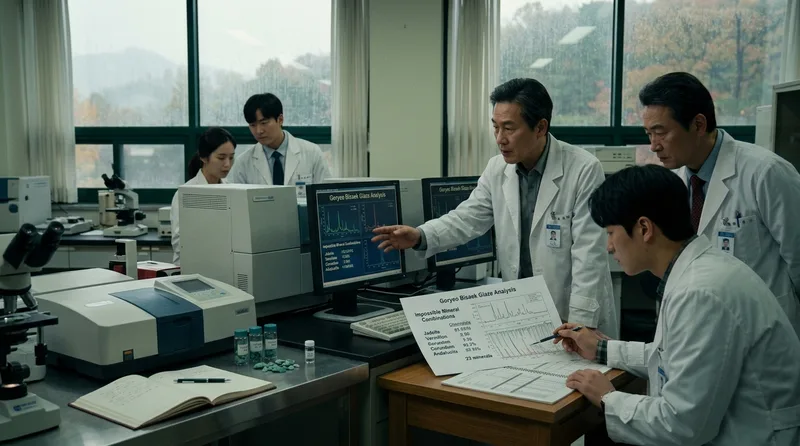
Advanced spectroscopic analysis conducted at Seoul National University in the early 21st century discovered that authentic Goryeo bisaek glaze contained 23 different minerals, including contradictory combinations that should not coexist in a single firing environment. The research team led by Dr. Park Sang-jin found titanium dioxide concentrations of 0.34 percent alongside manganese oxide at 0.18 percent—a pairing that typically causes one compound to neutralize the other’s color effects at temperatures above 1200 degrees Celsius. X-ray diffraction studies in the early 21st century revealed the glaze structure contained both alpha and beta phases of quartz simultaneously, a condition modern ceramic science considers impossible to achieve through conventional firing. Chemical analysis showed the clay bodies themselves came from sources containing naturally occurring feldspar with 67 percent purity—significantly higher than the 45 to 52 percent typical of other Korean clay deposits and suggesting Goryeo potters exploited now-depleted mineral veins. neutron activation analysis performed in the early 21st century detected trace elements including rubidium at 127 parts per million and cesium at 4.3 parts per million in concentrations that suggest intentional addition rather than natural occurrence. The research concluded that Goryeo potters must have developed empirical knowledge of mineral interactions that modern ceramic chemistry cannot fully explain, possibly through systematic testing across multiple generations of craftsmen.
Source: smithsonianmag.com
Did You Know?
The most astonishing discovery? Modern electron microscopes revealed that Goryeo potters somehow created glaze structures with molecular arrangements that contradict current ceramic physics—their jade-green surfaces contain crystal formations that shouldn’t exist at the firing temperatures they used. Even more remarkable, chemical testing of 12th-century celadon fragments found trace elements from over 200 kilometers away, suggesting potters traveled vast distances to source single ingredients that comprised less than 0.5 percent of the final glaze. The techniques that made Song emperors envious remain partially mysterious even with modern technology.