
While the Tang Dynasty is celebrated for poetry and art, its true legacy lies in revolutionary systems still embedded in Chinese society. From civil service exams that democratized power to currency reforms that unified commerce, Tang innovations created institutional DNA that outlasted the empire by thirteen centuries.
1. The Imperial Examination System Broke Aristocratic Monopoly on Power
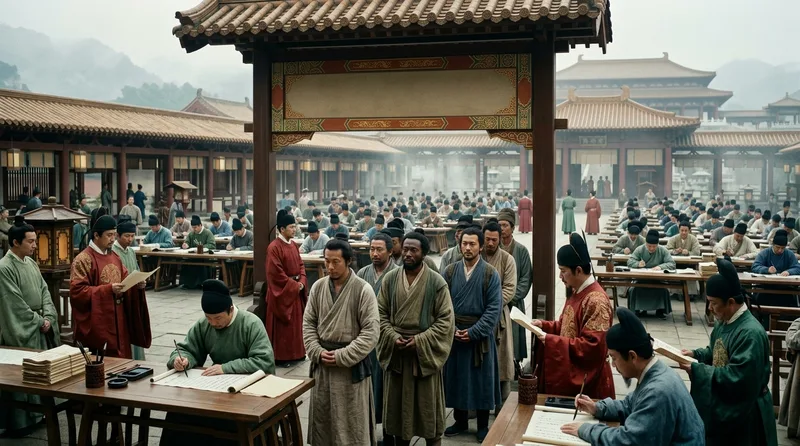
When Emperor Taizong expanded the keju examination system in 628 CE, he triggered a social revolution that would last until the early twentieth century. Unlike hereditary aristocracies elsewhere, Tang China allowed any male subject to sit for rigorous literary and philosophical tests, potentially elevating peasant scholars to positions of imperial authority. By 650 CE, approximately 30 examinees passed the highest jinshi degree annually, creating a new class of merit-based officials. The exams tested mastery of Confucian classics, poetry composition, and policy analysis across three grueling days of testing. Tang officials sourced from these exams proved more loyal than aristocratic appointees, lacking independent power bases. This system produced some of China’s greatest administrators, including the reformer Liu Yan who revolutionized tax collection in 780 CE. The examination pathway fundamentally altered Chinese social mobility, establishing education rather than birth as the primary route to prestige. Modern China’s gaokao university entrance examination, taken by 12 million students annually, directly descends from this Tang innovation, preserving the cultural belief that intellectual merit should determine social advancement.
Source: britannica.com
2. Kaiyuan Copper Coins Created China’s First Truly Unified Currency
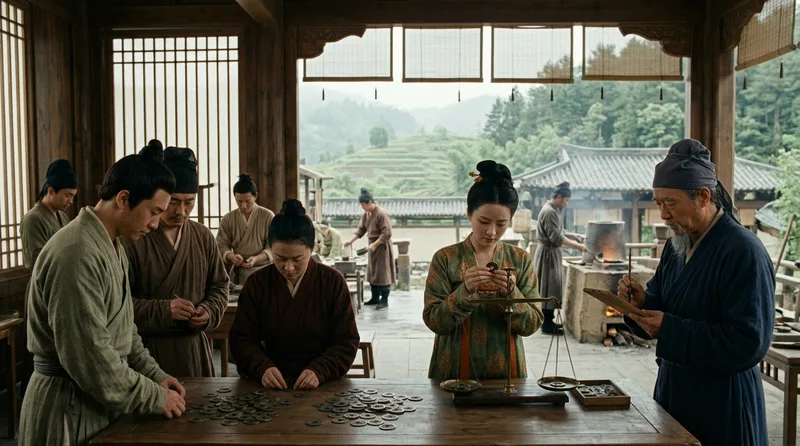
The kaiyuan tongbao coin introduced in 621 CE by Emperor Gaozu revolutionized Chinese commerce by establishing the first standardized currency in nearly four centuries. Each coin weighed exactly 4 grams and featured four characters reading “Kaiyuan Tongbao” (Inaugural Currency of the Circulating Treasure), setting a design template that endured for 1,300 years. Before this reform, China suffered from chaotic local currencies, barter systems, and fragmented markets that strangled interregional trade. Tang mints produced approximately 327 billion coins during the dynasty’s 289-year reign, flooding markets with reliable currency. The standardization extended beyond weight to copper content ratios, preventing the debasement that plagued earlier dynasties. Merchants could finally price goods consistently from Chang’an to Canton, while tax collection became predictable rather than dependent on grain or silk valuations. Emperor Xuanzong further refined the system in 737 CE by establishing strict mint supervision and counterfeit penalties. The coin’s square central hole allowed stringing 1,000 coins together as a standard accounting unit called a guan, simplifying large transactions. This monetary stability directly enabled the Silk Road trade boom, as foreign merchants trusted Tang currency more than their own.
Source: britannica.com
3. The Equal-Field System Redistributed 140 Million Acres to Peasants
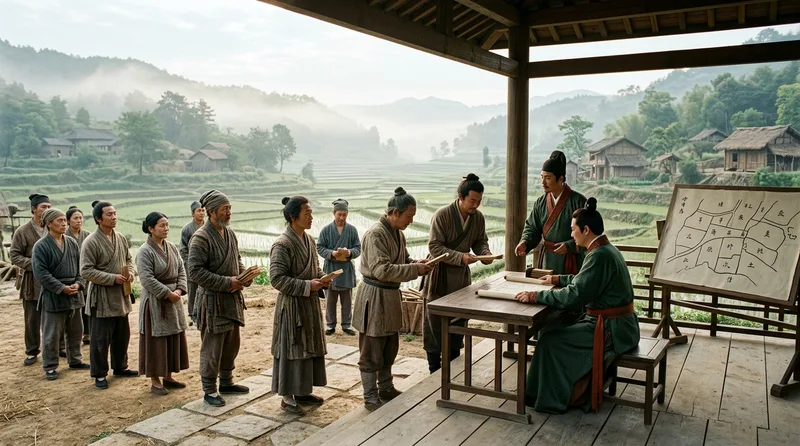
Implemented comprehensively by 624 CE, the juntianzhi land system attempted the most ambitious agrarian reform in ancient history by redistributing approximately 140 million acres to farming families. Each adult male received 100 mu (roughly 16 acres) of land, while women and elderly received proportionally smaller plots based on cultivation capacity. The system ingeniously divided allocations between “personal share land” for grain crops and “mulberry land” for silk production, ensuring both food security and export commodities. Tang administrators conducted land surveys across 358 prefectures, creating detailed registers that tracked soil quality, irrigation access, and household composition. When a male landholder died, 80 percent of his allocation returned to the state for redistribution, preventing accumulation of vast estates. This circulation mechanism supported approximately 50 million people during the dynasty’s peak under Emperor Xuanzong around 730 CE. The system collapsed after the An Lushan Rebellion of 755 CE fragmented central control, but established precedents for state-managed land redistribution. Modern China’s rural land reforms in the mid-twentieth century consciously echoed Tang principles, redistributing land to 300 million peasants using similar household-based allocation formulas.
Source: britannica.com
4. Grand Canal Expansion Connected 1,100 Miles of Economic Arteries
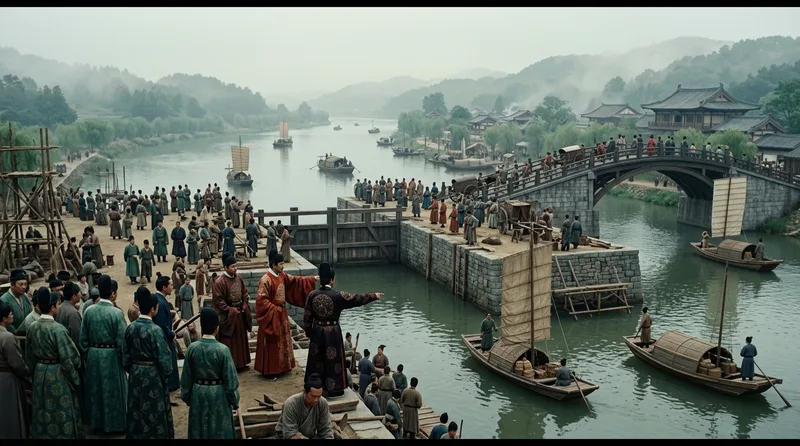
When Emperor Taizong ordered comprehensive Grand Canal improvements in 639 CE, engineers expanded China’s artificial waterway to 1,100 miles, linking the Yangtze River basin with the Yellow River and ultimately Beijing. The canal system transported 2 million shi (approximately 400,000 tons) of grain annually from southern rice paddies to northern cities and military garrisons by 735 CE. Tang hydraulic engineers constructed 24 major lock systems to manage elevation changes totaling 138 feet, pioneering pound lock technology that Europe wouldn’t adopt for another 600 years. The canal required constant maintenance from 180,000 laborers organized into rotating work brigades supervised by provincial water commissioners. Cargo barges called shachuan measured up to 67 feet long and carried 500 shi each, traveling the Chang’an to Yangzhou route in approximately 45 days under favorable conditions. This infrastructure created an integrated national economy, allowing southern tax revenues to support northern frontier defenses against Turkic incursions. Canal cities like Luoyang and Yangzhou exploded to populations exceeding 500,000, becoming cosmopolitan trading hubs. The waterway remains operational today as the Beijing-Hangzhou Grand Canal, making it the world’s oldest functioning artificial river and validating Tang engineering across 14 centuries.
Source: britannica.com
5. Woodblock Printing Turned Buddhist Sutras Into Mass-Produced Texts
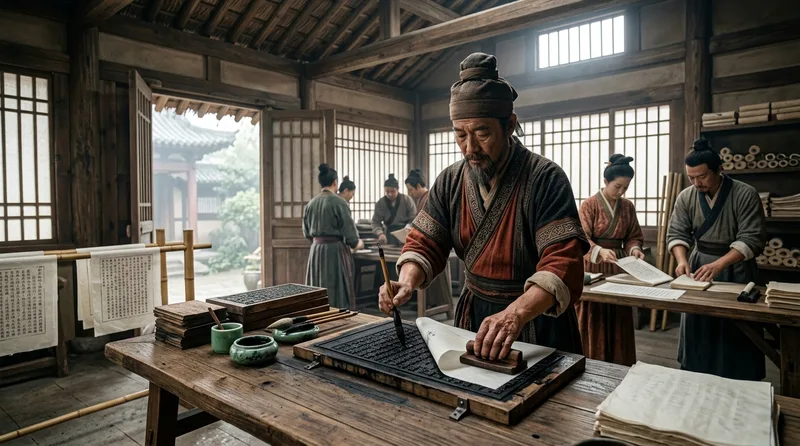
The Diamond Sutra, printed in 868 CE, represents the world’s oldest surviving dated printed book, but Tang woodblock printing had already been revolutionizing text reproduction for over a century before that landmark. By 650 CE, Buddhist monasteries in Chang’an employed specialized woodblock carvers who could reproduce entire sutras at one-tenth the cost and time of hand copying. A skilled carver required approximately 15 days to complete one printing block containing 300 characters, but that block could then produce 2,000 impressions before wearing out. The Dunhuang cave libraries contained over 40,000 printed documents from the Tang period, revealing an industrial-scale printing operation serving millions of believers. Unlike movable type which came later, woodblock printing excelled at reproducing complex Chinese characters with their thousands of unique forms. The government adopted the technology by 835 CE for printing calendars, which held religious and agricultural importance for peasant farmers planning planting cycles. This democratization of texts fundamentally challenged elite monopolies on knowledge. When Feng Dao established the first state printing office in the tenth century shortly after the Tang collapse, he built upon infrastructure Tang printers had already perfected, enabling the later explosion of printed Confucian classics.
Source: britannica.com
6. The Protectorate System Governed 2.5 Million Square Miles of Frontier

Tang China pioneered indirect imperial governance through six major protectorates established between 640 and 702 CE, administering approximately 2.5 million square miles of Central Asian territories without full annexation. The Protectorate General to Pacify the West, headquartered in Kucha from 640 CE, controlled the Tarim Basin and supervised 16 garrison towns with 50,000 troops managing Silk Road security. Rather than imposing direct Chinese administration, protectorates allowed local rulers to maintain power while accepting Tang suzerainty, paying tribute, and providing military contingents. This system proved remarkably cost-effective, requiring only 3,000 Tang administrative personnel to manage territories that would have demanded 200,000 soldiers under direct occupation. The Protectorate General to Pacify the North, established in 663 CE, governed Turkic peoples through their own khans who received Chinese titles and annual silk payments worth 200,000 bolts. Emperor Xuanzong maintained 14 military governors called jiedushi by 750 CE to supervise these frontier zones, though their eventual autonomy triggered the An Lushan catastrophe. Despite this failure, the protectorate concept influenced later Chinese frontier policy for centuries. Modern China’s autonomous region system governing Tibet, Xinjiang, and Inner Mongolia consciously echoes Tang protectorate principles of indirect control with central oversight.
Source: britannica.com
7. Census Registers Tracked 53 Million Citizens With Unprecedented Precision
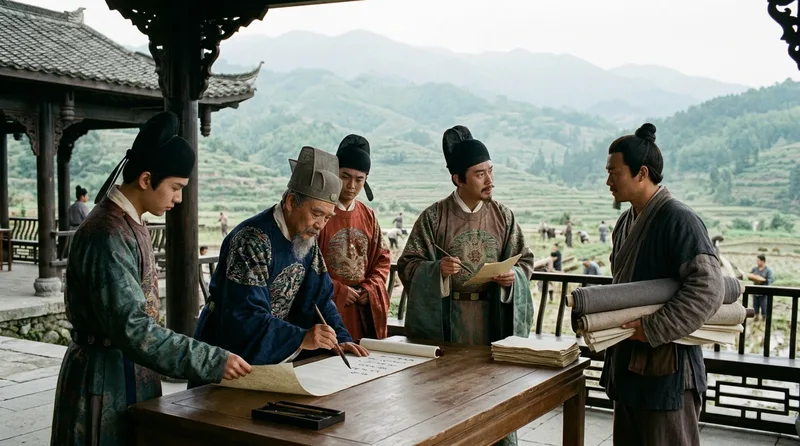
The Tang household registration system called hukou, formalized in 624 CE, created population records of staggering detail that modern historians still mine for demographic data. The census of 754 CE recorded exactly 52,880,488 individuals across 8,914,709 households, listing names, ages, occupations, and tax obligations with standardized forms replicated across 358 prefectures. Each household received a registration certificate that determined legal residence, military service requirements, corvée labor days owed annually, and grain tax assessments based on family size. Provincial registrars updated records every three years through door-to-door surveys conducted by subprefecture clerks supervised by central ministry inspectors. The system tracked population movements, requiring travel permits for journeys exceeding 100 li (approximately 30 miles) from registered residences. Tax avoidance through false registration became so sophisticated that Emperor Xuanzong ordered comprehensive re-registration in 726 CE, uncovering 800,000 previously unrecorded individuals. The hukou system enabled precise military conscription, with each registered male serving two years between ages 21 and 59. This bureaucratic infrastructure allowed Tang administrators to mobilize resources with unprecedented efficiency. Modern China’s hukou system, established in the mid-twentieth century, directly descends from Tang precedents, using similar registration mechanisms to control internal migration and resource allocation.
Source: britannica.com
8. State Granaries Stockpiled 45 Million Bushels Against Famine Cycles
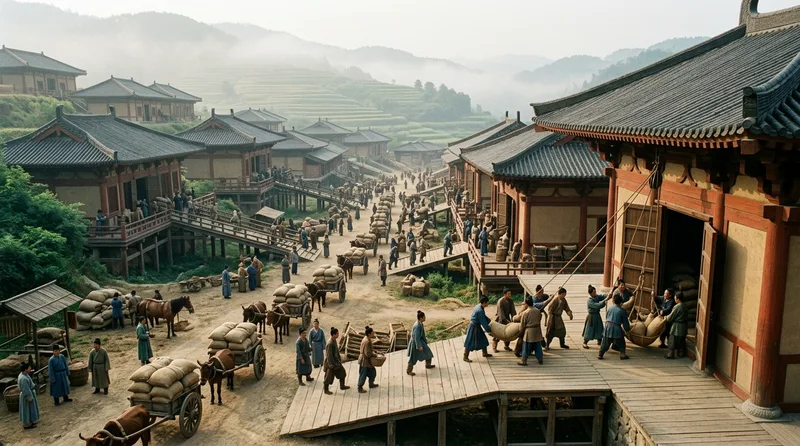
The ever-normal granary system expanded dramatically under Emperor Taizong in 627 CE, establishing approximately 2,500 state-managed grain warehouses that stockpiled 45 million bushels by 735 CE across the empire. These granaries operated on dual principles: the changping granaries purchased grain during harvest abundance to stabilize prices, while yicang charitable granaries distributed emergency rations during droughts and floods. Tang regulations required each prefecture to maintain grain reserves sufficient to feed its population for six months, with inspectors conducting quarterly inventory audits. The government purchased grain at fixed prices during autumn harvests, storing it in massive warehouses built with sophisticated ventilation systems that prevented spoilage for up to three years. During the devastating drought of 743 CE in Henan province, state granaries distributed 8 million bushels to 2 million affected peasants, preventing mass starvation. The system also strategically positioned granaries along the Grand Canal and frontier military zones, ensuring armies received supplies regardless of harvest conditions. Provincial governors who failed to maintain adequate reserves faced dismissal, making granary management a career-defining responsibility. This infrastructure transformed periodic famines from existential catastrophes into manageable crises. Modern China’s strategic grain reserve system, maintaining 150-200 million tons, applies Tang principles of price stabilization and emergency distribution on an unprecedented industrial scale.
Source: britannica.com
9. Postal Relay Stations Transmitted Messages 1,600 Miles in Eight Days
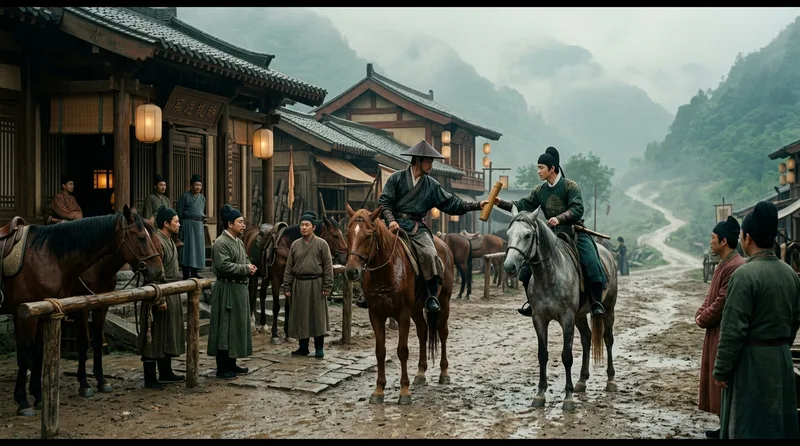
The yizhan postal system reached its zenith under Emperor Xuanzong around 740 CE, operating 1,639 relay stations spaced every 30 li (roughly 9 miles) along major routes, enabling imperial communications to traverse the empire with remarkable speed. Urgent military dispatches traveled from the western frontier at Kashgar to Chang’an, approximately 1,600 miles, in just eight days using dedicated relay riders who changed horses at each station. Each station maintained between 5 and 80 horses depending on route importance, with major stations also providing accommodations for traveling officials and warehousing facilities for tribute goods. The system employed approximately 20,000 personnel including postal clerks, stable hands, and armed guards protecting valuable shipments. Messages carried official seals indicating priority levels, with the highest emergency classification requiring riders to maintain speeds of 180 li per day regardless of weather. The postal infrastructure doubled as an intelligence network, with station masters reporting suspicious travelers, troop movements, and local conditions to provincial authorities. During the An Lushan Rebellion in 755 CE, rebel forces specifically targeted postal stations to disrupt Tang communications, recognizing their strategic importance. The system’s efficiency impressed Arab travelers like Ibn Wahab who documented in the ninth century that Chinese postal communications surpassed anything in the Abbasid Caliphate.
Source: britannica.com
10. Astronomical Clocks Measured Time to One-Tenth of Modern Seconds
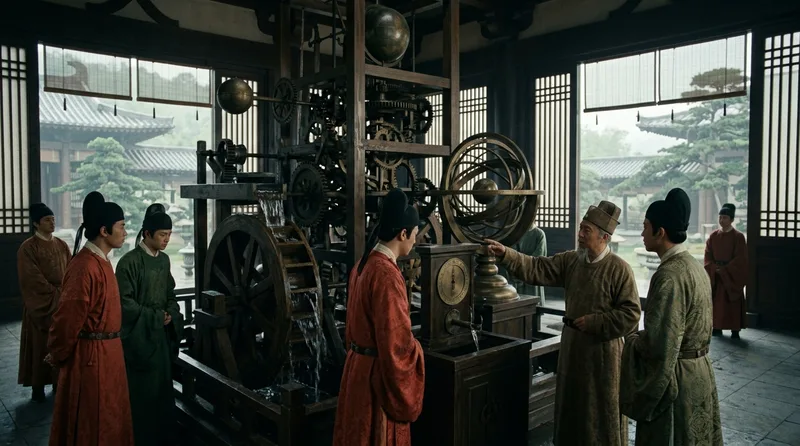
The water-powered astronomical clock tower designed by Buddhist monk Yi Xing and government engineer Liang Lingzan in 725 CE represented the most sophisticated timekeeping device in the world for five centuries. This mechanical marvel stood over 30 feet tall and featured an armillary sphere that automatically tracked celestial positions with accuracy within 1/100th of a ke (approximately 0.14 seconds in modern measurement). The clock’s escapement mechanism, which regulated water flow through a complex series of scoops and counterweights, anticipated European mechanical clock escapements by 600 years. Yi Xing’s astronomical observations, conducted between 721 and 727 CE using this instrument, calculated the solar year length as 365.2444 days, missing the actual value by less than one minute. The clock powered multiple display mechanisms including bronze figures that struck bells and drums to announce each ke (14.4 minute intervals), creating a public timekeeping system audible throughout Chang’an. Emperor Xuanzong was so impressed that he commissioned 12 additional clocks for provincial capitals, though most were destroyed during the An Lushan chaos. The technological sophistication required precision metalworking, advanced hydraulic engineering, and astronomical mathematics that wouldn’t converge again until Song Dynasty innovations 300 years later. Modern Chinese timekeeping standards, including the traditional 12 double-hour system still used in astrology, derive directly from Tang astronomical calculations.
Source: britannica.com
Did You Know?
Did You Know? The Tang Dynasty’s kaiyuan copper coin remained the design standard for Chinese currency for 1,300 years, yet the empire that created it lasted only 289 years. Even more surprising, the civil service examination system Tang emperors perfected to control their bureaucracy eventually empowered scholar-officials who limited imperial authority for the next millennium. These innovations succeeded precisely because they transcended their creators’ intentions, proving more adaptable than the dynasty itself.