
When Mongol armies appeared outside city walls, defenders knew terror was coming. The Mongols brought an arsenal assembled from Chinese engineers, Persian bombardiers, and Central Asian innovators—history’s most effective military technology transfer.
1. Counterweight Trebuchets: The Muslim Engineers’ Huihui Pao
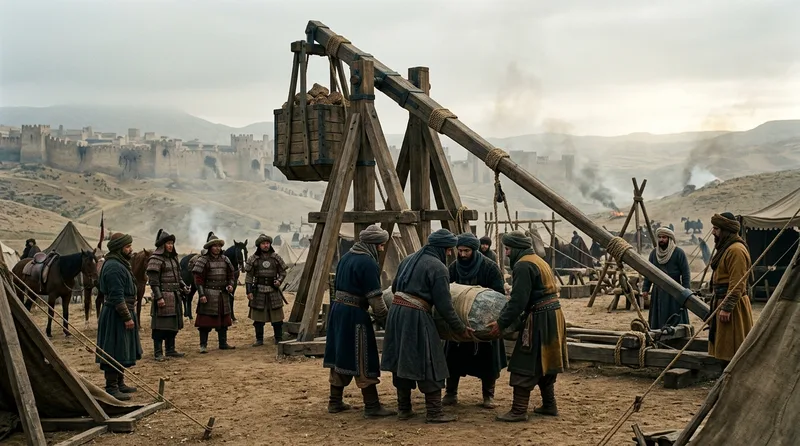
The huihui pao demolished the walls of Baghdad in 1258, hurling 150-pound stones over 300 yards with terrifying accuracy. Genghis Khan’s grandson Hulagu Khan brought Muslim engineers from Mosul specifically to construct these counterweight trebuchets, which used a massive weight box instead of human pullers. At the siege of Xiangyang in 1273, two huihui pao built by the Persian engineers Ismail and Ala al-Din al-Kashgani broke through walls that had resisted Chinese traction trebuchets for five years. These machines stood over 40 feet tall and required teams of 200 men to assemble, yet could be disassembled and transported across the Eurasian steppe. The counterweight mechanism—a wooden box filled with stones or earth weighing up to 20,000 pounds—provided consistent power that human-operated machines couldn’t match. This represented a critical technology transfer from the Islamic world to East Asia, forever changing the nature of siege warfare. The psychological impact proved as devastating as the physical damage: cities that witnessed these weapons battering their neighbors often surrendered without resistance rather than face the huihui pao themselves.
Source: britannica.com
2. Traction Trebuchets: Coordinated Teams Launching Death
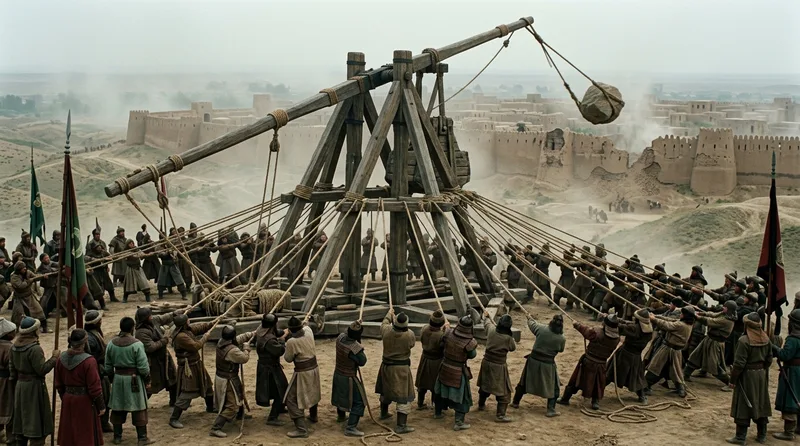
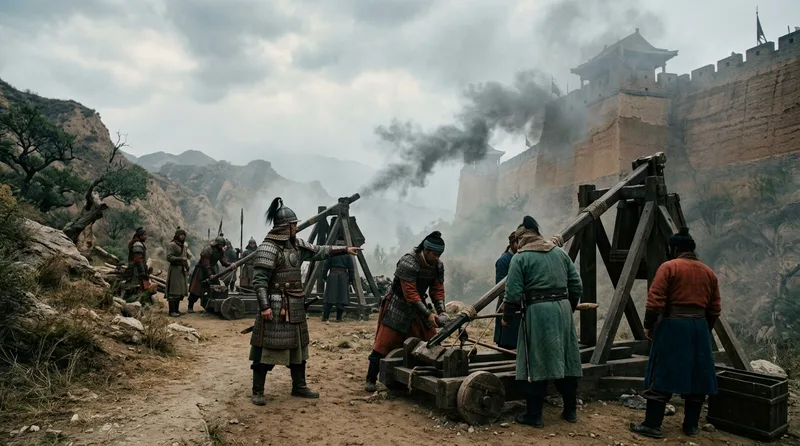
Before adopting counterweight designs, Mongol armies devastated Central Asian cities with Chinese-style traction trebuchets operated by precisely coordinated teams of 250 pullers. At the siege of Merv in 1221, Tolui Khan deployed over 300 of these machines, creating a thunderous barrage that shattered the city’s defenses in just four days. Each machine featured a massive wooden beam mounted on a pivot, with ropes attached to the short end and a sling holding projectiles on the long end. When the team pulled simultaneously on command, the beam whipped forward, hurling stones weighing 60 to 90 pounds at speeds exceeding 100 miles per hour. Mongol innovations included rapid-fire capability—trained teams could launch six projectiles per minute compared to the two per minute achieved by European or Middle Eastern crews. The Mongols also perfected the use of incendiary projectiles, wrapping stones in cloth soaked in naphtha before launching them into wooden structures. This weapon system’s true genius lay in its scalability and the Mongols’ logistical mastery: they could construct hundreds of machines from local timber within days of arriving at a siege site, transforming the landscape around a doomed city into a forest of mechanical death.
Source: britannica.com
3. Wheeled Siege Towers: Mobile Fortresses of the Steppe
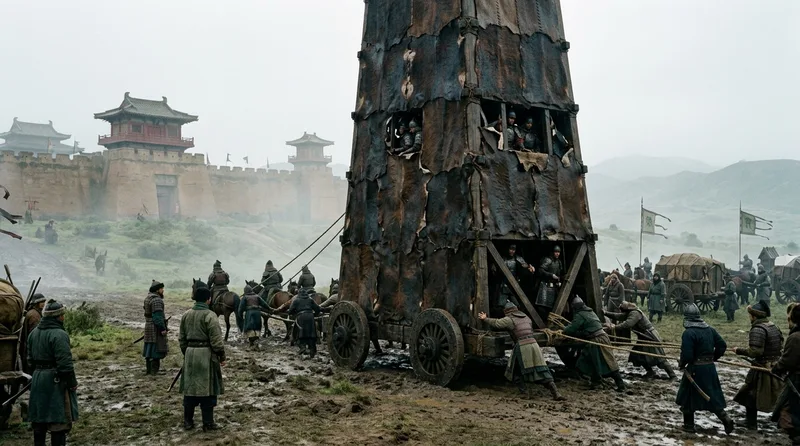
Mongol siege towers rolled toward city walls at the siege of Kaifeng in 1232, carrying 200 armored warriors and standing seven stories tall with fireproof cowhide covering. These mobile fortresses represented a synthesis of Chinese engineering and Mongol tactical innovation, featuring wheels reinforced with iron bands capable of traversing rough terrain. Each tower contained multiple firing platforms where archers and crossbowmen could shoot down into defending forces while protected by thick wooden walls covered in wet animal hides to resist fire arrows. The top level included a drawbridge that could be dropped onto city walls, allowing assault troops to pour directly onto the ramparts. At Zhongdu (modern Beijing) in 1215, Genghis Khan employed 36 of these towers simultaneously, overwhelming defenders who couldn’t man all threatened sections of the wall. The towers’ construction showcased remarkable engineering: counterweights and pulleys allowed the drawbridge mechanism to function smoothly, while internal staircases accommodated rapid troop movement between levels. Mongol commanders positioned these towers at night, covering their movement with smoke screens and suppressing fire from thousands of archers. By dawn, defenders would awaken to find these mechanical nightmares already pressed against their walls, archers raining arrows from above while assault teams prepared to storm across the drawbridges.
Source: britannica.com
4. Naphtha Launchers: Projecting Liquid Fire
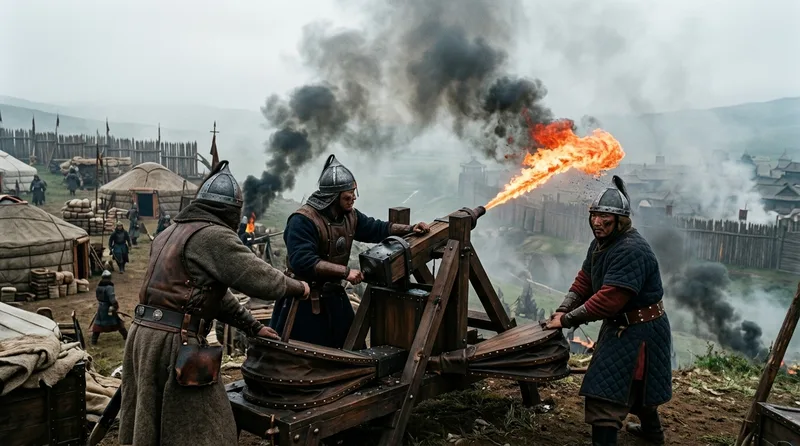
Persian fire oil projectors adopted by the Mongols in 1220 could spray burning naphtha over 50 feet, creating walls of flame that made defensive positions uninhabitable. These devices operated on principles developed in the Byzantine and Islamic worlds, using bellows or pumps to pressurize containers of refined petroleum mixed with sulfur and quicklime. At the siege of Nishapur in 1221, Mongol forces deployed 40 naphtha launchers that set the city’s wooden defenses ablaze within hours, forcing defenders to abandon entire sections of wall. The psychological terror these weapons inspired cannot be overstated—medieval soldiers had no understanding of chemistry and believed the Mongols commanded demonic fire that water couldn’t extinguish. The liquid would stick to surfaces and people, burning at temperatures exceeding 1,800 degrees Fahrenheit and continuing to burn even when submerged briefly in water. Mongol engineers improved the original Persian designs by creating portable versions mounted on carts, allowing rapid repositioning during assaults. They also developed clay grenades filled with naphtha that could be launched by trebuchet, shattering inside cities and spreading fire across multiple buildings simultaneously. This weapon system proved particularly effective against the wooden palisades common in Russian cities during the western campaigns of 1237-1242.
Source: britannica.com
5. Explosive Bombs: Gunpowder’s Terrifying Debut
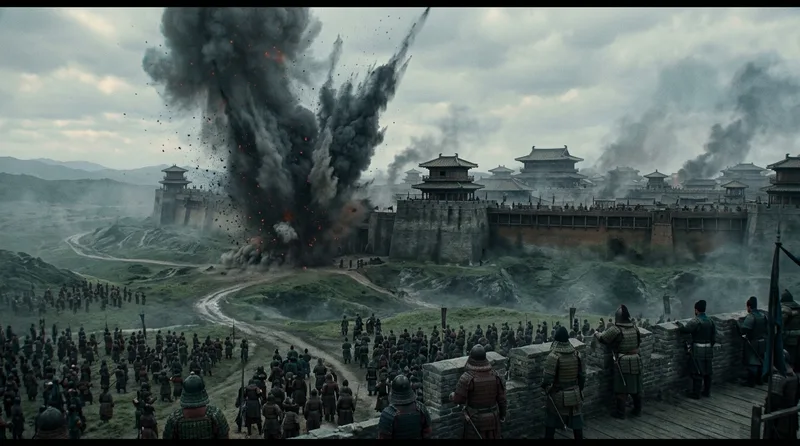
Chinese gunpowder bombs called zhentianlei (thunder crash bombs) exploded at the siege of Kaifeng in 1232 with such force that defenders reported hearing the blasts from 50 miles away. These iron-cased grenades, weighing between 10 and 20 pounds, contained a mixture of gunpowder, iron fragments, and porcelain shards designed to maximize casualties through both blast and shrapnel. The Mongols captured this technology from Jin Dynasty engineers and rapidly integrated it into their siege warfare doctrine, manufacturing thousands of bombs for major campaigns. At the siege of Xiangyang, Mongol forces launched approximately 3,000 explosive projectiles into the city over a six-year period, creating constant psychological pressure that prevented defenders from sleeping or relaxing their guard. The bombs’ fuses consisted of slow-burning treated paper tubes that allowed for timed detonation, though accuracy remained unpredictable. Mongol bombardiers developed specialized techniques for adjusting fuse length based on distance and trajectory, turning bomb deployment into a lethal science. The sound alone traumatized medieval populations who had never experienced explosions—contemporary Chinese sources describe defenders losing their minds from the constant bombardment, unable to distinguish the crashes of incoming projectiles from their own heartbeats. This marked humanity’s first large-scale use of explosive weapons in warfare, a grim milestone that would shape military technology for centuries.
Source: britannica.com
6. Giant Crossbows: Mechanical Snipers of Medieval Warfare
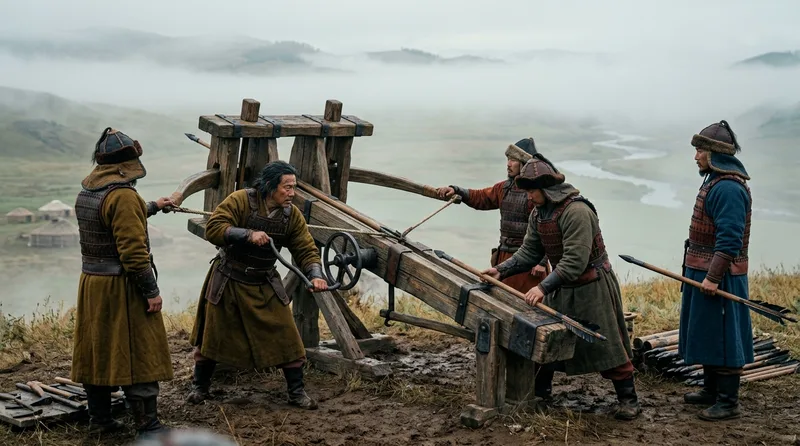
Mongol ballistas fired iron-tipped bolts three feet long that could penetrate three men standing in line or punch through wooden shields backed by leather armor at 400 yards. These oversized crossbows, mounted on pivoting stands requiring four men to operate, represented Chinese siege technology perfected over centuries before Mongol adoption. At the siege of Zhongdu in 1215, Genghis Khan deployed 200 of these weapons to suppress defender archery, with each machine capable of firing two bolts per minute with devastating accuracy. The bolts themselves weighed between five and eight pounds, with pyramidal heads designed to punch through any armor of the era. Mongol engineers developed incendiary versions wrapped in oil-soaked cloth that transformed buildings into infernos upon impact. The psychological effect proved as important as the physical damage—defenders watching these massive projectiles strike would see comrades literally nailed to walls or split apart by the impact force. The machines’ mechanical advantage came from multiple layers of laminated wood and sinew, creating draw weights exceeding 1,200 pounds that no human could pull manually. Mongol tactical doctrine placed these weapons in batteries of 20 to 30 machines firing in coordinated volleys, creating kill zones where defenders couldn’t show themselves above walls without facing instant death from three-foot bolts traveling faster than arrows.
Source: britannica.com
7. Protected Battering Rams: Fireproof Fortresses on Wheels
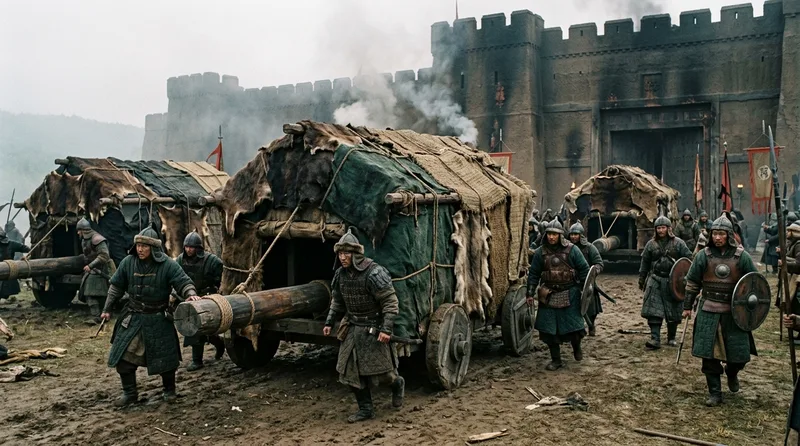
Mongol battering rams encased in fireproof housings shattered the gates of Samarkand in 1220 after defenders exhausted every incendiary weapon trying to destroy them. These massive siege engines featured bronze-capped rams weighing up to 2,000 pounds, suspended by chains inside mobile wooden sheds covered with multiple layers of wet cowhide, iron plates, and clay mixture that made them virtually immune to fire. Teams of 60 men operated each ram using synchronized pulling and pushing motions that generated tremendous kinetic force—contemporary sources describe gate hinges ripping from stone after fewer than 100 strikes. The Mongols improved upon Chinese and Persian designs by adding wheels with sophisticated suspension systems that allowed the ram to maintain momentum even over uneven ground filled with defensive obstacles. At the siege of Urgench in 1221, Mongol engineers deployed 15 rams simultaneously against different sections of wall, forcing defenders to divide their forces and eventually creating multiple breach points. The housing’s peaked roof deflected stones and projectiles while murder holes (openings for defenders to drop weapons) became useless against the overlapping armor layers. Inside, assault troops waited in relative safety, ready to pour through breached gates before defenders could organize counterattacks. This weapon’s effectiveness came not from technological sophistication but from the Mongols’ systematic approach: they would bombard gates with trebuchets to weaken them, then send in rams under covering fire from thousands of archers.
Source: britannica.com
8. Siege Tunnels: Underground Warfare Beneath Medieval Walls
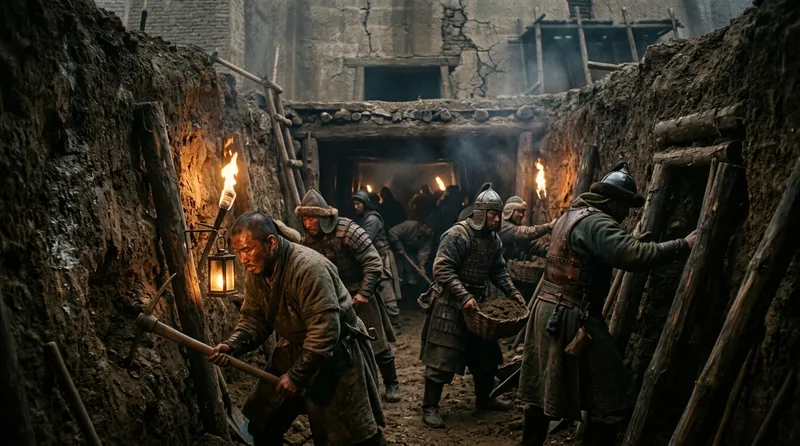
Mongol mining teams dug 200-foot tunnels beneath the walls of Gurganj in 1221, collapsing entire sections of fortification and trapping defenders in underground ambushes. These specialized engineers, recruited from Chinese and Khwarazmian populations with mining expertise, could tunnel up to 12 feet per day through soft soil using wooden support frames and specialized digging tools. The standard technique involved digging beneath foundations, shoring the tunnel with timber, then setting the supports ablaze with naphtha to collapse the mine and everything above it. At Nishapur, where the Mongols sought revenge for a slain prince, mining operations created such extensive underground networks that portions of the city simply vanished into sinkholes, swallowing defenders and buildings alike. Counter-mining—when defenders dug their own tunnels to intercept attackers—led to horrific underground combat in complete darkness where men fought with daggers and clubs in spaces too confined for swords. Mongol miners carried specialized equipment including reinforced leather helmets, small oil lamps that could detect dangerous gases by flame color, and listening devices made from stretched animal bladders that amplified sounds of enemy counter-tunneling. The psychological terror of siege mining exceeded even surface bombardment: defenders never knew when the ground beneath them might suddenly collapse, dragging entire towers and wall sections into the earth. This created constant paranoia that eroded morale more effectively than any weapon.
Source: britannica.com
9. Fire Lances and Incendiary Arrows: Prototypes of Firearms
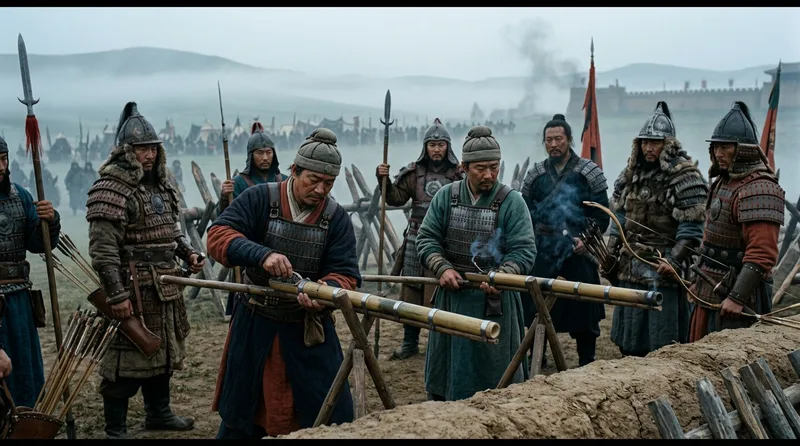
Chinese fire lances adopted by Mongol forces in 1230 shot flames and shrapnel 10 feet from bamboo tubes, representing the direct ancestor of all gunpowder weapons. These proto-firearms consisted of bamboo or bronze tubes packed with gunpowder and projectiles including small stones, iron pellets, and broken porcelain, attached to spear shafts for close combat. When ignited, the gunpowder propelled a gout of flame and debris that could blind, burn, or kill opponents at close range, while the spear shaft allowed the weapon to function conventionally after discharge. At the siege of Kaifeng, defenders and attackers both employed fire lances, creating night battles illuminated by hundreds of flame jets that contemporary chroniclers compared to dragons breathing fire. Incendiary arrows proved equally terrifying—standard arrows with small clay pots attached behind the head, filled with gunpowder, sulfur, and metal shavings that ignited on impact. Mongol archers could fire 20 incendiary arrows per minute, turning wooden structures into infernos within minutes of assault commencement. The arrows’ psychological impact exceeded their actual destructive power: defenders watching hundreds of flaming projectiles arc through the night sky often broke formation before the arrows even landed. These weapons represented the transition from purely mechanical siege warfare to chemical and explosive warfare, a technological revolution that the Mongols exploited ruthlessly across their empire spanning from Korea to Hungary.
Source: britannica.com
10. Poison Smoke Projectiles: Chemical Warfare’s Medieval Origins
Mongol poison smoke bombs deployed at the siege of Fancheng in 1273 contained arsenic compounds that killed defenders within minutes of exposure, marking history’s first large-scale chemical warfare. These clay pots, measuring 8 to 12 inches in diameter, held mixtures of gunpowder, arsenic sulfide, croton oil, and various toxic plant extracts that produced dense clouds of poisonous smoke when ignited. Chinese alchemists had developed these weapons decades earlier, but the Mongols systematized their manufacture and deployment, creating specialized bombardier units trained in handling toxic materials. The smoke was heavier than air, sinking into defensive trenches and low-lying positions where it asphyxiated or incapacitated defenders who couldn’t escape quickly enough. At Xiangyang, Mongol forces launched approximately 500 poison projectiles during the final assault, creating a toxic fog that forced defenders to abandon entire sections of wall. The Mongols also developed irritant smoke weapons using capsaicin (chili pepper extract) and mustard seed powder that caused temporary blindness and respiratory distress without killing—useful when they wanted to capture rather than destroy populations for future taxation. Contemporary Chinese medical texts describe symptoms including vomiting, convulsions, and bleeding from the nose and mouth among soldiers exposed to these weapons. The Mongols’ willingness to employ such weapons demonstrated their purely pragmatic approach to warfare: any technology that reduced their casualties while accelerating victory deserved immediate adoption regardless of moral considerations that constrained other medieval armies.
Source: britannica.com
Did You Know?
The Mongols’ siege weapons weren’t individual innovations but rather the world’s first truly international military-industrial complex—Chinese engineers, Persian bombardiers, and captured specialists from a dozen cultures collaborated under Mongol organization to create an arsenal no medieval city could withstand. Ironically, these weapons designed to conquer the world ultimately enabled the empire’s successor states to resist each other: when the Mongol Empire fragmented after 1260, former subjects used captured siege technology to defend against Mongol successor khans, turning the conquerors’ own weapons against them and preventing reunification of history’s largest contiguous land empire.