
When the Black Death arrived in 1347, it killed one in three Europeans within five years. Yet this catastrophe forced medieval societies to innovate in ways that reshaped labor laws, urban planning, and medicine for centuries.
1. Venice Invented Modern Quarantine by Trapping Ships for 40 Days

Venice established the world’s first formal quarantine system in 1348, forcing arriving ships to anchor at designated islands for 40 days before crew could disembark. The Venetian Great Council passed this revolutionary measure after plague killed nearly 60 percent of the city’s 110,000 residents within eighteen months. Officials chose the 40-day period based on biblical purification rituals and Hippocratic theories about disease incubation, creating the term ‘quarantino’ from the Italian ‘quaranta giorni’ meaning forty days. Ships anchored at Lazzaretto Vecchio island faced strict surveillance by health inspectors who monitored crew for symptoms like buboes and fever. Any vessel breaking quarantine faced confiscation of cargo and execution of the captain. This Venetian model spread throughout Mediterranean ports within two decades, fundamentally transforming maritime commerce and establishing quarantine as a permanent feature of European public health. The system proved so effective that Venice maintained continuous quarantine operations for over four centuries, adapting protocols based on plague outbreaks across trade routes. By creating standardized procedures for disease containment, Venice revolutionized how governments approached epidemic control and established the foundation for modern epidemiology.
Source: britannica.com
2. Flagellants Whipped Themselves Through 800 Cities Before the Pope Banned Them
The Brotherhood of the Flagellants emerged in German territories during autumn 1348, with members publicly scourging themselves for 33.5 days to match Christ’s earthly years. Groups of 50 to 500 men marched between towns performing ritualized whipping ceremonies twice daily, believing their suffering would appease God’s wrath and end the pestilence. Each flagellant wore a white robe marked with red crosses and wielded leather scourges embedded with iron spikes, striking their backs until blood flowed freely. The movement spread explosively across Central Europe, reaching over 800 cities and attracting perhaps 800,000 participants by early 1349. Flagellants rejected clerical authority, performed unauthorized baptisms, and claimed their blood-soaked processions held more spiritual power than sacraments administered by corrupt clergy. Their anti-clerical message threatened Church authority so severely that Pope Clement VI issued a papal bull in October 1349 declaring the movement heretical. Local bishops arrested flagellant leaders throughout 1350, with several burned at the stake for heresy in Erfurt and Sangerhausen. Though officially suppressed, flagellant ideology persisted in folk religious practices and influenced later reform movements, demonstrating how plague trauma generated radical religious experimentation that challenged medieval Catholicism’s monopoly on salvation.
Source: britannica.com
3. Milan Sealed Plague Victims Inside Their Homes and Survived With Minimal Deaths

Milan implemented the medieval world’s harshest containment policy in 1348 when Archbishop Giovanni Visconti ordered the immediate sealing of any house showing plague symptoms. City guards bricked up doors and windows of infected residences, trapping healthy and sick family members together without food or water until all occupants died. Three families faced this fate in the first outbreak, their screams audible for days before silence fell. This brutal enforcement deterred citizens from reporting symptoms and forced the sick to hide infections, yet paradoxically limited plague transmission through Milan’s dense urban quarters. The city recorded only approximately 15 percent mortality compared to 60 percent in nearby Florence and Pisa, suggesting the draconian measure achieved its epidemiological goal despite horrific human cost. Visconti’s health commission of 60 officials patrolled neighborhoods daily, interrogating residents and investigating any suspicious deaths with physicians conducting mandatory examinations. Anyone caught concealing sick relatives faced execution alongside the infected household. Milan’s relative success influenced other Northern Italian cities to adopt modified containment policies, though none matched Milan’s ruthlessness. The sealed-house strategy revealed medieval governments’ willingness to sacrifice individual rights for collective survival, establishing precedents for state-enforced health measures that resurface during every subsequent epidemic and fundamentally reshaping the relationship between personal liberty and public welfare.
Source: britannica.com
4. England Froze Wages While Labor Shortages Made Peasants Richer Than Ever

King Edward III enacted the Statute of Labourers in June 1351, attempting to freeze wages at pre-plague levels after the Black Death killed approximately 40 percent of England’s 5 million people. The law mandated that workers accept 1346 wage rates and prohibited laborers from leaving their home parishes to seek higher pay, with violators facing imprisonment and branding. Parliament passed this legislation because surviving peasants suddenly commanded unprecedented bargaining power, with plowmen demanding triple their former wages and refusing to work harvest unless paid in cash rather than customary labor obligations. Landowners faced catastrophic labor shortages with an estimated 1,300 deserted villages across England by the middle of the century, forcing desperate nobles to offer premium wages, better food, and reduced work hours to attract workers. The statute proved utterly unenforceable as royal courts prosecuted over 9,000 wage violations between 1351 and 1377, yet illegal wage increases continued unchecked. Workers simply moved between estates seeking the highest bidder, with some plowmen earning 10 pence daily compared to 2 pence before the plague. This failed wage control accelerated serfdom’s collapse as lords converted labor obligations to cash rents they could no longer enforce. The resulting economic transformation freed English peasants from feudal bondage decades faster than continental Europe, fundamentally restructuring medieval society and demonstrating how demographic catastrophe could paradoxically improve survivors’ living standards.
Source: britannica.com
5. Marseille Built Europe’s First Specialized Plague Hospitals Outside City Walls
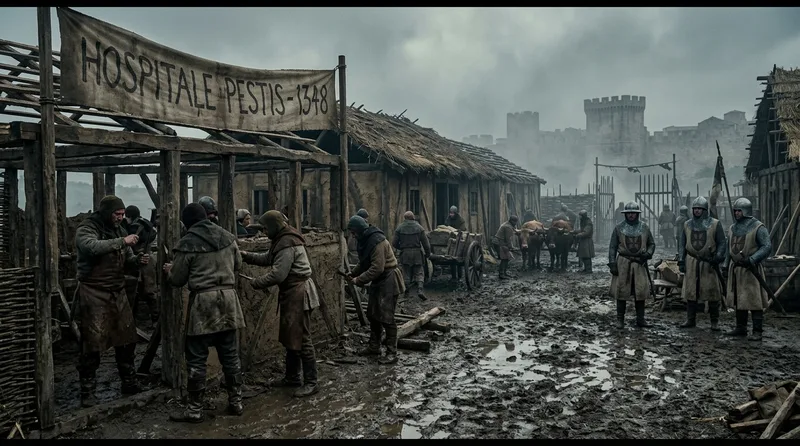
Marseille established dedicated plague hospitals beginning in 1348, constructing the first permanent pest houses at locations including Saint-Martin-de-Crau approximately 15 kilometers outside city walls. These specialized facilities segregated plague patients from other sick populations, housing up to 300 victims during outbreak peaks with separate wards for different disease stages. The municipal council hired 12 dedicated plague physicians who received triple normal salaries plus hazard bonuses of 50 florins annually to staff these isolated hospitals, where mortality rates exceeded 90 percent. Unlike traditional hospitals run by religious orders, Marseille’s plague institutions operated under secular municipal control with appointed administrators managing supplies, staffing, and patient admission based on symptom severity rather than spiritual worthiness. The city developed standardized treatment protocols including bloodletting, herbal poultices, and fumigation with aromatic substances, documenting outcomes in registers that represent medieval Europe’s earliest systematic medical record-keeping. Marseille mandated that all plague victims receive free treatment regardless of social status, a revolutionary concept that challenged medieval healthcare’s charity-based model. The pest house system proved so successful at containing outbreaks within controlled environments that Marseille maintained continuous plague hospital operations for centuries following, creating institutional knowledge that influenced hospital design throughout Mediterranean Europe and establishing the principle that contagious diseases required specialized facilities separate from general medical care.
Source: britannica.com
6. Ragusa Invented the 30-Day Trentino That Became International Law

The Republic of Ragusa established the trentino quarantine system on July 27, 1377, requiring all travelers from plague-infected areas to spend 30 days at designated isolation stations before entering the city. This Adriatic port initially chose the 30-day period based on lunar cycles and observation that plague symptoms typically manifested within four weeks of exposure. Ragusa constructed quarantine facilities at Cavtat and on Lokrum island, where incoming merchants lived in stone barracks under guard supervision with separate zones for travelers from different plague regions. Officials expanded the isolation period to 40 days in 1397 after observing some cases developing symptoms after the initial 30-day trentino, creating the more comprehensive quarantena that became standard across Europe. The republic employed dedicated health officers called provisores sanitatis who inspected cargo, fumigated goods with sulfur and herbs, and maintained detailed records of every quarantined individual’s origin and health status. Ragusa’s system proved remarkably effective, with the city experiencing only 3 major plague outbreaks between 1377 and 1533 compared to dozens in less-regulated ports. By mid-fifteenth century, over 20 Mediterranean cities had adopted Ragusa’s quarantine protocols, making it the first public health regulation to achieve international standardization. This small republic’s innovation transformed global trade by establishing that health security justified commercial delays, creating the framework for modern border health controls and demonstrating how smaller states could influence international policy through effective crisis management.
Source: britannica.com
7. Craft Guilds Slashed Apprenticeships From 12 Years to 3 After Masters Died

European craft guilds radically restructured apprenticeship requirements after plague mortality decimated master craftsmen ranks, with many guilds reducing training periods from 10-12 years to just 3-5 years by mid-fourteenth century. London’s Goldsmiths’ Company lost 43 of its 87 masters during 1348-1349, forcing the guild to lower entrance fees from 20 shillings to 5 shillings and accept journeymen with minimal experience as full masters. Florence’s wool guild, the Arte della Lana which employed over 30,000 workers before the plague, admitted 215 new masters in 1350 alone compared to typical annual admissions of 12-15 masters during pre-plague decades. Guild ordinances that previously restricted master status to those who completed lengthy apprenticeships, paid substantial fees, and produced elaborate masterworks collapsed under economic pressure as cities desperately needed skilled craftsmen to maintain production. The Parisian candlemakers’ guild eliminated its requirement that apprentices be unmarried, while Frankfurt’s bakers accepted women as full members for the first time in 1352, revolutionary changes that would have been unthinkable before demographic catastrophe. These relaxed standards democratized craft production, allowing ambitious workers to achieve master status and economic independence decades earlier than pre-plague career trajectories permitted. The resulting influx of new masters increased competition, drove innovation, and accelerated technological development across medieval industries, fundamentally reshaping urban economies and breaking hereditary monopolies that had controlled craft production for generations.
Source: britannica.com
8. Communities Burned 510 Jewish Settlements While Scapegoating Them for Plague

European Christians massacred Jewish communities in over 510 settlements between 1348 and 1351, accusing Jews of deliberately poisoning wells and spreading plague through supernatural conspiracy. The pogrom wave began in southern France during spring 1348 when Toulon residents burned the Jewish quarter after rumors claimed a captured Jew confessed to contaminating water sources with plague powder sent from Toledo. In Strasbourg on February 14, 1349, authorities burned approximately 900 Jews alive on a wooden platform erected in the Jewish cemetery despite the city not yet experiencing plague deaths. Basel, Freiburg, and Speyer witnessed similar massacres where entire Jewish populations faced execution, with property confiscated by municipal governments and distributed to Christian creditors who owed Jewish moneylenders substantial debts. Pope Clement VI issued two papal bulls in September 1348 and October 1349 declaring Jewish persecution illogical since plague killed Jews and Christians equally, noting that plague ravaged regions without Jewish populations, but local authorities ignored papal condemnation. German territories experienced the worst violence, with chronicles documenting the complete destruction of Jewish communities in Mainz where 6,000 died, Erfurt where 3,000 perished, and Worms where the entire Jewish population of 400 families was exterminated. Some Jewish communities chose mass suicide over forced conversion or death by torture, with 2,000 Jews in Erfurt setting fire to their own homes in March 1349. These pogroms devastated Ashkenazi Jewish civilization, forcing survivors eastward into Poland and Lithuania where rulers offered protection, permanently shifting European Jewish population centers and demonstrating how epidemic panic amplifies existing prejudices into genocidal violence.
Source: britannica.com
9. Pope Clement VI Commissioned Autopsies That Blamed Planetary Alignment for Death

Pope Clement VI assembled a medical commission at his Avignon palace in 1348, instructing the University of Paris medical faculty to investigate plague’s origins through systematic inquiry including human dissection. The resulting report, completed in October 1348 by 49 physicians including Johannes de Muris and Simon de Covino, concluded that a triple conjunction of Saturn, Jupiter, and Mars in Aquarius on March 20, 1345 had corrupted the atmosphere and generated pestilential vapors. These papal-sanctioned investigations represented medieval medicine’s most ambitious attempt at empirical disease research, with physicians conducting autopsies on plague victims to observe blackened lungs, swollen lymph nodes, and putrefied organs, though they misinterpreted these findings through humoral theory. The commission recommended preventative measures including avoiding bathing which supposedly opened pores to corrupted air, burning aromatic woods like juniper and cypress to purify atmosphere, and maintaining cheerful thoughts since melancholy humors predisposed bodies to infection. Clement VI personally implemented these recommendations, sitting between two blazing fires in his papal chambers throughout plague outbreaks and surviving three waves of pestilence while thousands of Avignon residents died around him. The papal investigation legitimized observational medicine and autopsy practice despite reaching incorrect conclusions, establishing precedent for institutional scientific inquiry into disease causation. Within two decades, dozens of medical treatises built upon the Paris faculty’s work, creating a body of plague literature that influenced European medicine until germ theory emerged centuries later and demonstrating how even flawed systematic investigation advances scientific methodology.
Source: britannica.com
10. England’s Land Redistribution Created a New Middle Class of Peasant Landowners

Post-plague England witnessed unprecedented land redistribution between 1350 and 1380 as approximately 45 percent of agricultural holdings changed hands through inheritance, abandonment, and market sales. Surviving peasants inherited multiple tenancies from deceased relatives, with some families accumulating 60-80 acres compared to typical pre-plague holdings of 10-15 acres per household. The Hundreton Manor in Essex recorded 23 tenant deaths in 1349, leaving vacant holdings that the lord divided among 8 remaining families who suddenly controlled enough land to generate substantial agricultural surplus for market sale. This consolidation created a prosperous peasant class with enough capital to hire laborers, invest in improved farming equipment, and purchase luxury goods previously reserved for gentry, fundamentally altering England’s social hierarchy. Manorial court rolls document thousands of land transactions during the 1350s as mobility restrictions collapsed, with peasants freely buying and selling tenancies despite lords’ attempts to maintain traditional inheritance customs. Some enterprising peasants accumulated sufficient wealth to purchase their freedom from serfdom, with Winchester’s Pipe Rolls recording 127 manumission purchases between 1348 and 1360 compared to just 18 in the previous dozen years. This newly wealthy peasant class demanded political representation, contributing directly to the social tensions that exploded in the Peasants’ Revolt in the late fourteenth century when 60,000 rebels marched on London demanding complete abolition of serfdom. Though the revolt failed militarily, the underlying economic transformation proved irreversible, establishing England’s yeoman farmer class that would dominate agriculture for centuries and demonstrating how demographic collapse could permanently restructure feudal society’s rigid class boundaries.
Source: britannica.com
Did You Know?
Did you know that Venice’s 40-day quarantine was twice as long as necessary? Modern epidemiology shows plague’s incubation period is just 2-6 days, meaning Venetian ships waited in isolation for over a month beyond any medical necessity. Yet this excessive caution accidentally created the perfect buffer against asymptomatic carriers and shipboard rat populations, making the system effective for entirely unintended reasons. The medieval world’s greatest public health innovation succeeded through fortunate miscalculation.