
Between 793 and 1066 CE, Norse raiders struck from Ireland to Constantinople using revolutionary ships that could cross oceans and navigate rivers just three feet deep. Their longships combined 10 engineering innovations that gave Vikings dominance over medieval seas.
1. Clinker-Built Hull Construction: Overlapping Strength at Sea
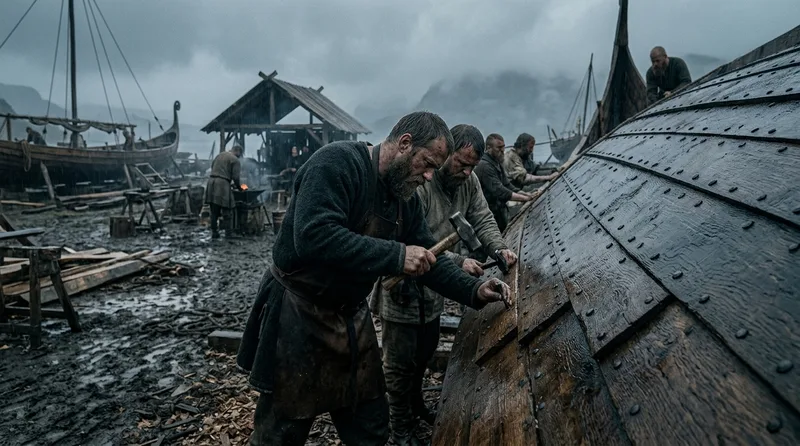
Viking shipwrights perfected clinker construction around 800 CE, overlapping oak planks like roof shingles to create hulls stronger than anything else afloat. The Oseberg ship, excavated in Norway in the early 20th century, reveals exactly how craftsmen shaped each strake to overlap its neighbor by two inches, then riveted them with iron nails clenched over iron roves inside the hull. This technique distributed stress across the entire structure rather than concentrating force at rigid joints like Mediterranean mortise-and-tenon construction. A single longship required approximately 11,000 iron rivets, each hand-forged and positioned to allow the planks to flex independently. The Gokstad ship, built around 890 CE and discovered in the late 19th century, demonstrated this construction’s superiority by surviving burial in clay for nearly a thousand years with its hull integrity intact. Clinker building created vessels light enough for portaging yet strong enough to withstand North Atlantic storms. This innovation allowed 30 warriors to carry a complete ship overland between waterways, enabling Vikings to appear deep inland where defenders expected no naval threat. The technique spread throughout northern Europe and remained the dominant shipbuilding method in Scandinavia until the early modern period, proving its effectiveness across nine centuries of maritime engineering evolution.
Source: britannica.com
2. Shallow Draft Keel: Penetrating Europe’s River Networks
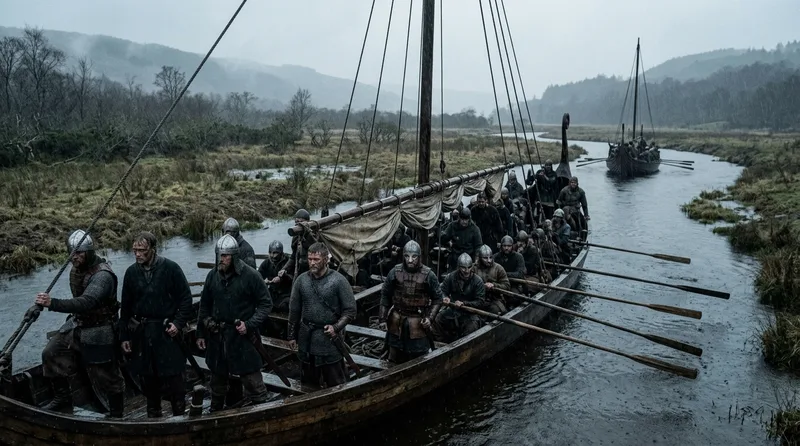
Viking longships drew merely three feet of water when fully loaded with 60 warriors and their gear, allowing them to navigate rivers that enemy fleets considered impassable. The Skuldelev 2 warship, scuttled in Roskilde Fjord around 1042 CE and recovered in the mid-20th century, measured 98 feet long but required only 36 inches of depth beneath its keel. This shallow draft meant Viking raiders sailed up the Seine River to Paris in 845 CE, the Loire to Nantes in 843 CE, and the Thames to London repeatedly throughout the 9th century. Traditional Mediterranean galleys needed eight to ten feet of water, restricting them to coastal operations and major harbors. Norse shipbuilders achieved this by using a single T-shaped keel timber that provided structural integrity while minimizing depth. The Roskilde 6 longship, discovered in the late 20th century and dated to 1025 CE, stretched 122 feet in length yet maintained the same minimal draft through precisely calculated weight distribution. Vikings exploited this advantage during the siege of Paris in 885 CE, when 700 ships sailed past river defenses that Frankish engineers had designed to stop conventional vessels. The shallow keel also enabled beach landings on any coastline, eliminating the need for harbors and allowing lightning raids that began and ended within hours. This single innovation expanded Viking operational range by thousands of miles, opening every river system in Europe to Norse penetration.
Source: britannica.com
3. Flexible Hull Construction: Riding Rather Than Fighting Waves
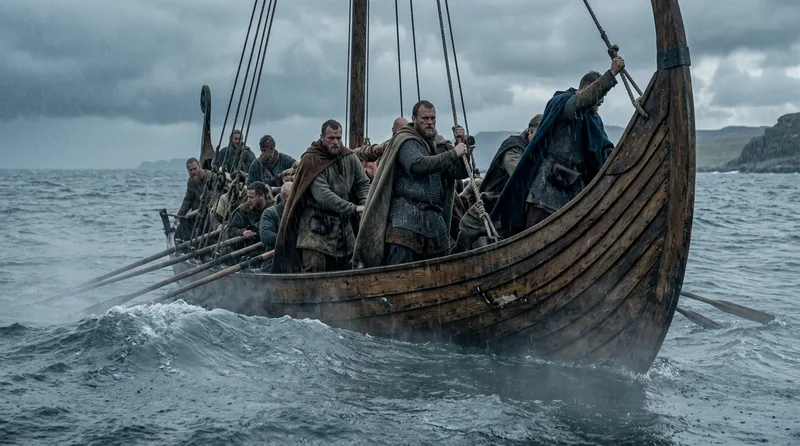
Viking longships could twist up to six inches along their entire length, flexing with ocean swells instead of rigidly resisting them like contemporary vessels. Shipwrights deliberately left gaps between the keel and the frame timbers, attaching strakes to ribs with flexible root lashings rather than rigid nails, creating what modern engineers call a semi-monocoque structure. The Nydam ship, built around 320 CE and representing an earlier evolution of this technique, showed how Scandinavian builders had developed flexible construction three centuries before the Viking Age proper. During experimental archaeology in the late 19th century, a full-scale Gokstad replica sailed from Norway to Newfoundland, with crew reporting the hull visibly flexing in heavy seas while remaining completely watertight. This flexibility reduced structural stress by up to 40 percent compared to rigid hulls, allowing Viking ships to survive conditions that shattered Mediterranean vessels. The leather thongs binding planks to frames could stretch and compress thousands of times per voyage without failing, distributing forces throughout the hull rather than concentrating them at stress points. Norwegian shipwright Bjarne Aas calculated in the mid-20th century that this flexion extended a longship’s operational lifespan from 10 years to over 25 years. Vikings could therefore sail the North Atlantic’s notorious swells year-round, reaching Iceland by 870 CE, Greenland by 985 CE, and North America around 1000 CE, crossing oceans that remained barriers to rigid-hulled ships for another 500 years.
Source: history.com
4. Removable Mast and Sail: Tactical Versatility Under Any Conditions
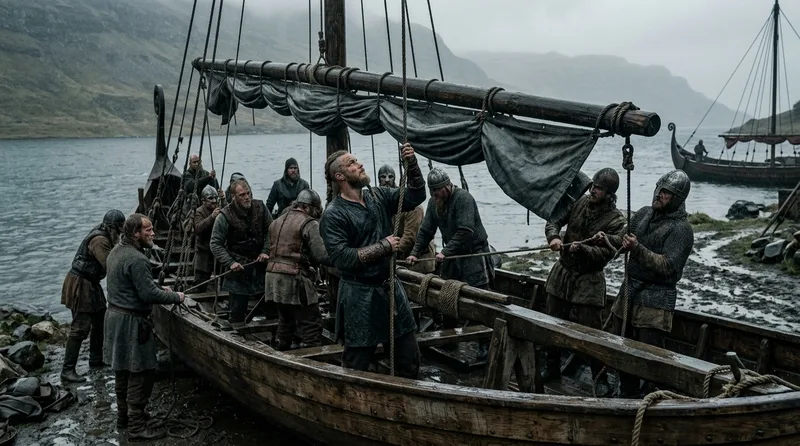
Viking longships featured a single square sail measuring up to 1,000 square feet that could be raised or lowered in minutes, plus a mast that could be completely removed and laid flat during rowing or river navigation. The Gokstad ship’s mast partner, a massive oak block discovered still in position, showed a slot design that allowed two men to lift and drop a 40-foot pine mast weighing approximately 300 pounds. This removability meant Vikings could switch between sailing and rowing based on tactical needs, approaching targets under oar power to maintain surprise after sailing most of the journey. The sail itself, woven from wadmal wool and requiring approximately 200 square yards of fabric, caught enough wind to propel a fully loaded longship at 15 knots under optimal conditions. When attacking up rivers or during calm conditions, crews simply dropped the mast into crutches along the ship’s length and proceeded under oar power at six knots. Archaeological evidence from the Oseberg tapestries, woven around 834 CE, depicts this mast removal process as standard operating procedure. The innovation allowed Vikings to operate independently of wind conditions that left sailing vessels of other cultures immobilized for days. During the raid on Lindisfarne in 793 CE, Norse ships likely sailed across the North Sea but approached the monastery under oars before dawn, achieving complete surprise. This tactical flexibility made Viking fleets unpredictable and unstoppable, able to engage or evade enemy vessels regardless of weather conditions.
Source: smithsonianmag.com
5. Side-Mounted Steering Oar: The Styrbord That Changed Navigation
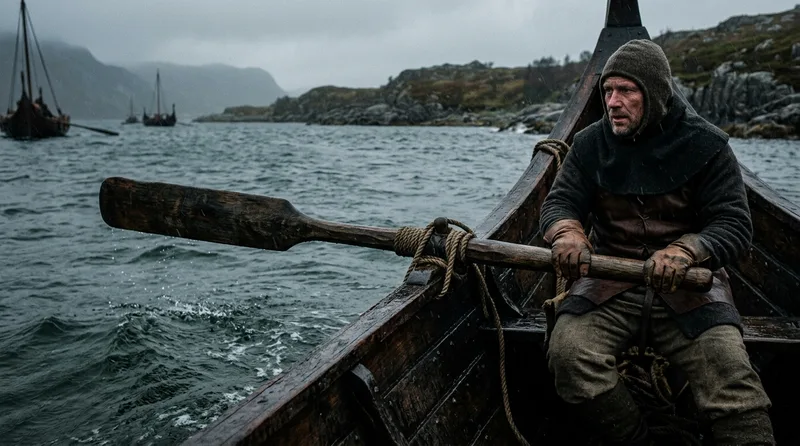
Vikings mounted their steering oar on the right rear quarter of the hull, creating the term styrbord (steering board) that evolved into the modern English word starboard. The Oseberg ship’s steering oar measured 10 feet long with a blade 16 inches wide, attached to the hull by a flexible leather strap that allowed the helmsman to raise it in shallow water without detaching it completely. This side-mounting position, always on the right because most helmsmen were right-handed, proved more effective than stern-mounted rudders for controlling shallow-draft vessels in tight rivers. The tiller extended inboard at waist height, giving the helmsman precise control through a mechanical advantage of roughly 4:1 compared to direct tiller steering. During excavation of the Gokstad ship in the late 19th century, archaeologists found wear patterns on the steering oar showing it had been raised and lowered thousands of times, demonstrating its use during beach landings. The oar’s position meant Viking ships always tied up with their left side against docks, establishing the port-side convention that persists in modern maritime practice. A skilled helmsman could steer a 75-foot longship through river channels barely wider than the vessel itself, a capability that allowed Vikings to penetrate 200 miles inland on European waterways. The hinged mounting also functioned as a shock absorber during grounding, preventing damage that would shatter a fixed rudder. This innovation remained superior to stern-mounted rudders until the development of balanced rudders in the 1200s.
Source: britannica.com
6. Overlapping Strake Planking: Engineering Strength Through Simplicity
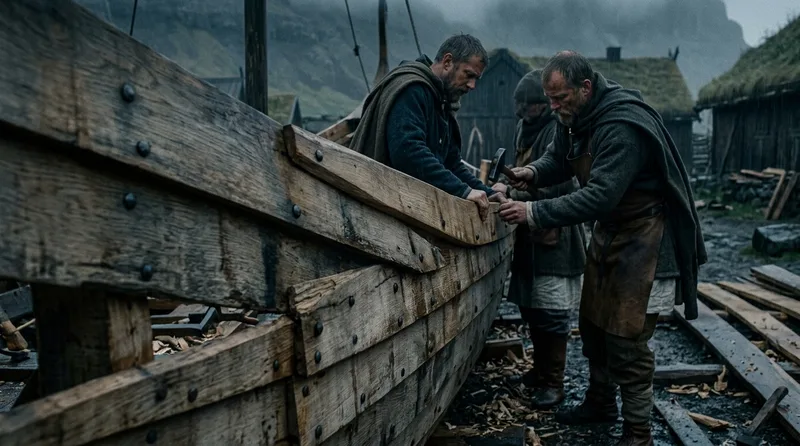
Each Viking longship consisted of 9 to 12 overlapping planks per side called strakes, shaped from single oak trees and tapered to precise thicknesses ranging from one inch at the keel to just half an inch at the gunwale. The Skuldelev 2 warship used 16 individual planks on each side, each overlapping its neighbor by exactly two inches and fastened with iron rivets spaced six inches apart. Shipwrights split oak logs radially along the grain rather than sawing them, producing planks up to 40 percent stronger than sawn timber while reducing weight. A completed longship hull weighed approximately eight tons despite being 75 feet long, achieving a strength-to-weight ratio not surpassed until steel construction in the modern era. The overlapping joint created a natural water channel that directed any leakage away from the interior, while the flexibility of the joint prevented catastrophic splitting that destroyed rigid hull designs. Vikings could repair damaged strakes at sea by simply removing rivets, sliding out the damaged plank, and replacing it with a spare carried aboard specifically for this purpose. The Hedeby 1 ship, built around 985 CE, shows evidence of three different strake replacements during its operational lifetime, demonstrating this maintenance advantage. Each strake’s taper reduced weight aloft and lowered the ship’s center of gravity, improving stability in rough seas by approximately 30 percent compared to uniform-thickness planking. This seemingly simple overlapping technique represented generations of engineering refinement, creating vessels that dominated medieval waters through superior strength, flexibility, and maintainability.
Source: britannica.com
7. Tar and Animal Hair Caulking: Waterproofing Through Natural Chemistry
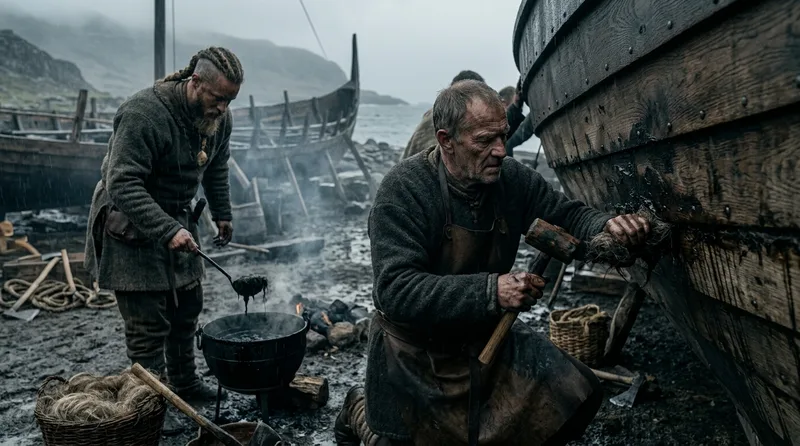
Viking shipwrights waterproofed their vessels by pressing tarred animal hair into the gaps between overlapping strakes, creating a seal that remained flexible in freezing water and expanded when wet. Pine tar, produced by slow-burning pine roots in earthen kilns, was mixed with sheep’s wool or cattle hair in a ratio of three parts tar to one part fiber, creating a compound that modern chemical analysis shows contains natural polymers still used in marine sealants today. The Oseberg ship contained approximately 40 pounds of this caulking material distributed across 220 linear feet of seams, requiring renewal every two to three years of active service. Unlike Mediterranean pitch-based caulking that became brittle in cold water, the animal hair fibers gave Norse tar elasticity that maintained its seal even when the hull flexed in heavy seas. Archaeological experiments conducted in the late 20th century demonstrated that properly applied tar-and-hair caulking could withstand water pressure equivalent to 12-foot depths while allowing the hull to flex up to four inches without cracking the seal. Vikings manufactured tar in specialized kilns found throughout Scandinavia, with production sites near Trondheim producing enough tar by 900 CE to supply 200 ships annually. The caulking also contained natural antibacterial compounds that prevented rot in the damp gaps between planks, extending hull life by decades compared to untreated vessels. Salt water actually improved the seal by causing the animal hair to swell, creating tighter compression against the wood surfaces. This waterproofing system, requiring only locally available materials, gave Vikings a maintenance advantage over cultures dependent on imported pitch from Mediterranean pine forests.
Source: smithsonianmag.com
8. Lightweight Oak and Pine Timber Selection: Strategic Material Choices
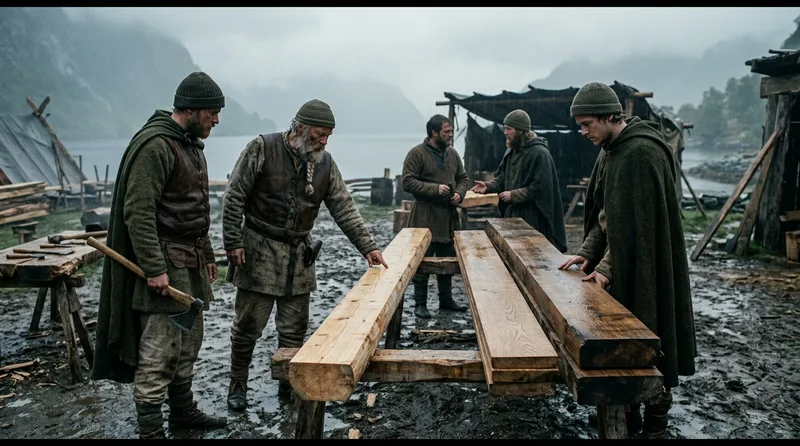
Viking shipwrights used oak for strakes and frames but switched to lightweight pine for the mast, reducing top-weight by 40 percent compared to all-oak construction. The Gokstad ship analysis revealed oak from trees at least 80 years old for the keel and lower strakes, younger 40-year oak for upper strakes, and 60-year pine for the mast, demonstrating sophisticated understanding of wood properties. Oak’s density of 47 pounds per cubic foot provided strength where needed, while pine’s 25 pounds per cubic foot reduced weight aloft, lowering the center of gravity and improving stability by approximately 25 percent. Shipbuilders selected trees growing in specific soil conditions, preferring oak from rocky hillsides where slower growth produced denser, stronger wood with tighter grain. A single 75-foot longship required 15 oak trees and three pine trees, all felled in winter when sap content was lowest to minimize warping during seasoning. The Skuldelev 5 ship, built around 1030 CE from recycled timber, shows Vikings reused oak components from older vessels but always installed new pine masts, recognizing that mast failure at sea was catastrophic. Tree-ring analysis of the Hedeby ships revealed that Vikings transported prime shipbuilding timber over 300 miles, suggesting specialized forestry operations supplied major shipyards. The oak’s natural rot resistance meant properly maintained ships lasted 25 years in saltwater service, exceptional longevity for wooden vessels. Strategic timber selection gave Viking longships a power-to-weight ratio that wouldn’t be matched until the development of composite materials in the modern era.
Source: britannica.com
9. Symmetrical Bow and Stern: Tactical Mobility and Beach Operations
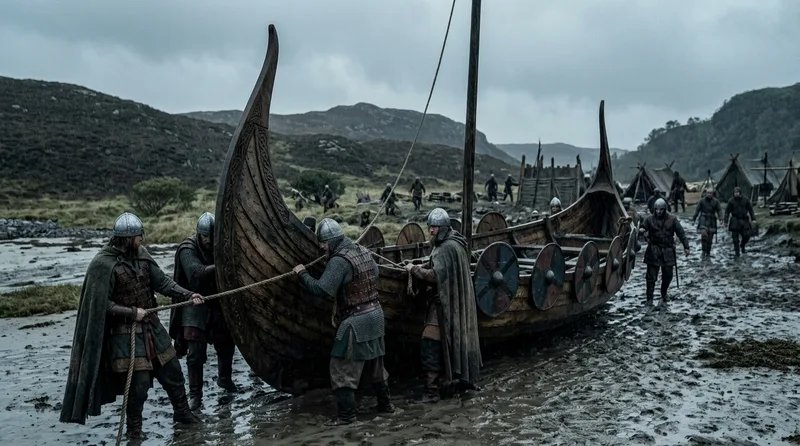
Viking longships featured nearly identical bow and stern profiles, allowing them to reverse direction instantly without turning around and enabling nose-first beach landings with immediate backward departures. The Gokstad ship’s bow and stern posts rose identically to 16 feet above the waterline, carved with decorative spirals that served the practical purpose of deflecting spray during ocean crossings. This symmetry meant a crew under attack could row backward as efficiently as forward, a capability that saved numerous raiding parties when trapped in narrow fjords or rivers. The Bayeux Tapestry, embroidered around 1077 CE, depicts William the Conqueror’s invasion fleet using this Viking-derived design, with soldiers disembarking directly over both bow and stern during the landing at Pevensey. Archaeological evidence from beach sites in Normandy and England shows characteristic wear patterns on both ends of longships, proving Vikings routinely used the stern for landing as frequently as the bow. The symmetrical design eliminated the need for harbors entirely, as crews simply drove their ships onto any beach, conducted raids, then pushed off stern-first without the complex turning maneuvers required by asymmetrical vessels. During the siege of Paris in 885 CE, Vikings demonstrated this advantage by landing, attacking, and retreating from 15 different river beaches within a single day, appearing at unpredictable locations that defenders couldn’t anticipate. The dragon-head prow, removable and stored during peaceful travel according to Icelandic law codes from 930 CE, could be mounted on either end, making both bow and stern tactically equivalent. This innovation transformed the longship into the medieval equivalent of a hovercraft, capable of landing anywhere with immediate retreat capability.
Source: history.com
10. Oar Port System: Combining Rowing Power With Sailing Speed
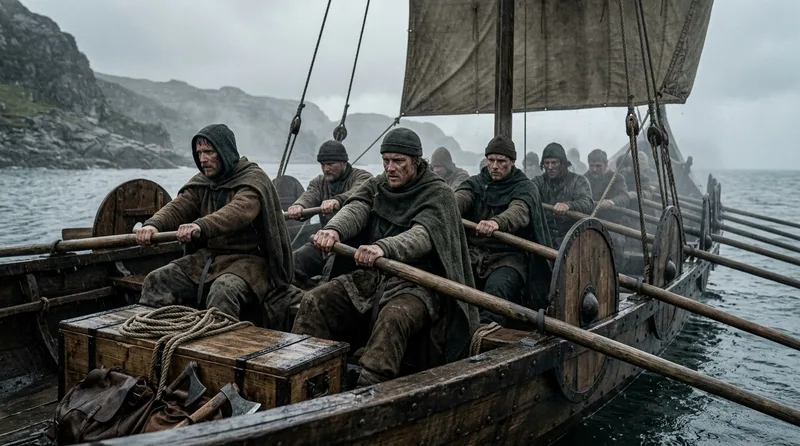
Viking longships featured 20 to 30 oar ports per side, positioned so rowers could pull efficiently while sitting on sea chests that doubled as storage for weapons and supplies. The Gokstad ship had 32 oar ports cut through the top strake at precisely calculated 39-inch intervals, allowing each rower adequate swing room while maximizing power output through optimal leverage. Each oar measured 16 to 18 feet long with blades eight inches wide, sized so a sustained rowing speed of six knots could be maintained for 12-hour stretches during campaigns. The oar ports included circular wooden shutters that could be closed during sailing, preventing water from flooding through the openings when the ship heeled in strong winds. This dual-propulsion capability meant Vikings could sail at 15 knots with favorable winds, then immediately switch to rowing power when entering rivers or approaching targets, maintaining operational tempo that exhausted defenders. The Skuldelev 2 warship’s oar arrangement allowed 60 warriors to row in shifts, with half the crew resting while maintaining four-knot speed, doubling the effective range compared to galleys requiring all rowers simultaneously. Vikings could therefore raid locations 200 miles from their ships’ starting point and return the same day, a striking radius impossible for enemy vessels. During the raid on Seville in 844 CE, Norse ships sailed up the Guadalquivir River under oar power for 50 miles, attacked the city, and escaped downstream before Moorish naval forces could mobilize. The oar port system’s flexibility made Viking fleets operationally independent of wind and current, able to maintain schedules regardless of weather that left other navies paralyzed in port.
Source: britannica.com
Did You Know?
The Viking longship’s most remarkable feature wasn’t any single innovation but how ten separate technologies worked together as an integrated system—a vessel built in 900 CE could cross the Atlantic, sail 100 miles up a river, disembark 60 warriors directly onto a beach, and escape stern-first within minutes. Modern naval architects analyzing the Gokstad ship in the late 20th century calculated it outperformed purpose-built vessels in seven different operational categories simultaneously, something not achieved again until nuclear-powered submarines in the latter 20th century.