
When Reformation fires split Europe in the 1500s, Catholic authorities burned thousands who refused to recant. These ten martyrs chose death over compromise—transforming execution stakes into symbols of defiance that still shape Protestant identity today.
1. William Tyndale: The Translator Strangled for an English Bible
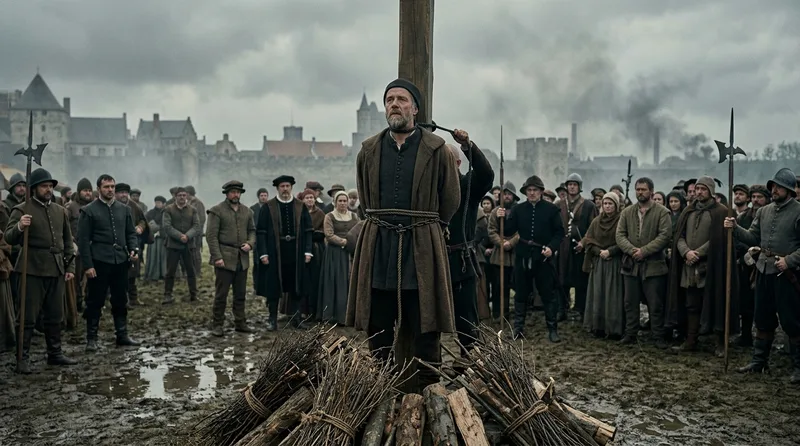
William Tyndale met his death on October 6, 1536, strangled at the stake before flames consumed his body in Vilvoorde, Belgium. His crime? Translating the Bible into English so common people could read scripture without priestly interpretation. Born around 1494 in Gloucestershire, Tyndale mastered eight languages at Oxford and Cambridge, growing convinced that direct access to scripture would expose Catholic corruption. When English bishops blocked his translation work in 1523, he fled to the continent. Working in hiding across Germany and Belgium, he completed his English New Testament in 1526—copies smuggled into England hidden in cloth bales and wine barrels. Church authorities burned these Bibles publicly, paying merchants premium prices to destroy every copy they could find. Tyndale’s translation work was so precise that 83% of his phrases survived unchanged in the King James Bible published 75 years later. Betrayed by an English friend named Henry Phillips, Tyndale spent 500 days imprisoned in a cold castle dungeon. His final words, spoken as the noose tightened, became legendary: ‘Lord, open the King of England’s eyes.’ Within three years, Henry VIII authorized an English Bible—based largely on Tyndale’s forbidden translation. His death transformed him from hunted fugitive into Protestant hero, proof that truth spoken in the vernacular threatened Rome’s control more than any theological argument.
Source: britannica.com
2. Jan Hus: The Czech Prophet Burned a Century Before Luther
On July 6, 1415, Jan Hus burned at the stake in Constance, Germany, 102 years before Martin Luther nailed his theses to a church door. This Czech priest and university rector anticipated Reformation theology by a full century, challenging papal authority and calling for scripture in the common tongue. Born around 1372 in Husinec, Bohemia, Hus earned his master’s degree at Prague’s Charles University in 1396, becoming its rector by 1409. He preached to crowds exceeding 3,000 at Bethlehem Chapel, delivering sermons in Czech rather than Latin and attacking the sale of indulgences that promised reduced time in purgatory. When Pope John XXIII excommunicated him in 1411, Hus wrote treatises arguing that an immoral pope had no authority over true believers—heresy that struck at Rome’s foundation. Emperor Sigismund promised Hus safe conduct to defend his ideas at the Council of Constance, but Catholic authorities arrested him anyway, holding him in chains for eight months. At trial, they demanded 39 recantations. Hus refused every one, declaring he would not perjure himself before God. As flames rose around the stake, witnesses reported he sang hymns until smoke suffocated him. His ashes were thrown into the Rhine to prevent relic-hunting. Bohemia erupted in revolt—the Hussite Wars raged for two decades, with his followers defeating five consecutive Crusades sent against them. Luther later wrote that he was ‘a Hussite without knowing it.’
Source: britannica.com
3. Anne Askew: The Noblewoman Racked Before Burning
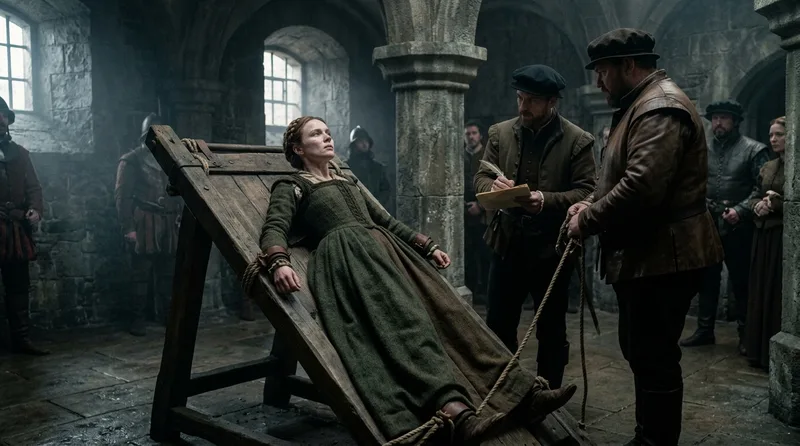
Anne Askew became the only woman on record tortured in the Tower of London when, on June 29, 1546, she endured the rack for hours while interrogators demanded she name Protestant sympathizers at court. Born around 1521 into Lincolnshire gentry, Askew received unusual education for a woman—reading Latin and studying theology independently. Forced at 15 to marry her sister’s betrothed after the sister’s death, she left her Catholic husband around 1543 when he beat her for reading banned Protestant books. In London, she joined evangelical discussion circles, distributing prohibited literature and openly denying transubstantiation—the Catholic doctrine that bread and wine literally became Christ’s flesh during Mass. Arrested twice in 1545, she talked her way free both times through clever theological arguments that embarrassed her questioners. The third arrest proved fatal. Authorities suspected she had connections to Queen Katherine Parr’s Protestant circle. Lord Chancellor Thomas Wriothesley personally operated the rack, stretching her body until joints dislocated and bones cracked audibly. She refused to name anyone. Unable to walk, guards carried her to Smithfield in a chair on July 16, 1546. Executioners chained her upright to the stake. As flames rose, she maintained consciousness long enough to debate theology with a priest trying to save her soul. She was 25 years old. Her defiance under torture became Protestant propaganda gold—proof that women’s faith equaled men’s, and that Catholic authorities feared truth more than they valued mercy.
Source: britannica.com
4. Patrick Hamilton: Scotland’s First Reformation Martyr at 24
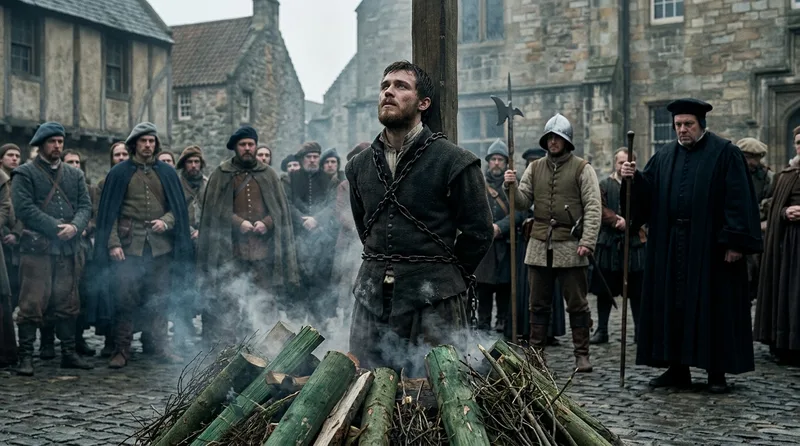
Patrick Hamilton burned for six hours on February 29, 1528, at St Andrews, Scotland—green wood chosen deliberately to prolong his agony. Born in 1504 to Scottish nobility, Hamilton descended from two royal houses and seemed destined for church leadership. He studied at the University of Paris in 1520, then Leuven, where Lutheran ideas circulated despite official bans. By 1523, as a student at St Andrews, Hamilton was openly discussing justification by faith rather than works—a direct challenge to Catholic sacramental theology. His noble blood initially protected him. Archbishop James Beaton sent him to the continent in 1527, hoping distance would cool his radicalism. Instead, Hamilton visited Martin Luther in Wittenberg and Philipp Melanchthon in Marburg, returning to Scotland in 1527 more convinced than ever. He wrote ‘Patrick’s Places,’ a clear summary of Protestant theology in English rather than Latin. When Beaton summoned Hamilton to St Andrews in February 1528, friends warned it was a trap. Hamilton went anyway, believing his aristocratic status made him untouchable. Arrested immediately, he stood trial for 13 counts of heresy. Convicted within hours, executioners dragged him to the stake before he could appeal to Rome. The prolonged burning horrified witnesses—one Catholic observer famously said, ‘The reek of Master Patrick Hamilton infected as many as it blew upon.’ His death ignited Scottish Reformation more effectively than any sermon. Within 30 years, Scotland officially became Protestant, its church still named for reformers like Hamilton.
Source: britannica.com
5. Thomas Cranmer: The Archbishop Who Recanted Six Times Then Died Anyway
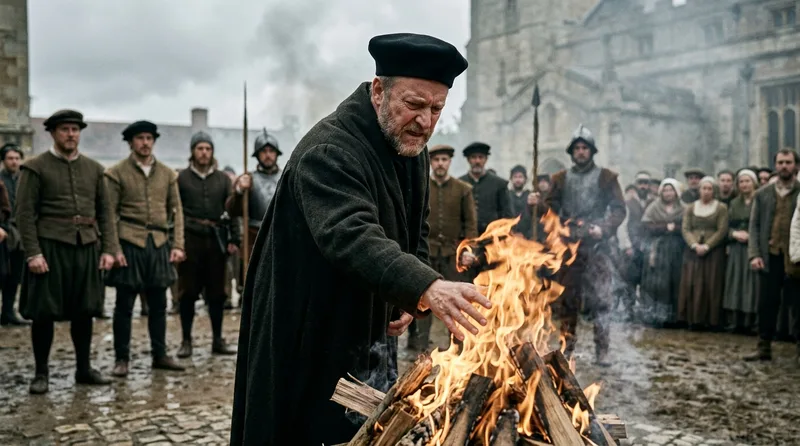
Thomas Cranmer thrust his right hand into flames first on March 21, 1556, burning the hand that had signed six separate recantations of Protestant faith. Born in 1489 in Nottinghamshire, Cranmer rose through Cambridge scholarship to become Henry VIII’s Archbishop of Canterbury in 1533—a position he held for 23 years while crafting English Protestantism’s theological foundation. He authored the Book of Common Prayer in 1549, still used in modified form today, and annulled Henry’s marriage to Catherine of Aragon, enabling the English break from Rome. Under the child-king Edward VI, Cranmer pushed Reformation further—abolishing mandatory celibacy, removing images from churches, and establishing the 42 Articles of faith. When Catholic Mary I took the throne in 1553, Cranmer’s fate was sealed. Imprisoned for two years, facing execution, the 66-year-old archbishop weakened. Between December 1555 and March 1556, he signed six separate documents recanting Protestant beliefs, hoping Mary would spare him. She refused—his execution was necessary political theater. At his final sermon on March 21, 1556, at St. Mary’s Church, Oxford, Catholics expected public Protestant repudiation. Instead, Cranmer shocked listeners by renouncing all his recantations, declaring the pope ‘Christ’s enemy and Antichrist.’ Guards dragged him to the stake outside Balliol College. Remembering his cowardice, Cranmer held his right hand in flames until it burned away, crying ‘This unworthy right hand!’ His courage erased his weakness—transforming a compromised archbishop into martyrdom’s most dramatic figure.
Source: britannica.com
6. Latimer and Ridley: The Oxford Bishops Burned Back-to-Back
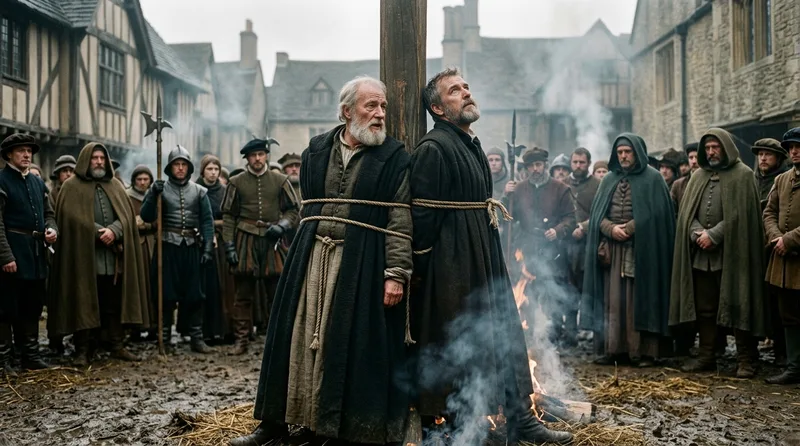
Hugh Latimer called out ‘Be of good comfort, Master Ridley, and play the man’ as flames rose around both men on October 16, 1555, in Oxford’s town ditch. The two bishops—Latimer 70 years old, Ridley 55—had been chained to the same stake, burned simultaneously as Catholic England purged Protestant leadership. Nicholas Ridley, born around 1500 in Northumberland, earned Cambridge doctorate in theology and became Bishop of London in 1550, abolishing Catholic vestments and stone altars. Hugh Latimer, born around 1485 in Leicestershire, preached before Henry VIII and served as Bishop of Worcester, famous for sermons attacking social injustice and clerical corruption. Both resigned their positions rather than accept Catholic restoration under Mary I. Imprisoned together in Oxford for 18 months, they debated Catholic theologians publicly in April 1554—a show trial where their fate was predetermined. At execution, a bag of gunpowder hung around each man’s neck, intended to hasten death. Ridley’s fire, built with green wood, burned slowly. Latimer’s caught quickly—he died within minutes, apparently peacefully. Ridley suffered horribly, trapped below smoldering logs, crying ‘Let the fire come unto me! I cannot burn!’ until someone pushed wood aside and flames reached the gunpowder. Their deaths, witnessed by thousands, became England’s most famous martyrdom. John Foxe’s ‘Acts and Monuments’ devoted 40 pages to their story, cementing them in Protestant memory as examples of learned men choosing conscience over survival.
Source: britannica.com
7. Giordano Bruno: The Philosopher Burned for Cosmic Heresy
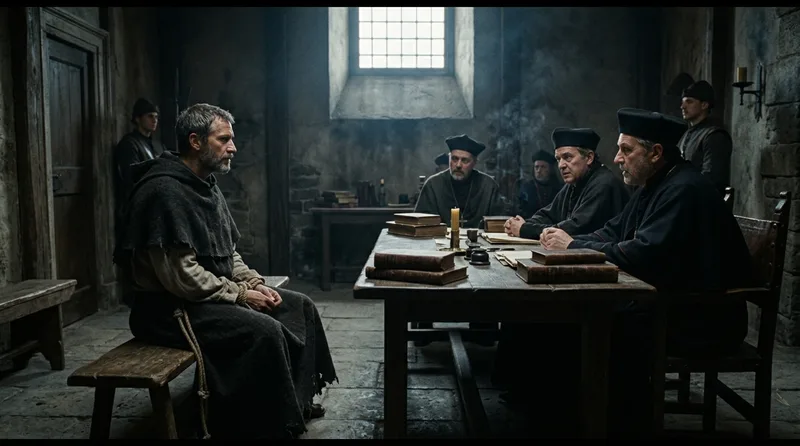
Giordano Bruno refused to recant on February 17, 1600, telling Roman Inquisitors ‘You are more afraid to deliver this sentence than I am to receive it’ before guards nailed his tongue still and burned him in Campo de’ Fiori. Born Filippo Bruno in 1548 in Nola, Italy, he joined the Dominican Order at 15, taking the name Giordano. Brilliant and argumentative, he earned his doctorate in theology in 1575 but was accused of heresy within a year for questioning transubstantiation and the Trinity. He fled Naples, beginning a 16-year odyssey across Europe—Geneva, Paris, London, Oxford, Frankfurt—publishing controversial works wherever he went. His heresies went beyond typical Protestant-Catholic disputes: he argued for infinite universes, denied Christ’s divinity, rejected biblical miracles as metaphors, and claimed the Earth circled the sun decades before Galileo’s trial. In 1591, a Venetian nobleman invited Bruno to teach, then betrayed him to the Inquisition. Imprisoned for eight years, Bruno endured interrogation and torture while Inquisitors demanded he recant 10 specific propositions. He refused every one, arguing his cosmology and theology stemmed from reason and observation. On February 8, 1600, the Inquisition declared him an ‘impenitent and pertinacious heretic.’ Nine days later, stripped naked and bound to a stake in Rome’s public square, Bruno died with a wooden gag preventing final words. While Catholic Europe celebrated eliminating a dangerous philosopher, Protestant nations added him to martyrologies—proof Rome feared questions more than answers.
Source: britannica.com
8. Jan van Leiden: The Anabaptist King Tortured to Death in a Cage
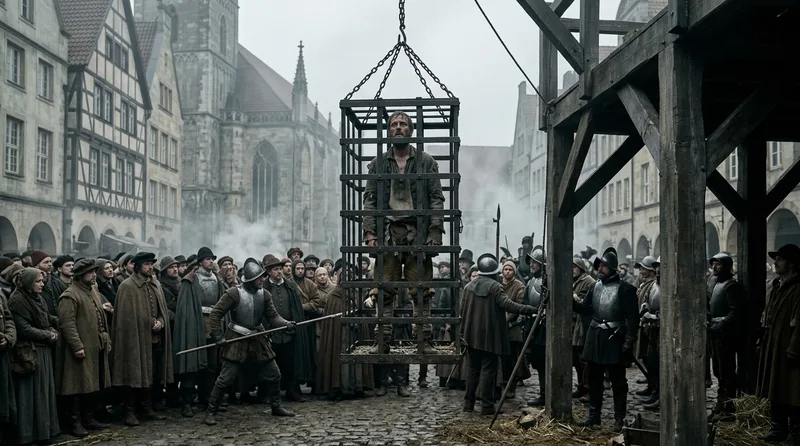
Jan van Leiden died on January 22, 1536, tortured with red-hot tongs for an hour in Münster’s marketplace before executioners tore out his tongue and stabbed his heart. Born Jan Beukels in 1509 in Leiden, Netherlands, this charismatic tailor and innkeeper became an Anabaptist preacher in 1533, joining the radical Protestant movement that rejected infant baptism and advocated communal property. When Anabaptists seized control of Münster in February 1534, van Leiden emerged as the movement’s prophet-king, proclaiming the city ‘New Jerusalem’ and himself King David reborn. He instituted polygamy, taking 16 wives himself, and executed dissenters publicly. For 16 months, Münster held out against Catholic and Lutheran forces. Inside the besieged city, van Leiden enforced increasingly bizarre laws—mandatory communal meals, execution for complaining, biblical names for all streets. Starvation claimed 2,000 residents. When the city fell on June 24, 1535, van Leiden tried escaping through sewers but was captured. Prince-Bishop Franz von Waldeck ordered exemplary punishment. For six months, van Leiden toured German cities in chains—a traveling exhibition of defeated heresy. His execution was deliberately theatrical: tortured publicly while still alive, then his body displayed in an iron cage hung from St. Lambert’s Church tower. The cage remains hanging there today, 488 years later—empty but visible. The Münster disaster discredited radical Anabaptism for generations, driving peaceful Anabaptist groups like Mennonites to emphasize pacifism and reject political power permanently.
Source: britannica.com
9. Dirk Willems: The Anabaptist Who Saved His Executioner
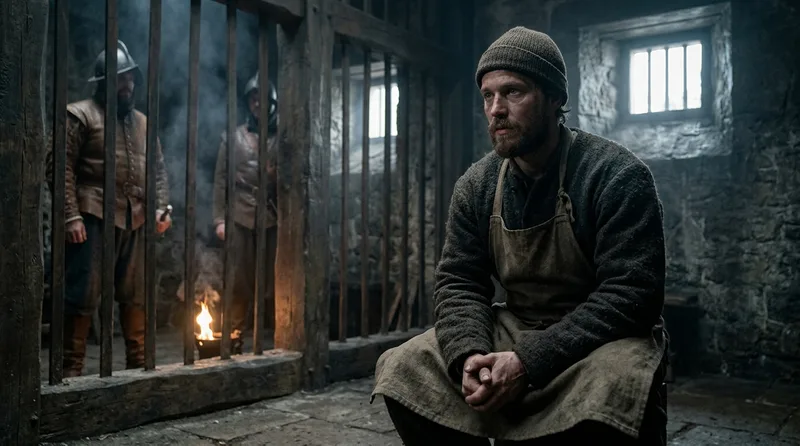
Dirk Willems turned back on the ice on a winter day in 1569, saving the life of the man pursuing him to arrest—a decision that cost him his own life weeks later. Born around 1535 near Asperen in the Netherlands, Willems was a cloth merchant who joined the Anabaptist movement around 1560, baptized as an adult believer and hosting illegal worship meetings in his home. Dutch authorities, enforcing Catholic Spain’s anti-heresy laws, imprisoned Anabaptists systematically—over 1,500 would die in the Netherlands between 1530 and 1580. Willems escaped his prison cell in Asperen’s town hall using a rope made from knotted rags, fleeing across a frozen pond during winter 1569. His pursuer, a local sheriff, broke through the thin ice and began drowning. Willems, already safely across, heard the man’s cries. Despite knowing what recapture meant, he returned across the ice and pulled the sheriff from freezing water. The humiliated sheriff wanted to release Willems, but the burgomaster ordered the arrest completed. On May 16, 1569, authorities burned Willems at the stake in Asperen. Executioners positioned the stake downwind from a castle so prevailing winds would prolong his suffering—he roasted slowly rather than burning quickly. Witnesses reported hearing his cries for over an hour before death. His story became Anabaptist martyrdom’s most famous example—proof that true Christianity meant loving enemies even when they carried death warrants. The image of Willems turning back on the ice appeared in countless Protestant martyrologies, a moment of mercy that justified an entire theological movement.
Source: britannica.com
10. The Guernsey Martyrs: Mother and Daughters Burned Together at the Stake
Perotine Massey gave birth in the flames on July 18, 1556, as executioners burned her alive in Guernsey’s marketplace along with her mother and sister—the baby fell from her body into the fire, only to be thrown back by a witness when guards refused to save it. This obscure Channel Islands martyrdom became one of the Reformation’s most horrifying stories, demonstrating that Catholic persecution targeted entire families without regard for age, gender, or condition. Perotine, heavily pregnant, was convicted of heresy for Protestant beliefs alongside her mother Katherine Cowchee and her sister Guillemine Gilbert. Authorities arrested them in 1556 for denying transubstantiation and refusing to attend Mass. Guernsey’s bailiff, Helier Gosselin, enforced Queen Mary I’s heresy laws zealously despite the island’s distance from London—between 1556 and 1558, at least three people burned there. At trial, Perotine’s pregnancy was obvious, and civil law prohibited executing pregnant women until after birth. Gosselin ignored this protection, declaring heresy trumped all legal niceties. On execution day, guards chained all three women to a single stake. As flames rose, Perotine’s labor began—the trauma and heat triggering premature delivery. The baby boy fell into the straw at the stake’s base. A spectator, moved by the sight, pulled the infant from the flames. Gosselin ordered the child thrown back, shouting that offspring of heretics were accursed. All four died within minutes. When Elizabeth I took England’s throne in 1558, she ordered investigations into Marian persecutions. Gosselin was punished, though not executed. The Guernsey martyrs’ story appeared in Foxe’s ‘Acts and Monuments,’ ensuring Protestant memory preserved this example of persecution’s absolute cruelty—proof that Rome’s fear of dissent exceeded even basic humanity.
Source: britannica.com
Did You Know?
The iron cages that held Jan van Leiden’s body still hang from St. Lambert’s Church in Münster—empty tourist attractions today, visible reminders that yesterday’s heretics become tomorrow’s heroes. Eighty-three percent of William Tyndale’s forbidden translation survived unchanged in the King James Bible, meaning millions still pray using words that once carried a death sentence. These martyrs’ deaths accomplished what their lives couldn’t: transforming local dissent into international movements. Catholic authorities thought fire purified error, but Protestant presses ensured each execution created thousands of converts. History’s irony—trying to silence truth only amplifies it across centuries.