
Before oil or gold, spices ruled the world economy. A pound of black pepper could buy a house in 15th-century Europe, while cloves were worth more than their weight in gold. These ten routes sparked the Age of Exploration and reshaped global power.
1. Black Pepper Route from Malabar Coast to Venice
The Malabar Coast of southwestern India produced 90% of the world’s black pepper supply by 1400 CE, making it the most valuable spice trade route in medieval history. Venetian merchants controlled European distribution through their monopoly partnership with Arab and Indian traders, charging markup rates exceeding 1000% by the time peppercorns reached London or Paris. A single Venetian galley carrying 200 tons of pepper could generate profits equivalent to 2 million gold ducats—enough to finance a small war. The route stretched 6,000 miles from Calicut through the Red Sea to Alexandria, then across the Mediterranean to Venice’s Rialto market. Portuguese navigator Vasco da Gama’s 1498 voyage directly to Calicut shattered Venice’s stranglehold, offering European buyers pepper at one-fifth the Venetian price. This single route transformation triggered the decline of Venice as a Mediterranean superpower and established Portugal as the first global maritime empire. The pepper trade alone funded Portuguese exploration of Africa, Brazil, and Asia throughout the 16th century, proving that control of a single spice route could determine which nations rose to world dominance.
Source: britannica.com
2. Cinnamon Route from Ceylon Controlled by Portuguese
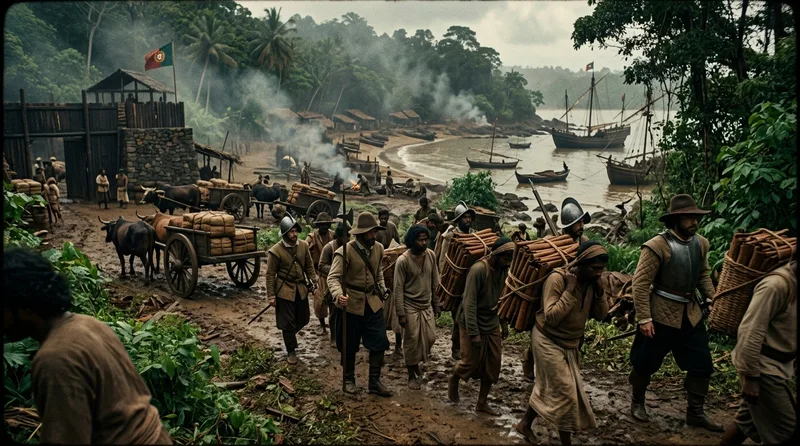
Ceylon, modern-day Sri Lanka, held the world’s only source of true cinnamon until 1505 CE, when Portuguese commander Lourenço de Almeida stumbled upon the island during a storm. Arab traders had jealously guarded the cinnamon route for over 2,000 years, spinning tales that the spice grew in valleys guarded by giant birds to discourage European competitors. The Portuguese brutally seized control in 1518 CE, establishing Fort Colombo and forcing Sinhalese peelers to harvest 280,000 pounds of cinnamon bark annually at gunpoint. European demand was insatiable—physicians prescribed cinnamon for everything from plague prevention to digestive complaints, while wealthy households burned cinnamon sticks as incense worth more than frankincense. A single pound of Ceylon cinnamon sold for the equivalent of a laborer’s annual wages in 1580s Amsterdam. The Dutch East India Company murdered, bribed, and warred their way to monopoly control by 1658 CE, limiting global supply to inflate prices artificially. This ruthless business model made the cinnamon route the most profitable trade path per pound in the 17th century, generating returns of 300% on each voyage and funding Dutch colonial expansion across Indonesia.
Source: smithsonianmag.com
3. Clove Route from Moluccas via Arab Intermediaries
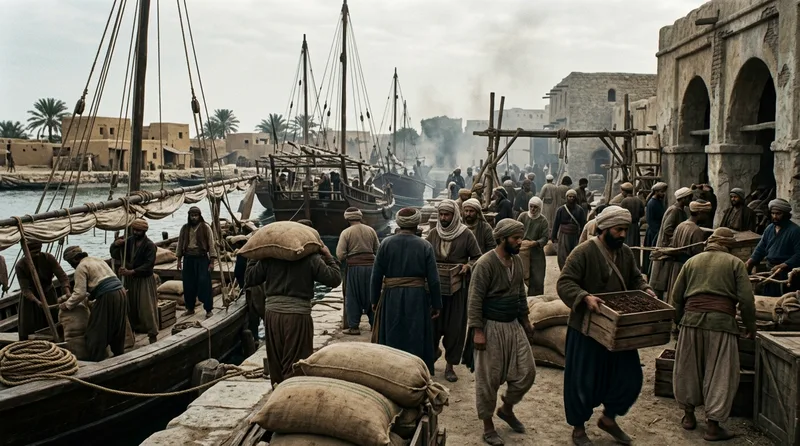
The Moluccas archipelago, five tiny volcanic islands in eastern Indonesia, produced the world’s entire clove supply until 1512 CE when Portuguese explorer Francisco Serrão became the first European to reach them. Arab traders had monopolized this 4,500-mile route since 200 BCE, transporting cloves through Javanese ports to India, then across the Indian Ocean to Arabian Peninsula markets, marking up prices 100-fold at each transfer point. Europeans valued cloves as powerfully as gold—a single clove could preserve meat for months, mask the taste of spoiled food, and supposedly cure dozens of ailments from toothaches to infertility. Ferdinand Magellan’s 1521 CE circumnavigation mission aimed specifically to break Arab control of the clove route, though he died in the Philippines before reaching the Moluccas. His surviving crew loaded 26 tons of cloves worth 10,000 ducats, enough to profit even after losing 4 of 5 ships and 90% of the crew. The Dutch massacred 15,000 Bandanese islanders between 1621 and 1629 CE to establish absolute monopoly, destroying clove trees on unauthorized islands and executing anyone who smuggled seeds. This genocidal control made cloves worth literally their weight in gold in Amsterdam markets until French smugglers broke the monopoly in 1770 CE by stealing seedlings to Mauritius.
Source: history.com
4. Nutmeg Route from Banda Islands Monopolized by Dutch
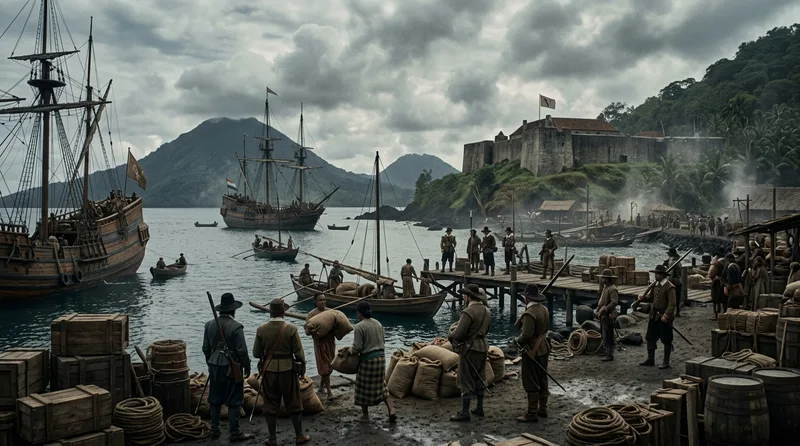
The Banda Islands, ten volcanic specks totaling just 17 square miles, grew the world’s only nutmeg trees until 1621 CE when Dutch Governor-General Jan Pieterszoon Coen orchestrated one of history’s most brutal monopolies. Nutmeg sold for 60,000% markup in European markets—a single nutmeg purchased in Banda for 1 penny sold in London for 3 shillings, enough to buy 600 loaves of bread. European nobles believed nutmeg could cure plague, prevent food poisoning, and induce abortions, making it the most sought-after spice despite limited supply. The Dutch systematically murdered or enslaved the entire indigenous Bandanese population of 15,000 people between 1621 and 1629 CE, replacing them with Dutch plantation overseers and imported slave labor. They burned nutmeg groves on neighboring islands and patrolled surrounding waters with warships, executing anyone caught with smuggled seeds. A single Dutch East India Company ship carrying 100 tons of nutmeg generated profits exceeding 200,000 guilders per voyage, funding Amsterdam’s transformation into Europe’s financial capital. The nutmeg monopoly lasted until 1770 CE when French botanist Pierre Poivre smuggled seedlings to Mauritius, breaking Dutch control and crashing nutmeg prices by 90% within two decades.
Source: smithsonianmag.com
5. Ginger Trade Route from India to Mediterranean
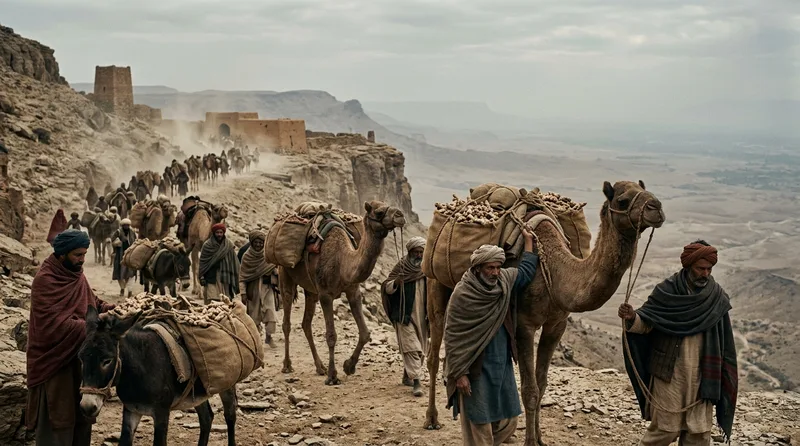
Indian ginger dominated global trade for 4,000 years before European exploration, with archaeological evidence showing ginger in Egyptian tombs from 1500 BCE and Roman accounts pricing it at 5 denarii per pound in 300 CE. The ginger route stretched 5,000 miles from Kerala’s Malabar Coast through Persian Gulf ports to Alexandria, then distributed across Mediterranean Europe via Genoese and Venetian traders. Medieval Europeans consumed ginger more than any other imported spice—accounting for 40% of England’s total spice imports by 1390 CE—using it to flavor everything from ale to meat pies to medicinal compounds. Queen Elizabeth I reportedly invented the ginger bread man cookie in 1560 CE, fashioning them to resemble visiting dignitaries. Unlike pepper or cloves, ginger’s lower price point made it accessible to middle-class households, though still expensive at 2 shillings per pound compared to a chicken at 3 pence. Portuguese discovery of direct routes to India in 1498 CE reduced ginger prices by 60%, democratizing access and spurring European demand to 800 tons annually by 1600 CE. The ginger trade proved less violently contested than cloves or nutmeg because multiple regions could cultivate it, making monopoly control impossible and allowing more peaceful commercial competition between European trading companies.
Source: britannica.com
6. Saffron Route from Kashmir through Persian Networks
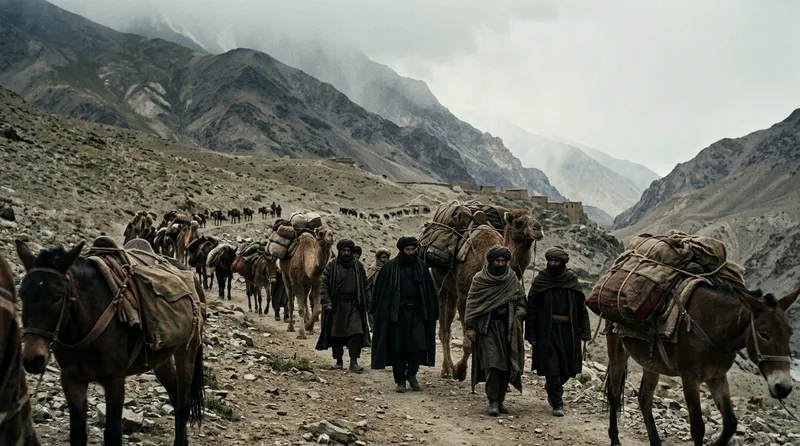
Kashmir saffron commanded prices 3,000 times higher than equivalent weight beef in medieval European markets, making it history’s most expensive spice by unit cost at 15 gold florins per pound in 1450 CE. Persian traders controlled the route from Kashmir through Central Asian oasis cities like Samarkand and Bukhara to Mediterranean ports, taking 18 months to complete the 4,000-mile journey with heavily armed caravans. European demand was driven by culinary fashion, textile dyeing, and medical superstition—physicians prescribed saffron for melancholy, heart problems, and dozens of other conditions despite zero medicinal value. Venetian merchants imported approximately 200 pounds of saffron annually by 1400 CE, enough to color 50,000 yards of luxury fabric that wealthy nobles wore to signal status. The saffron route’s extreme prices stemmed from brutal harvest requirements: 75,000 crocus flowers yielded just one pound of dried saffron threads, requiring 40 hours of hand labor. Spanish cultivation in La Mancha region after 1500 CE partially broke Persian monopolies, though Kashmir saffron remained premium priced at double Spanish rates. Unlike violent clove or nutmeg monopolies, the saffron trade succeeded through information control—Persian traders convinced Europeans that Kashmir possessed unique soil chemistry impossible to replicate, protecting their markup chains for centuries.
Source: smithsonianmag.com
7. Cardamom Route from Western Ghats to Arabian Peninsula
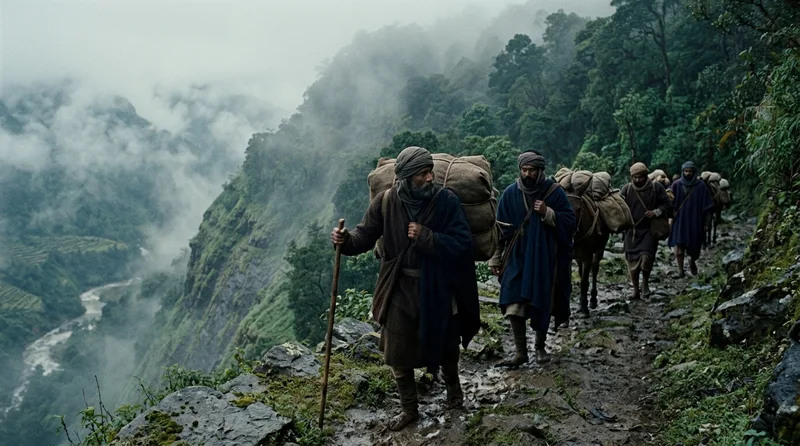
Wild cardamom grew exclusively in India’s Western Ghats mountain forests until 1500 CE, making the spice valuable enough that Arab merchants guarded route secrets as fiercely as military intelligence. The cardamom route connected Kerala’s mountain traders with Arabian Peninsula markets through Malabar Coast ports, then across the Indian Ocean to Aden and Jeddah in a 2,500-mile journey taking 6 months. Arab coffee culture drove cardamom demand after 1400 CE—wealthy households from Cairo to Istanbul added 2-3 crushed cardamom pods per coffee pot, consuming approximately 50 tons annually by 1600 CE. Europeans initially ignored cardamom until Portuguese colonizers in India discovered Arab merchants paid 40 ducats per hundredweight, triple black pepper’s price, making it worth investigating. Medieval Arab physicians prescribed cardamom for digestive problems and bad breath, creating medical demand that persisted into European markets by 1580 CE. Portuguese attempts to monopolize cardamom failed because wild forest growth made supply control impossible—unlike clove or nutmeg trees on tiny islands, cardamom vines spread across thousands of square miles of inaccessible mountain terrain. The cardamom route remained predominantly Arab-controlled until British colonial plantations in 1800s Ceylon finally broke the monopoly, though Guatemala eventually became the world’s largest producer after successful transplantation in 1920 CE.
Source: history.com
8. Mace Route from Indonesian Archipelago to Europe
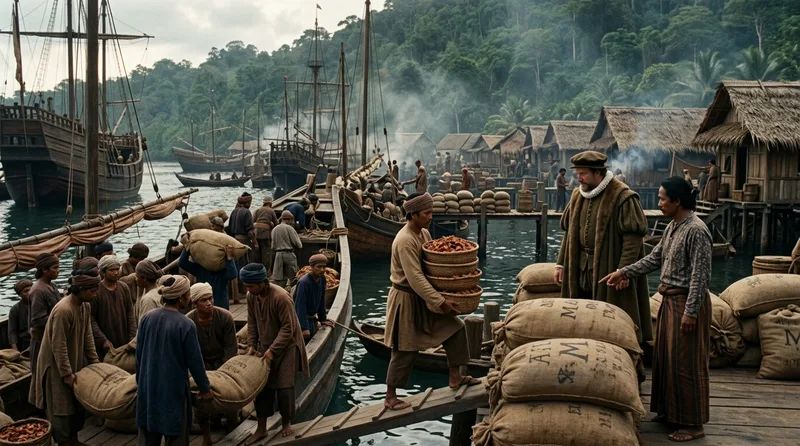
Mace, the crimson web covering nutmeg seeds, sold for even higher prices than nutmeg itself in 16th-century European markets at 4 shillings per ounce compared to nutmeg’s 2 shillings. The mace route originated identically to nutmeg in the Banda Islands, but Dutch traders classified mace separately to maximize profits through artificial scarcity—they could sell both products from a single nutmeg tree at premium prices. One nutmeg tree yielded only 10 pounds of mace annually versus 100 pounds of nutmeg, making mace genuinely rarer and justifying even more extreme monopoly enforcement. Dutch colonizers executed 8 Japanese merchants in 1623 CE at Amboina for allegedly conspiring to smuggle mace seeds, an incident that nearly triggered war between Netherlands and England. European aristocrats particularly prized mace for savory dishes while reserving nutmeg for desserts, creating distinct market demand that kept both spices profitable despite coming from identical trees. The Dutch earned approximately 30,000 guilders per ton of mace versus 20,000 for nutmeg on Amsterdam markets in 1650 CE, incentivizing them to harvest mace even from immature nutmegs, which reduced long-term tree productivity. Mace’s extreme value created the bizarre situation where Dutch plantation overseers guarded the red webbing more carefully than the actual nutmeg seeds, even though both came from the same fruit.
Source: britannica.com
9. Turmeric Route from South India Through Maritime Networks
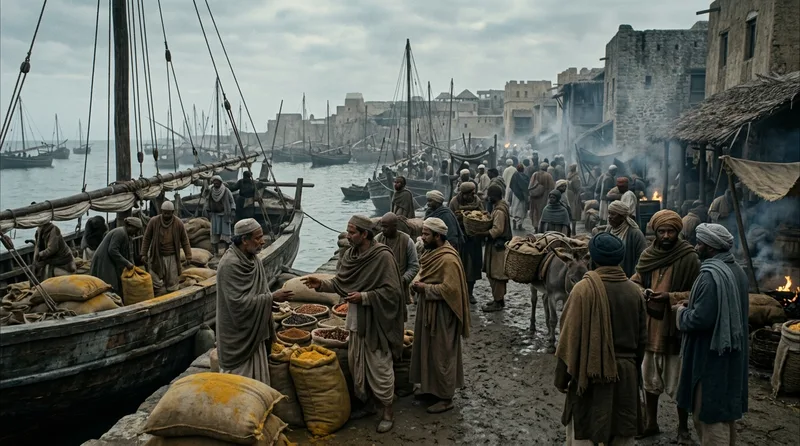
Turmeric traveled 6,000 miles from Tamil Nadu and Kerala through Indian Ocean maritime networks to East African ports, then overland to Mediterranean markets by 800 CE, though Europeans largely ignored it until Portuguese traders recognized its value in 1520 CE. Arab and Persian merchants valued turmeric primarily as a textile dye producing brilliant yellow colors that European woad and saffron couldn’t match, shipping 400 tons annually through Red Sea routes by 1400 CE. The spice cost one-tenth nutmeg’s price but sold in 100 times greater volume, making total turmeric trade revenue comparable to premium spices and less risky to transport since pirates often ignored seemingly mundane yellow roots. Indian merchants deliberately kept European traders ignorant of turmeric’s culinary uses until 1600 CE, preferring to sell it as cheap dye while reserving culinary-grade turmeric for Asian markets at triple the price. Portuguese Estado da India imported 200 tons of turmeric to Lisbon by 1580 CE, where it gained popularity as a cheaper saffron substitute for coloring rice dishes at one-twentieth the cost. Dutch and English trading companies ignored turmeric for decades, dismissing it as low-profit bulk cargo, which allowed Portuguese merchants to dominate European turmeric trade throughout the 16th century. The turmeric route proved remarkably peaceful compared to violent clove and nutmeg monopolies because multiple regions cultivated it successfully and low profit margins discouraged military action.
Source: smithsonianmag.com
10. Vanilla Route Post-Columbian Exchange from Mexico to Europe
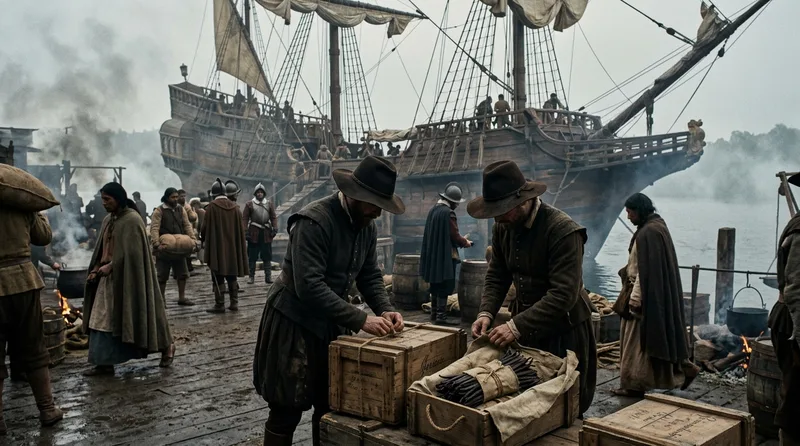
Vanilla existed nowhere outside Mexico until Spanish conquistador Hernán Cortés tasted chocolate flavored with vanilla at Montezuma II’s court in 1520 CE and shipped pods to Spain, creating Europe’s first entirely New World spice route. The Totonac people of Veracruz had cultivated vanilla orchids for over 1,000 years using specialized hand-pollination techniques that Spanish colonizers couldn’t replicate, creating an accidental Mexican monopoly lasting 300 years. European demand exploded after 1602 CE when Queen Elizabeth I’s apothecary Hugh Morgan created pure vanilla flavoring, but global supply remained limited to approximately 2,000 pounds annually from Veracruz. Spanish authorities earned 50,000 pesos yearly taxing vanilla exports by 1650 CE, making it Mexico’s third most valuable export after silver and cochineal dye. The vanilla route differed dramatically from Asian spice trades because it flowed westward across the Atlantic rather than eastward around Africa, utilizing Spanish treasure fleet convoys that departed Veracruz twice yearly. French colonizers attempted vanilla cultivation in Madagascar and Réunion after 1819 CE but failed completely until 12-year-old slave Edmond Albius invented practical hand-pollination in 1841 CE, breaking Mexico’s monopoly. The vanilla route proved unique among spice trades because monopoly control resulted from pollination biology rather than military force, demonstrating that nature could protect trade secrets more effectively than any navy.
Source: history.com
Did You Know?
Did You Know? The Dutch East India Company once traded Manhattan Island to the British for Run Island in the Banda archipelago—a 3-kilometer speck valued solely for its nutmeg trees. In 1667 CE, nutmeg seemed the obviously superior asset, yet this lopsided swap accidentally gave Britain New York City while the nutmeg monopoly collapsed within a century, proving that spice routes could make nations tragically misjudge which resources would matter most.