
In 1608, a Dutch spectacle maker accidentally aligned two lenses and glimpsed a church tower magnified beyond belief. Within decades, this discovery shattered humanity’s cosmic understanding, revealing Jupiter’s moons, Saturn’s rings, and a universe far vaster than imagined.
1. Galileo’s Refracting Telescope Shattered the Perfect Heavens
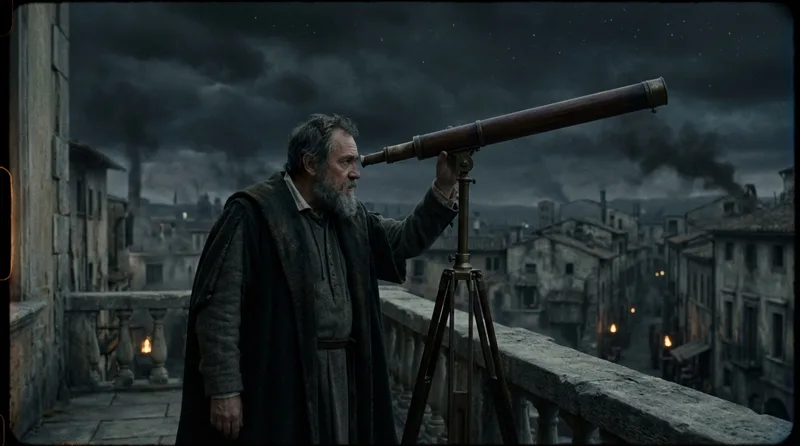
When Galileo Galilei turned his 20-power refracting telescope toward Jupiter on January 7, 1610, he discovered four moons orbiting the planet—a finding that demolished the ancient belief that all celestial bodies circled Earth. His instrument, constructed in Padua during 1609, used a convex objective lens and a concave eyepiece to achieve magnifications previously impossible with simple spyglasses. The telescope consisted of a lead tube roughly 3 feet long with lenses ground by Galileo himself in his workshop. Within months, he had cataloged mountains on Earth’s Moon, resolved the Milky Way into countless individual stars, and observed the phases of Venus—each discovery a hammer blow against the Aristotelian cosmos that had dominated for 2,000 years. The Catholic Church initially celebrated these findings until their implications became clear: if Venus showed phases like the Moon, it must orbit the Sun, not Earth. By March 1610, Galileo published these observations in “Sidereus Nuncius” (Starry Messenger), selling all 550 copies within a week. His telescope design, though simple by contemporary standards, magnified objects roughly 30 times by 1610, enough to reveal that the universe operated by physical laws, not divine perfection. This single instrument transformed astronomy from philosophical speculation into empirical science, forcing scholars to abandon centuries of cosmic certainty for observable evidence.
Source: britannica.com
2. Kepler’s Convex Eyepiece Design Doubled Astronomical Clarity
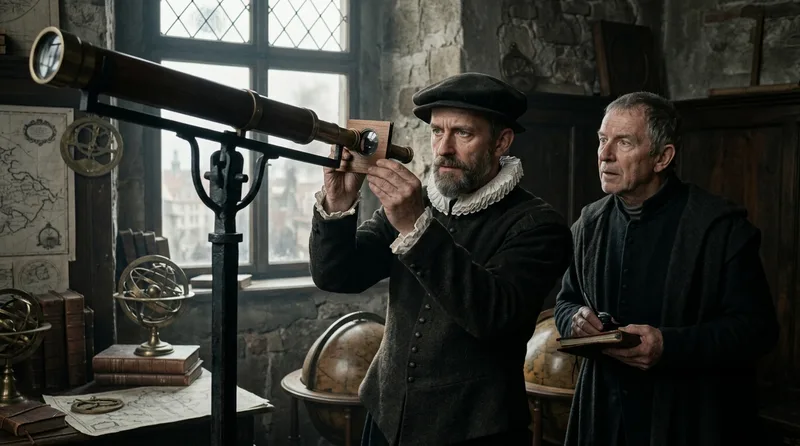
Johannes Kepler revolutionized telescope design in 1611 by replacing Galileo’s concave eyepiece with a convex lens, creating what astronomers would call the Keplerian telescope. This seemingly minor adjustment, published in his treatise “Dioptrice,” doubled the field of view and produced significantly sharper images, though at the cost of inverting the image—irrelevant for celestial observation. Kepler’s design used two convex lenses separated by the sum of their focal lengths, typically spanning 4 to 6 feet in early models. The German mathematician and astronomer had never actually built the telescope himself; he merely described the optical principles in 1611 after studying Galileo’s instruments during a visit to Italy. Christoph Scheiner, a Jesuit astronomer, constructed the first working Keplerian telescope around 1613 and immediately discovered that sunspots rotated, proving the Sun itself spun on an axis. The design’s superior light-gathering ability and wider field made it the preferred instrument for serious astronomical work throughout the 17th century. By 1630, most European observatories had abandoned Galilean designs entirely in favor of Kepler’s configuration. The Keplerian telescope became the foundation for all modern refracting telescopes, including those used by astronomers for the next 250 years. This optical arrangement permitted the later addition of crosshairs and micrometers for precise measurements, transforming astronomy from mere observation into quantitative science capable of mathematical analysis.
Source: britannica.com
3. Hevelius’s 150-Foot Aerial Telescope Required an Entire Crew

Johannes Hevelius, the wealthy brewer-turned-astronomer of Danzig, constructed the longest telescope of the 17th century in 1673—a monstrous 150-foot-long aerial refractor that required a team of assistants and an elaborate wooden framework to operate. The instrument’s extreme length addressed a critical problem: chromatic aberration, the colored halos that plagued all refracting telescopes when multiple lenses were used together. By spacing a single objective lens 150 feet from the eyepiece with no connecting tube, Hevelius achieved magnifications exceeding 150 times while minimizing optical distortions. The telescope’s objective lens, ground to Hevelius’s specifications, measured nearly 8 inches in diameter and weighed 12 pounds. Operating this contraption required at least 3 people: one to aim the suspended objective lens using ropes and pulleys, another to position the eyepiece on a separate mast, and a third to record observations while perched precariously on a viewing platform. Hevelius used this unwieldy instrument to create the most detailed lunar maps of his era, cataloging 1,564 stars in his “Prodromus Astronomiae” published in 1690. Despite its astronomical power, the telescope proved nearly impossible to use in anything stronger than a gentle breeze, and adjusting aim took upward of 15 minutes. The instrument represented the absolute limit of aerial telescope design—any longer and atmospheric turbulence rendered observations impossible. Within fifty years, Newton’s reflecting design had made such extreme lengths unnecessary, but Hevelius’s persistence demonstrated the extraordinary lengths 17th-century astronomers would pursue for clearer cosmic views.
Source: britannica.com
4. Newton’s Mirror Design Eliminated Chromatic Aberration Entirely
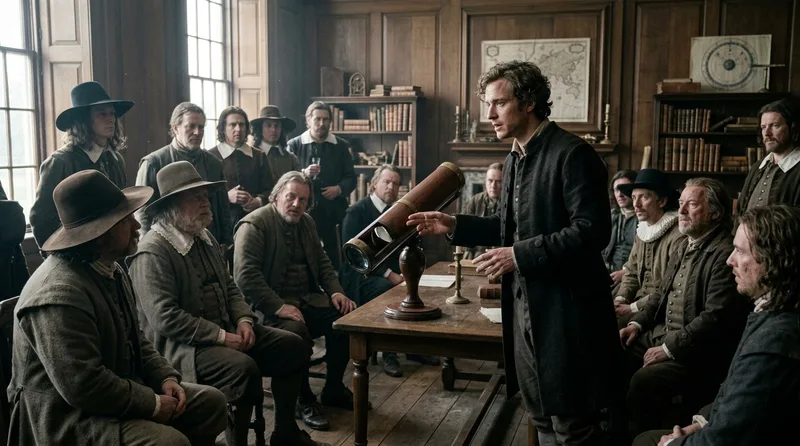
Isaac Newton presented his revolutionary reflecting telescope to the Royal Society on January 11, 1672, silencing critics who claimed mirrors could never match lenses for astronomical observation. His 6-inch-long instrument, built in 1668, used a curved primary mirror made of speculum metal—an alloy of copper and tin polished to extraordinary smoothness—to gather and focus light without the chromatic aberration that plagued all refracting telescopes. The design featured a flat secondary mirror angled at 45 degrees to direct light to an eyepiece mounted on the telescope’s side, a configuration now called the Newtonian reflector. Newton had ground the primary mirror himself in his Cambridge rooms, achieving a focal length of approximately 6 inches with a magnification of 40 times, matching telescopes three times longer. The instrument weighed barely 2 pounds yet performed as well as a 6-foot-long refractor, prompting Newton’s election to the Royal Society at age 29. By using reflection rather than refraction, Newton eliminated the fundamental problem that had forced astronomers like Hevelius to build absurdly long telescopes. The design faced initial skepticism because speculum metal tarnished quickly and required frequent repolishing, losing reflectivity within months. Nevertheless, by 1730, most serious astronomers recognized that reflecting telescopes represented the future of large-aperture astronomy. Newton’s innovation permitted the construction of much larger telescopes—eventually spanning dozens of feet in diameter—that would have been impossible with glass lenses too heavy to support their own weight. This single design dominated professional astronomy for 250 years until the invention of silvered glass mirrors in the nineteenth century.
Source: britannica.com
5. Cassegrain’s Compact Design Doubled Power in Half the Length
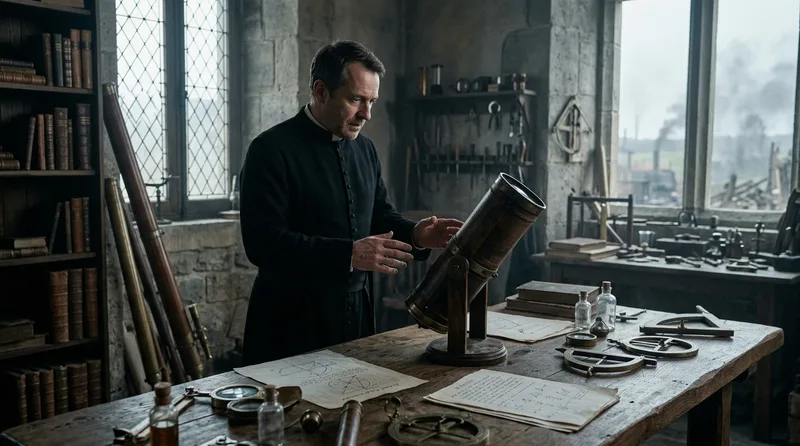
Laurent Cassegrain, a French Catholic priest and teacher, published a revolutionary reflecting telescope design in 1672 that folded the light path back on itself, creating an instrument far more compact than Newton’s yet equally powerful. His design employed a concave primary mirror with a hole at its center and a convex secondary mirror that reflected light back through this opening to an eyepiece behind the primary—essentially doubling the focal length within the same physical tube. A Cassegrain telescope measuring 2 feet long could match the performance of a 4-foot Newtonian reflector, making it vastly more portable and easier to mount. The design appeared in the “Journal des Sçavans” on April 25, 1672, just three months after Newton presented his telescope to the Royal Society, triggering a brief priority dispute. Astronomers initially dismissed Cassegrain’s instrument as overly complex, requiring two precisely curved mirrors instead of Newton’s single parabolic primary and flat secondary. Guillaume Cassegrain (no relation to Laurent) built the first working model around 1680, demonstrating that the compact design actually reduced mechanical stress on the mounting. By 1730, the Cassegrain configuration had become the preferred design for observatory telescopes because its shorter tube flexed less under its own weight during observations. The design’s true genius lay in its scalability: while Newtonian telescopes became unwieldy beyond 10 feet in length, Cassegrain reflectors could reach equivalent focal lengths of 40 feet while remaining structurally manageable. Modern professional telescopes, including later innovations, still employ variations of Cassegrain’s 17th-century optical arrangement, testament to its enduring elegance and efficiency.
Source: britannica.com
6. Huygens’s Tubeless Design Let Astronomers Observe from Anywhere

Christiaan Huygens solved the problem of unwieldy aerial telescopes in 1684 by eliminating the tube entirely, suspending the objective lens from a tall pole and holding the eyepiece separately dozens of feet away. His tubeless aerial telescope, described in “Astroscopia Compendiaria,” used a ball-and-socket joint atop a wooden mast roughly 40 feet high, allowing the objective lens to swivel freely while the observer manipulated the eyepiece position using cords threaded through the apparatus. The Dutch mathematician and astronomer had discovered Titan, Saturn’s largest moon, in 1655 using a conventional 12-foot refractor of his own construction, but observing fainter objects demanded longer focal lengths without the structural challenges of maintaining a rigid 100-foot tube. Huygens’s design employed objective lenses up to 8 inches in diameter with focal lengths reaching 210 feet—the longest successfully used in the 17th century. A single observer could now operate the telescope alone by adjusting three control lines: one for elevation, one for azimuth, and one to rotate the objective lens for focusing. By 1690, observatories across Europe had adopted Huygens’s system, with astronomers in Paris routinely using 70-foot configurations to study Saturn’s rings and Jupiter’s cloud bands. The design required calm weather and exceptional patience—aligning the separated optical elements took upward of 20 minutes—but produced images of unprecedented clarity. Huygens himself used a 123-foot tubeless telescope in 1686 to measure the diameter of Mars with accuracy not surpassed for another century. These instruments represented the apex of refracting telescope development before Newton’s reflecting design rendered extreme focal lengths unnecessary.
Source: britannica.com
7. Gregory’s Design Preceded Newton’s but Suffered From Implementation
James Gregory, a Scottish mathematician, published the first practical design for a reflecting telescope in 1663—five years before Newton built his—but failed to find craftsmen capable of grinding the necessary parabolic and elliptical mirrors to sufficient precision. His “Optica Promota,” released in London, described a two-mirror system using a concave parabolic primary mirror and a concave elliptical secondary that reflected light back through a hole in the primary to an eyepiece behind it. The Gregorian telescope promised several advantages over simple refractors: no chromatic aberration, a compact design with the eyepiece conveniently located for observation, and an upright image useful for terrestrial viewing. Gregory calculated that a primary mirror 6 inches in diameter with a focal length of 30 inches would produce magnifications exceeding 100 times in an instrument barely 2 feet long. London instrument maker Richard Reive attempted to construct Gregory’s telescope in 1664 but abandoned the project after failing to polish the complex curves accurately enough—the margin of error required was less than one-thousandth of an inch. Robert Hooke successfully built the first working Gregorian telescope around 1674, demonstrating that Gregory’s mathematics had been sound all along. By 1680, the design had become popular for smaller portable telescopes because it produced an erect image, unlike Newton’s and Cassegrain’s inverted views. The Gregorian configuration excelled for lunar and planetary observation, with astronomers in Edinburgh using a 5-foot model to compile detailed maps of the Moon by 1735. Despite its technical merits, the difficulty of manufacturing the elliptical secondary mirror meant Gregorian telescopes never dominated astronomy as Newton’s simpler design did, though the configuration remained in use at observatories well into the eighteenth century.
Source: britannica.com
8. Herschel’s 40-Foot Giant Discovered Moons and Doubled Known Universe
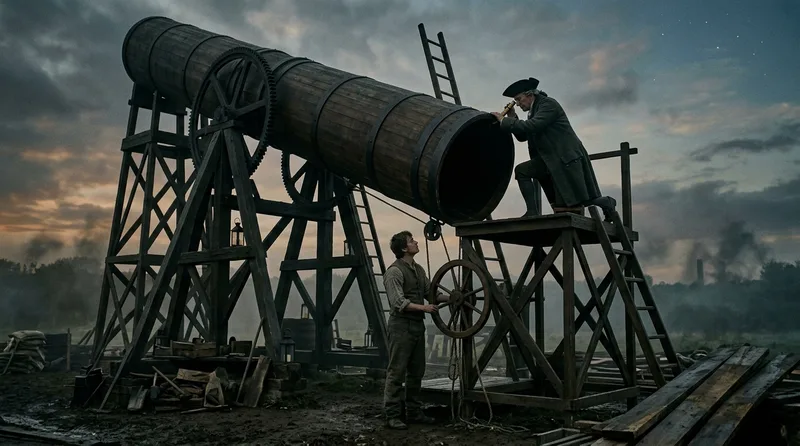
William Herschel completed his colossal 40-foot reflecting telescope in August 1789 at his Slough observatory, creating the largest scientific instrument in the world with a 48-inch-diameter primary mirror weighing 2,118 pounds. The tube itself stretched 40 feet long and required a massive wooden framework with pulleys, ladders, and platforms for the observing team—Herschel’s sister Caroline often assisted from a separate station, shouting observations through speaking tubes. The speculum metal mirror, cast in Herschel’s own furnace after numerous failed attempts, gathered 900 times more light than the human eye and could detect objects as faint as 17th magnitude. On August 28, 1789—just three weeks after completion—Herschel discovered Enceladus, the sixth moon of Saturn, followed by the detection of Mimas on September 17 of that same year. The telescope’s immense light-gathering power revealed nebulae and star clusters never before imagined, leading Herschel to catalog more than 2,500 deep-sky objects by 1802. Operating the instrument demanded extraordinary physical effort: raising or lowering the tube required 2 assistants working winches, while Herschel perched on a movable platform 50 feet above ground in darkness. The mirror tarnished so rapidly that Herschel maintained a second identical mirror, swapping them every few months for repolishing—a process requiring 14 hours of grinding. Despite these challenges, the 40-foot telescope doubled the known diameter of the universe by revealing stars at unprecedented distances. King George III personally visited the telescope in 1790, walking through the tube before its assembly—legend holds the King remarked, “Come, my Lord Bishop, I will show you the way to Heaven.” This monument to Herschel’s ambition operated for fifty years until structural decay forced its dismantling in 1839.
Source: britannica.com
9. Dollond’s Achromatic Lens Finally Conquered Color Distortion
John Dollond shocked the astronomical community in 1758 by successfully creating an achromatic lens that eliminated the chromatic aberration plaguing all refracting telescopes for 150 years—something Newton himself had declared theoretically impossible. The London optician combined crown glass and flint glass elements with different refractive properties into a single compound lens, each element canceling the other’s color distortion. Dollond’s breakthrough came after studying Chester Moor Hall’s earlier experiments from 1733, though Hall had never publicized his discovery or developed it commercially. The achromatic doublet lens permitted refractors to compete with reflecting telescopes for the first time since Newton’s invention, offering sharper images without the light loss and frequent repolishing that plagued metal mirrors. Dollond’s 3-foot achromatic refractor, completed in 1758, produced images rivaling those from 6-foot single-lens instruments while weighing half as much and requiring no special mounting. The Royal Society awarded Dollond the Copley Medal in 1758, and King George II granted him a patent despite priority disputes from other opticians. By 1765, Dollond’s workshop was producing achromatic telescopes ranging from 2 to 5 feet in length for observatories across Europe, selling for £20 to £100 depending on aperture. His design revolutionized both astronomy and navigation—achromatic telescopes became standard equipment on Royal Navy vessels by 1770, dramatically improving celestial navigation accuracy. The compound lens design permitted construction of much larger refractors; by 1824, instrument makers had built achromatic telescopes with 10-inch apertures and 15-foot focal lengths. Dollond’s innovation ensured that refracting telescopes remained competitive with reflectors until the early twentieth century, when the difficulty of casting large glass blanks finally gave mirrors permanent supremacy.
Source: britannica.com
10. Bradley’s Zenith Sector Proved Earth Moves Through Space
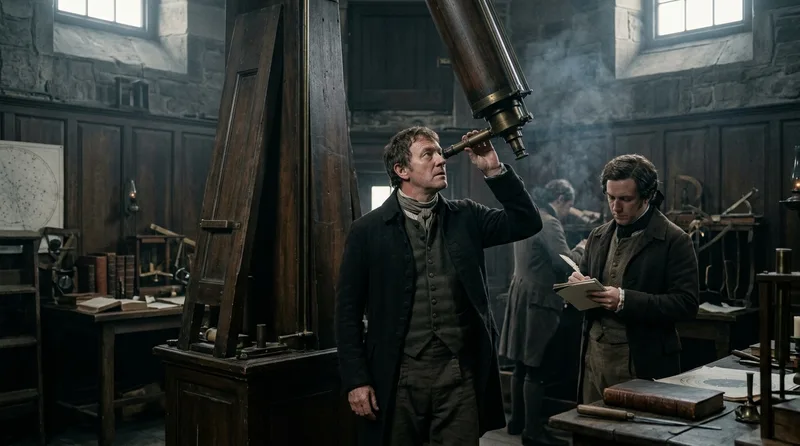
James Bradley revolutionized positional astronomy in 1727 by constructing a 24-foot zenith sector—a specialized telescope fixed to observe only stars passing directly overhead—that finally proved Earth orbits the Sun through direct measurement. His instrument, installed at Kew Observatory, consisted of a precisely graduated brass arc mounted vertically with a plumb line defining true vertical to an accuracy of 1 arc second (1/3600th of a degree). Bradley designed the zenith sector to measure stellar parallax, the apparent shift in star positions caused by Earth’s orbital motion, which astronomers had sought unsuccessfully for centuries. Instead of parallax, Bradley discovered stellar aberration: stars appeared displaced by up to 20 arc seconds depending on the season, not because they moved, but because light traveled at finite speed while Earth moved through space. His measurements, published in 1729, demonstrated that Earth traveled approximately 18.5 miles per second in its orbit—the first accurate determination of orbital velocity. The discovery required Bradley to observe the star Gamma Draconis nightly for over a year, measuring its position to previously impossible precision. His zenith sector design featured a telescope 24 feet long with a 2.5-inch objective lens suspended from a brass quadrant marked in degrees, minutes, and seconds. Bradley’s observations also led to his 1748 discovery of nutation, the slight wobble in Earth’s axis caused by the Moon’s gravitational pull—detected as tiny periodic variations in stellar positions over an 18.6-year cycle. The zenith sector design spread to observatories throughout Europe by 1740, becoming the standard instrument for precise positional measurements. Bradley’s discoveries transformed astronomy from the study of celestial motions into astrophysics, proving that measuring stellar positions with sufficient accuracy could reveal fundamental properties of light, Earth’s motion, and even gravitational effects invisible to casual observation.
Source: britannica.com
Did You Know?
Did You Know? The massive 40-foot Herschel telescope that discovered two moons of Saturn in 1789 was so large that King George III once walked through its tube before assembly, joking about showing his bishop “the way to Heaven.” Even more surprising: this engineering marvel was rendered obsolete within seventy years by smaller telescopes using Dollond’s achromatic lenses, proving that optical innovation often trumps sheer size in astronomical discovery.