
The Renaissance didn’t spontaneously rediscover ancient wisdom—it was rescued by obsessive scholars who spent decades hunting through dusty monastery libraries, literally saving Western philosophy from extinction with single crumbling manuscripts.
1. Poggio Bracciolini Found the Only Surviving Copy of Lucretius in a German Tower
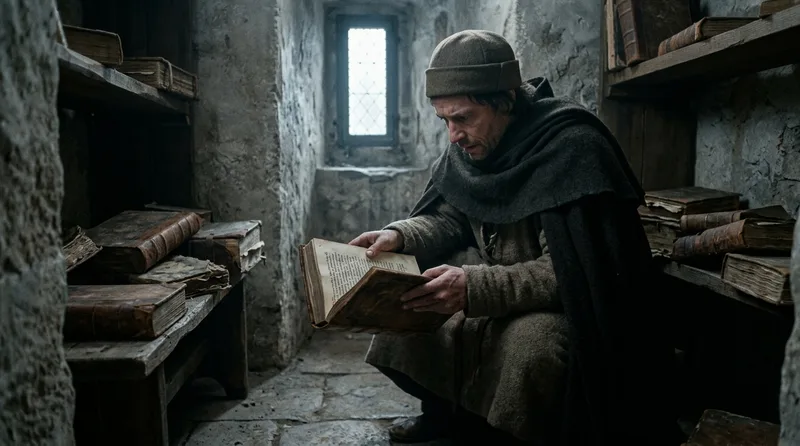
In January 1417, Poggio Bracciolini discovered a complete manuscript of Lucretius’s ‘De Rerum Natura’ gathering dust in a tower library at the Abbey of Fulda in Germany. This single copy contained the only surviving version of the Roman poet’s revolutionary atomic theory, which argued that all matter consisted of invisible particles moving through empty space. Poggio, serving as apostolic secretary to Pope John XXIII, had been exploring monastic libraries during the Council of Constance when he stumbled upon the 9th-century codex. The manuscript’s ideas about atoms, evolution, and a universe without divine intervention directly challenged medieval Christian cosmology. Within 30 years of Poggio’s discovery, scribes had produced over 50 copies, spreading Epicurean philosophy across Renaissance Italy. Without this single find, modern atomic theory might have lacked its ancient precedent, and Enlightenment thinkers would have missed a crucial bridge between classical materialism and scientific revolution. Poggio’s detective work in that German tower literally pulled Western science back from a thousand-year detour into purely theological explanations of nature.
Source: britannica.com
2. Manuel Chrysoloras Brought the Greek Language Back to Western Europe After 700 Years
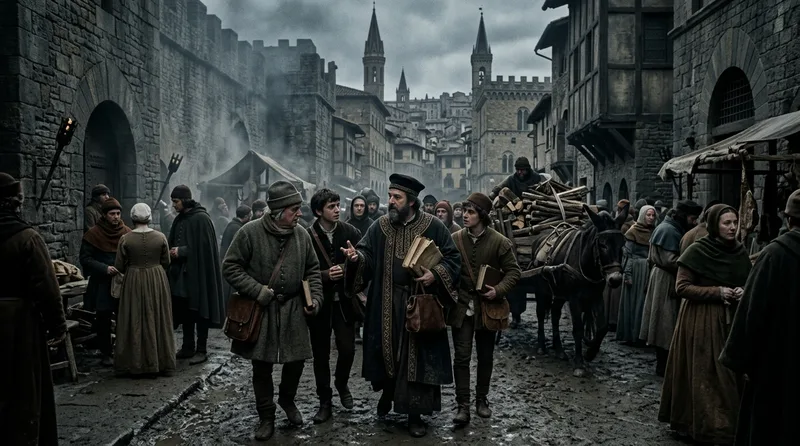
When Manuel Chrysoloras arrived in Florence in February 1397, no Western scholar had taught Greek language there for seven centuries. The Byzantine diplomat transformed Renaissance scholarship by establishing the first systematic Greek instruction program, allowing Italian humanists to read Homer, Plato, and Aristotle in their original tongue rather than through often-mangled Arabic-to-Latin translations. Chrysoloras came at the invitation of Chancellor Coluccio Salutati, who offered him the extraordinary annual salary of 150 florins—more than most professors earned in five years. His students included Guarino da Verona, Leonardo Bruni, and Palla Strozzi, who would become the next generation’s leading humanist scholars. Before Chrysoloras, Western Europeans depended entirely on second-hand Latin versions of Greek philosophy, losing subtle meanings and entire concepts in translation. His grammar textbook ‘Erotemata’ became the standard Greek primer for 200 years, printed in over 30 editions. By teaching Florence’s intellectual elite to read classical Greek directly, Chrysoloras cracked open the original source code of Western philosophy, revealing layers of meaning that medieval scholars had never accessed.
Source: britannica.com
3. Marsilio Ficino Spent 12 Years Translating Every Word Plato Ever Wrote
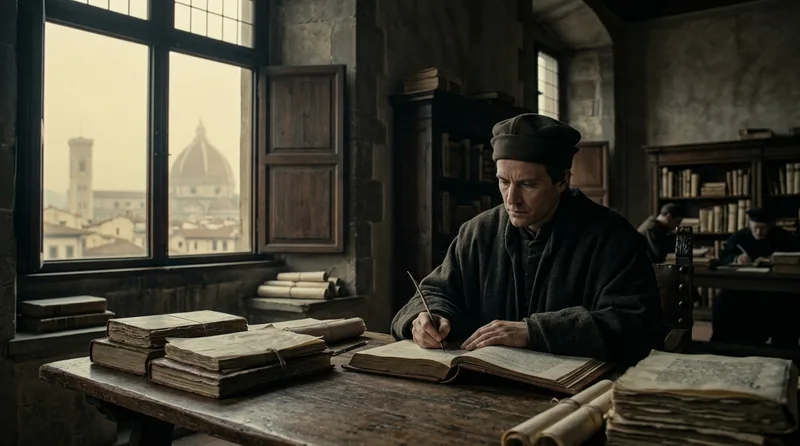
Between 1463 and 1475, Marsilio Ficino completed the monumental task of translating all 36 of Plato’s dialogues from Greek into Latin—the first time the complete Platonic corpus existed in a Western European language. Cosimo de’ Medici provided Ficino with a villa, an annual stipend of 200 florins, and a collection of Greek manuscripts specifically to accomplish this translation project. Before Ficino’s work, Western philosophers knew Plato primarily through Aristotle’s critiques and a partial translation of the ‘Timaeus’ made in the 4th century by Calcidius. Ficino’s translations revealed the full complexity of Platonic thought, including theories of love, beauty, and the immortal soul that medieval scholars had never encountered. His accompanying commentaries synthesized Platonic philosophy with Christian theology, creating ‘Neoplatonism’ that would dominate Renaissance thought for 200 years. The translations spread rapidly after printing—the 1484 Florence edition sold over 1,000 copies in its first year. By making Plato accessible and acceptable to Christian readers, Ficino fundamentally altered Western philosophy’s trajectory, establishing idealism as a respectable alternative to Aristotelian scholasticism.
Source: britannica.com
4. Giovanni Aurispa Smuggled 238 Greek Manuscripts Out of Constantinople Just Before It Fell

In 1423, Giovanni Aurispa returned to Italy from Constantinople carrying 238 Greek manuscripts—the single largest transfer of classical texts from Byzantine to Western libraries. This Sicilian priest and diplomat had spent years in Constantinople acquiring codices of Aeschylus, Sophocles, Plato, and Plotinus, recognizing that the Byzantine Empire’s political instability threatened these unique copies. Aurispa’s timing proved prophetic—Constantinople fell to Ottoman forces in 1453, just 30 years after his departure, and many remaining manuscripts were destroyed or scattered. Among his rescued texts were the only existing copies of several Platonic dialogues and the complete plays of Sophocles, including ‘Oedipus Rex’ and ‘Antigone’ that would inspire Renaissance tragedy. He sold portions of his collection to Pope Martin V for 500 gold ducats and deposited others in the library of Cosimo de’ Medici. Without Aurispa’s foresight and physical courage in transporting such a massive collection across dangerous Mediterranean waters, dozens of foundational Greek texts would have vanished completely, leaving Renaissance humanism without crucial primary sources for understanding ancient philosophy and drama.
Source: britannica.com
5. Lorenzo Valla Used Linguistic Analysis to Expose the Vatican’s Greatest Forgery
In 1440, Lorenzo Valla proved that the Donation of Constantine—the document justifying papal territorial control over Italy—was a medieval forgery, not a 4th-century imperial decree. Valla’s revolutionary textual analysis identified Latin vocabulary and grammatical constructions that didn’t exist until 700 years after Emperor Constantine’s death in 337 CE. The document claimed Constantine had granted Pope Sylvester I sovereignty over Rome and the Western Roman Empire, but Valla demonstrated it contained 8th-century Carolingian Latin phrases impossible in Constantine’s era. His treatise ‘De falso credita et ementita Constantini Donatione’ catalogued 37 specific anachronisms, including references to feudal terminology that postdated Constantine by four centuries. The Catholic Church had used the Donation for 600 years to legitimize temporal power over the Papal States, making Valla’s exposure politically explosive—he narrowly escaped execution and found protection with King Alfonso V of Naples. Valla’s method established philology and textual criticism as scientific disciplines, proving that rigorous linguistic analysis could uncover historical truth regardless of institutional authority’s claims. His work pioneered the critical approach that would eventually expose numerous forged medieval documents.
Source: britannica.com
6. Pico della Mirandola Mastered Hebrew and Arabic at 23 to Access Texts Christians Had Ignored

Giovanni Pico della Mirandola shocked Renaissance Italy in 1486 by publishing 900 theological theses drawing from Hebrew Kabbalah and Arabic philosophy—sources Christian scholars had systematically excluded for centuries. This 23-year-old prodigy had learned Hebrew, Aramaic, and Arabic specifically to read Jewish and Islamic commentaries on Aristotle and Plato that offered interpretations radically different from Christian orthodoxy. Pico argued in his ‘Oration on the Dignity of Man’ that truth transcended religious boundaries, and that Jewish mystical texts like the Zohar contained insights into human nature as valid as any Church Father’s writings. Pope Innocent VIII condemned 13 of Pico’s theses as heretical, forcing him to flee to France in 1488. His integration of Kabbalistic thought with Neoplatonism created ‘Christian Kabbalah,’ a syncretic tradition that influenced European esotericism for 300 years. By treating Hebrew and Arabic texts as legitimate sources of wisdom rather than enemy literature, Pico expanded the humanist project beyond recovering Greco-Roman classics to embracing a truly multicultural intellectual heritage that challenged Christian Europe’s cultural insularity.
Source: britannica.com
7. Angelo Poliziano Invented Modern Textual Criticism by Comparing 50 Manuscript Versions
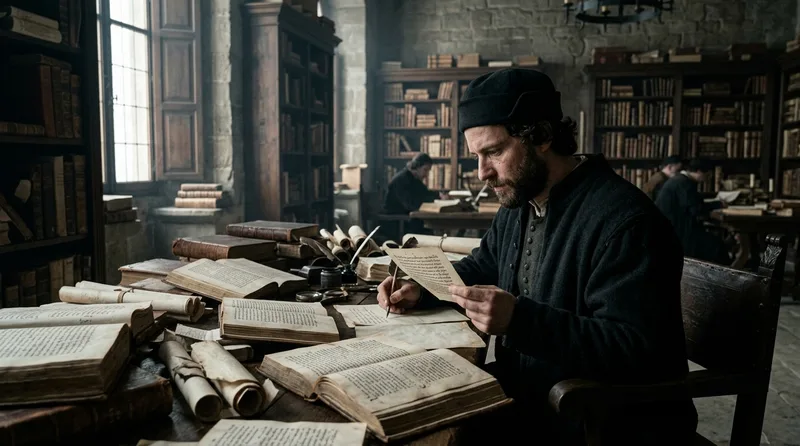
Angelo Poliziano revolutionized scholarship in the 1480s by systematically comparing dozens of manuscript copies to reconstruct original classical texts corrupted by centuries of scribal errors. His method of collating 50 different manuscripts of Cicero’s letters to identify copying mistakes and determine which version stood closest to the lost original established textual criticism as a rigorous discipline. Before Poliziano, scholars simply copied whatever manuscript they found; he proved that tracing copying relationships through shared errors could create family trees of texts, revealing which manuscripts descended from which. His ‘Miscellanea’ published in 1489 demonstrated this technique across 100 classical passages, correcting errors that had persisted for 800 years. Poliziano served as tutor to Lorenzo de’ Medici’s children and held the prestigious Greek chair at the University of Florence, earning 150 florins annually. His insight that later manuscripts might preserve better readings than older ones if copied from superior lost sources overturned the assumption that oldest automatically meant most accurate. Poliziano’s methods became the foundation for all modern scholarly editing, from biblical criticism to contemporary textual studies.
Source: britannica.com
8. Guarino da Verona Created the Educational System That Trained Three Generations of Humanists

Between 1429 and 1460, Guarino da Verona established at Ferrara the first complete humanist curriculum based entirely on recovered classical texts, training over 1,000 students who spread this educational model across Europe. After studying Greek with Manuel Chrysoloras in Constantinople for five years, Guarino returned to Italy in 1408 with 54 Greek manuscripts and a revolutionary teaching method emphasizing direct reading of ancient authors over medieval commentaries. His curriculum at the court school of Ferrara required students to master Latin grammar through Cicero, Greek through Homer, and rhetoric through Quintilian’s ‘Institutio Oratoria,’ which Poggio had rediscovered in 1416. Students spent seven years progressing through grammar, poetry, history, moral philosophy, and rhetoric—the studia humanitatis that defined Renaissance education for 300 years. Guarino’s pupils included princes, bishops, and future humanist teachers who established similar schools in Venice, Milan, and Mantua. His textbooks remained standard references until the 17th century, and his insistence on reading complete works rather than excerpted passages transformed education from memorizing authorities to engaging critically with primary sources.
Source: britannica.com
9. Niccolò Niccoli Spent His Entire Fortune Building Florence’s First Public Library
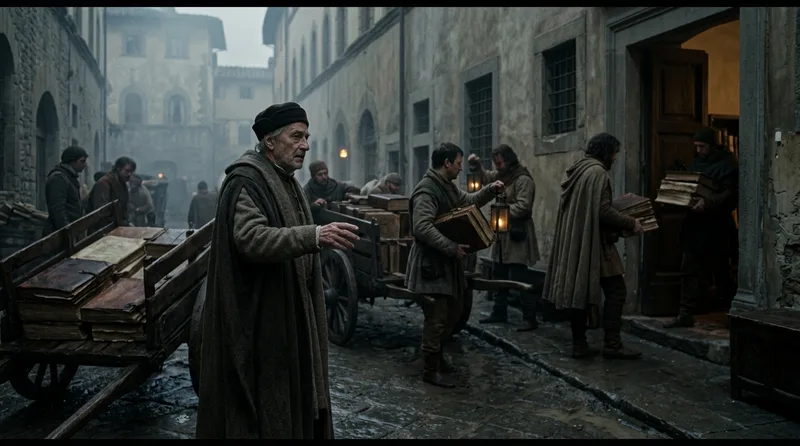
Niccolò Niccoli assembled 800 classical manuscripts between 1400 and 1437, bankrupting himself to create the largest private collection of ancient texts in Italy, which he bequeathed to become Florence’s first public library. This wealthy merchant spent 25,000 florins—equivalent to building three grand palaces—purchasing every classical codex he could locate across Europe and Byzantium. Niccoli’s collection included rare works by Ammianus Marcellinus, Tertullian, and Plautus that existed in only one or two other copies worldwide. He commissioned Poggio Bracciolini and other manuscript hunters, paying premium prices for discoveries and employing 45 scribes to produce copies in his distinctive humanist script that replaced medieval Gothic lettering. Cosimo de’ Medici paid Niccoli’s massive debts after his death in 1437 on condition the collection remain accessible to scholars—it formed the nucleus of the Biblioteca Medicea Laurenziana, Europe’s first lending library open to qualified readers regardless of social status. Niccoli’s obsessive collecting preserved texts that would otherwise have perished and established the principle that classical knowledge belonged to humanity, not private owners.
Source: britannica.com
10. Francesco Filelfo Found Lost Cicero Speeches Hidden in a Cathedral’s Forgotten Chest
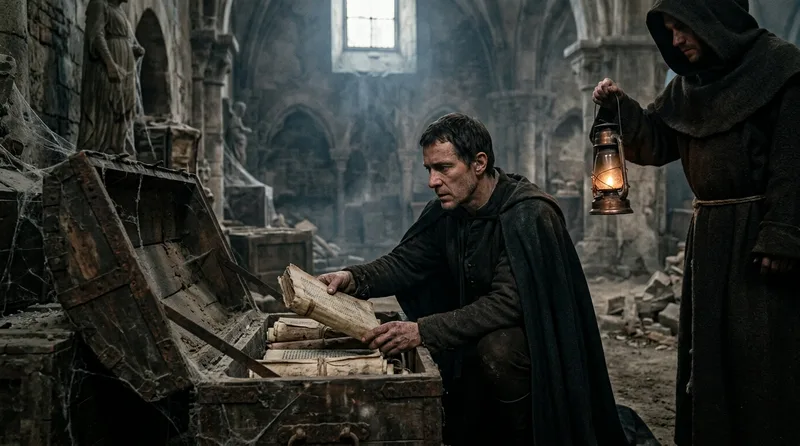
In 1421, Francesco Filelfo discovered a manuscript containing seven previously unknown orations by Cicero in the cathedral library at Lodi, doubling the number of known Ciceronian speeches and transforming Renaissance understanding of Roman rhetoric. The manuscript, a 9th-century codex stored in a locked chest that hadn’t been opened in 300 years, included ‘Pro Caecina’ and ‘Pro Cluentio’—courtroom speeches demonstrating forensic techniques medieval scholars had considered lost forever. Filelfo, who had spent seven years in Constantinople mastering Greek and marrying the daughter of Manuel Chrysoloras, recognized the manuscript’s significance immediately and made copies before church officials could restrict access. His Latin eloquence and Greek expertise made him the highest-paid humanist of his era, earning 600 florins annually at the University of Milan—six times a typical professor’s salary. The recovered speeches revolutionized legal education and rhetorical training, providing models of argumentation that law schools incorporated into curricula across Europe. Filelfo’s find demonstrated that major classical texts still lay undiscovered in provincial church libraries, inspiring decades of systematic searches that recovered dozens of additional Roman works.
Source: britannica.com
Did You Know?
Did You Know? If Poggio Bracciolini had arrived at Fulda Abbey just 20 years later, the only complete copy of Lucretius would have been destroyed—monks were systematically recycling pagan manuscripts into binding materials for prayer books. Even more surprising: Giovanni Aurispa’s 238 rescued manuscripts traveled to Italy packed in wine barrels to disguise them from pirates, meaning Western philosophy literally survived by being smuggled as contraband alcohol.