
When Galileo pointed his telescope at Jupiter in 1610, he discovered moons that would land him under house arrest for life. The Scientific Revolution was warfare between observation and orthodoxy, where each experiment risked excommunication or worse.
1. Galileo’s Telescope Revealed Four Moons Orbiting Jupiter
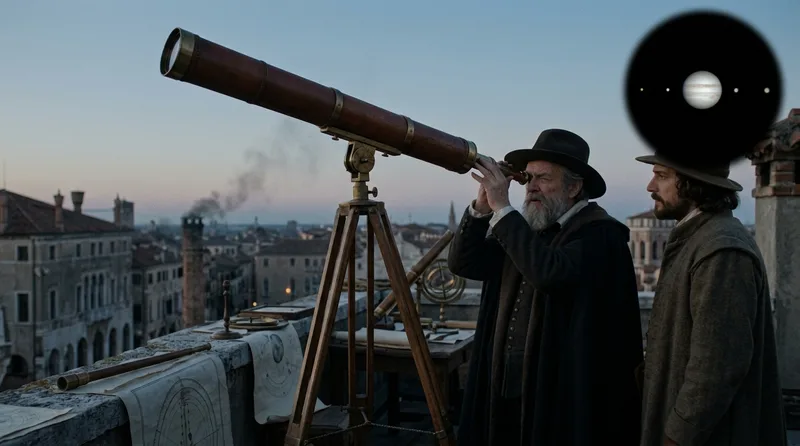
On January 7, 1610, Galileo Galilei turned his newly improved 20-power telescope toward Jupiter and witnessed something the Church insisted was impossible: four points of light moving around the planet. Over successive nights, he tracked what he called the Medicean Stars—now known as Io, Europa, Ganymede, and Callisto—and documented their orbital patterns in precise detail. This observation shattered the Aristotelian cosmology endorsed by the Catholic Church, which declared that all celestial bodies must orbit Earth. Galileo published his findings in Sidereus Nuncius (Starry Messenger) in March 1610, selling out all 550 copies within a week. The discovery provided direct evidence for the Copernican system, demonstrating that Earth was not the universe’s center. By 1633, the Roman Inquisition convicted Galileo of heresy, forcing him to recant and sentencing him to house arrest for the remaining nine years of his life. His observations with that 3-foot-long tube fundamentally redefined humanity’s place in the cosmos, proving that empirical observation could trump centuries of religious doctrine.
Source: britannica.com
2. William Harvey Proved Blood Circulates Against Scripture
In 1628, English physician William Harvey published De Motu Cordis, demonstrating through systematic experimentation that blood circulates throughout the body in a closed system powered by the heart. Harvey calculated that the heart pumped roughly 2 ounces per beat, meaning it moved over 500 pounds of blood daily—far too much for the liver to continuously produce, as Church-endorsed Galenic theory claimed. Through vivisections on over 80 animal species and mathematical proofs, Harvey showed the heart functioned as a mechanical pump, with valves ensuring one-way flow through arteries and veins. This contradicted the teachings of Galen of Pergamon, whose 2nd-century theories the Church had declared infallible medical doctrine for nearly 1,500 years. Religious authorities attacked Harvey’s work because it implied the body operated by mechanical principles rather than divine humors and spirits. The College of Physicians initially condemned his findings, and Harvey’s medical practice collapsed as patients fled from the heretical doctor. Yet within 50 years, his circulation model became accepted worldwide, establishing the experimental method as superior to ancient authority and proving that systematic observation could overturn millennium-old dogma.
Source: britannica.com
3. Copernicus Calculated Earth’s Motion Around the Sun

Nicolaus Copernicus spent over 30 years developing mathematical models proving that Earth revolves around the Sun, finally publishing De Revolutionibus Orbium Coelestium in 1543, reportedly on his deathbed at age 70. His heliocentric calculations explained planetary retrograde motion—when Mars and Jupiter appear to move backwards—as an optical illusion caused by Earth’s own orbital velocity of approximately 67,000 miles per hour. The Church had declared geocentrism an article of faith, citing Biblical passages like Joshua 10:13 where God stops the Sun’s movement across the sky. Copernicus reduced the mathematical complexity of astronomy from Ptolemy’s 80 epicycles to just 34 circular orbits, making his model both simpler and more accurate. Church authorities initially tolerated the work as a mathematical hypothesis, but when evidence mounted supporting its physical truth, the Sacred Congregation of the Index banned De Revolutionibus in 1616, placing it on the Index of Forbidden Books for over two centuries. Copernicus had removed humanity from the universe’s center, a demotion the Church considered heretical. His calculations launched a revolution that culminated with Newton’s laws, proving mathematics could decode divine creation better than scripture.
Source: britannica.com
4. Vesalius Dissected Corpses to Disprove Galen’s Anatomy
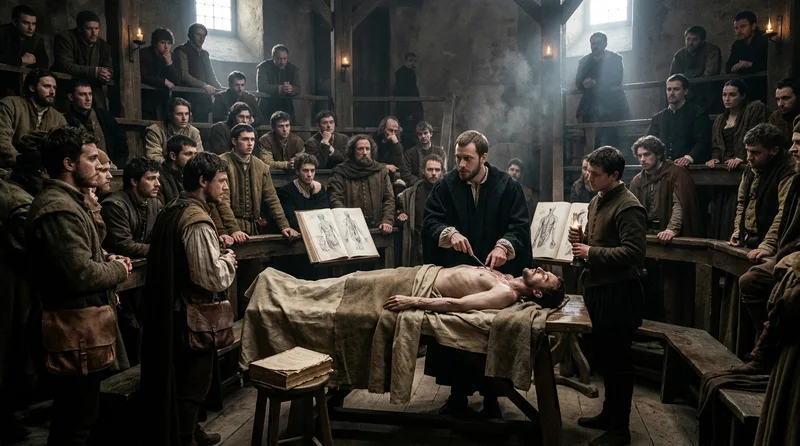
Andreas Vesalius performed systematic human dissections in Padua during the 1530s, discovering over 200 errors in Galen’s anatomy texts that the Church had sanctified as medical gospel for 1,400 years. His 1543 masterwork De Humani Corporis Fabrica contained 273 detailed woodcut illustrations based on direct observation of human cadavers, revealing that men and women possess the same number of ribs—contradicting the Genesis account of Eve’s creation—and that the human jaw is a single bone, not two as Galen claimed. Vesalius demonstrated that blood does not flow between heart ventricles through invisible pores as Church doctrine maintained, fundamentally challenging the spiritual interpretation of cardiac anatomy. Religious authorities condemned his work as sacrilege because dissecting human bodies violated the sanctity of God’s image and disrupted bodily resurrection. At age 28, Vesalius faced such intense ecclesiastical pressure that he burned his remaining manuscripts and became court physician to Emperor Charles V. The Spanish Inquisition later charged him with dissecting a living man, forcing a pilgrimage to Jerusalem from which he never returned, dying in a shipwreck in 1564 at age 49. His empirical approach established anatomy as a science of observation rather than textual authority.
Source: britannica.com
5. Torricelli’s Mercury Barometer Created a Forbidden Vacuum
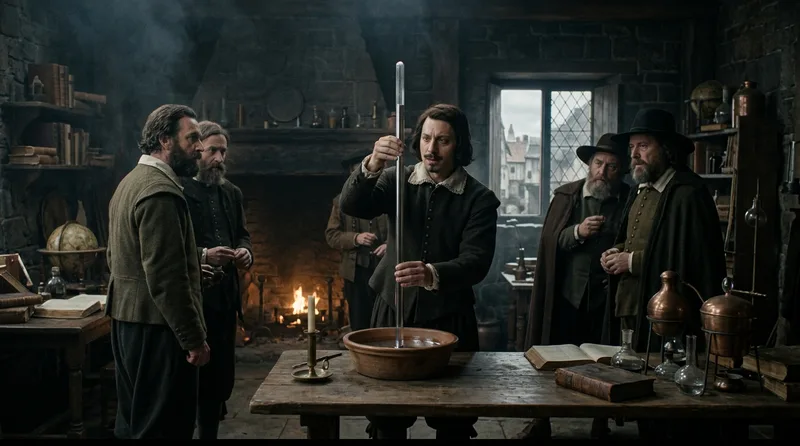
In 1643, Evangelista Torricelli filled a 3-foot glass tube with mercury, inverted it into a basin, and created the first sustained vacuum—a space the Church declared impossible because nature abhors emptiness. The mercury column fell to approximately 30 inches, leaving a void at the top that contradicted Aristotelian physics endorsed by Catholic doctrine for 2,000 years. Torricelli’s experiment proved that atmospheric pressure—about 14.7 pounds per square inch at sea level—supports the mercury column, and that the space above contains neither air nor spiritual essence. Church philosophers insisted that if vacuums existed, demons could inhabit regions devoid of God’s presence, making Torricelli’s glass tube theologically dangerous. The experiment also explained why suction pumps cannot lift water higher than 34 feet, a practical problem plaguing Florentine fountain engineers. Religious critics attacked Torricelli’s interpretation, arguing the space contained invisible matter or divine ether. As Galileo’s former secretary and student, Torricelli faced suspicion from ecclesiastical authorities, though his death in 1647 at age 39—possibly from typhoid—came before formal heresy charges. His barometer became the foundation for understanding atmospheric phenomena, weather prediction, and altitude measurement, proving that physical reality sometimes requires empty space.
Source: britannica.com
6. Robert Hooke’s Microscope Revealed Hidden Living Worlds
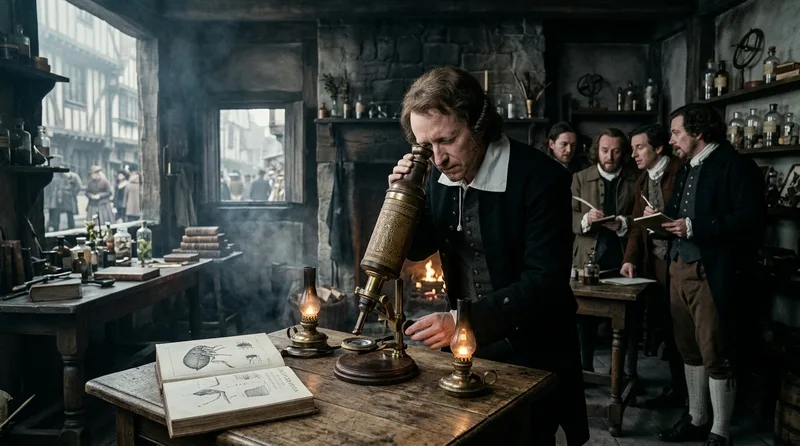
Robert Hooke published Micrographia in 1665, documenting observations made with his compound microscope that magnified objects up to 50 times their size, revealing intricate structures in fleas, lice, and cork tissue that challenged divine creation narratives. His illustration of a flea’s eye—showing it possessed superior optical design to human eyes—troubled theologians who insisted humans were created in God’s perfect image. Most controversially, Hooke coined the term “cells” after observing the honeycomb structure of cork, describing microscopic compartments approximately 1/1000th of an inch across that formed the building blocks of living matter. This implied life assembled from invisible units rather than being breathed whole by the Creator as Genesis described. The Royal Society debated whether examining God’s creations at such minute scales constituted impious prying into divine mysteries meant to remain hidden. Hooke’s detailed engravings of a 38-inch-long louse magnified to monstrous proportions shocked readers by revealing complexity in creatures dismissed as insignificant. Church authorities worried the microscope undermined scriptural authority by showing that human perception was fundamentally limited and that biblical descriptions of nature were incomplete. Micrographia sold out immediately, becoming the first scientific bestseller and establishing that entire universes existed beyond unaided vision.
Source: britannica.com
7. Newton’s Prism Shattered Light Into Seven Colors
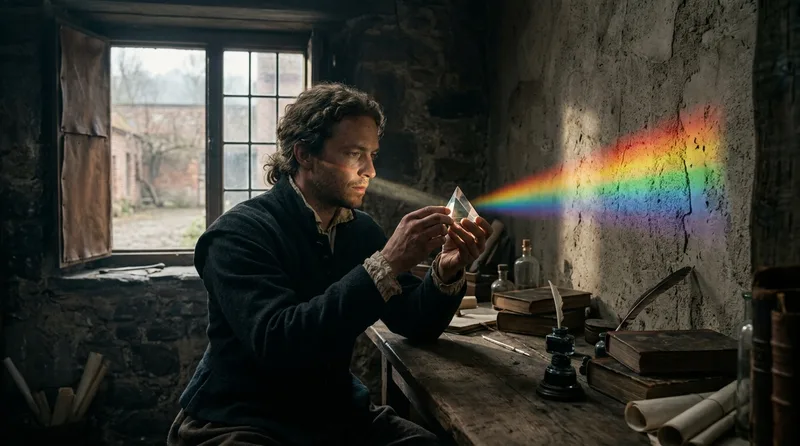
In 1666, during the plague year when Cambridge University closed, 23-year-old Isaac Newton purchased a triangular glass prism at a fair and conducted experiments proving that white light consists of seven distinct colors—red, orange, yellow, green, blue, indigo, and violet. He darkened his room, admitted a single sunbeam through a hole roughly 1/3 inch in diameter, and passed it through the prism, projecting a spectrum 5 times longer than traditional theories predicted. Newton then used a second prism to recombine the separated colors back into white light, demonstrating that color was an intrinsic property of light rather than a modification created by the prism as Aristotelian optics claimed. The Church had taught that light represented divine purity and unity, making its decomposition into multiple colors philosophically troubling—it implied the heavenly substance was compound rather than elemental. Newton delayed publishing his findings until 1672, partly fearing religious backlash to his mechanical explanation of God’s “Let there be light.” His experiments required mathematical precision, with refraction angles calculated to within 1 degree, establishing that divine phenomena obeyed quantifiable laws. The work laid foundations for spectroscopy, eventually enabling scientists to determine the composition of distant stars, proving the universe operated by universal physical principles rather than celestial mysteries.
Source: britannica.com
8. Van Helmont’s Willow Tree Defied Biblical Creation

Jan Baptist van Helmont planted a 5-pound willow sapling in exactly 200 pounds of dried soil in 1628, then watered it with only rainwater for five years. In 1648, he uprooted the tree and weighed it at 169 pounds while the soil had lost merely 2 ounces, concluding that plant matter came primarily from water rather than earth as Genesis 2:9 described God creating plants from soil. This quantitative experiment, using a precision balance accurate to 1/10th of an ounce, challenged the doctrine of ex nihilo creation and the four-element theory Aristotle proposed and the Church endorsed. Van Helmont’s conclusion was partially wrong—he didn’t account for atmospheric carbon dioxide—but his experimental method was revolutionary, demonstrating that biblical descriptions of natural processes could be tested and refined. The Catholic physician faced Inquisition charges in 1634 for mystical writings, spending years under house arrest defending his spiritual orthodoxy. Church authorities worried that reducing creation to chemical transformations denied God’s ongoing providence in nature’s operations. Van Helmont conducted over 20 years of chemical experiments in his private laboratory, coining the term “gas” and laying groundwork for understanding photosynthesis. His willow experiment established that faith claims about natural processes required empirical verification, not scriptural interpretation alone.
Source: britannica.com
9. Pascal’s Mountain Experiment Measured Heaven’s Weight

On September 19, 1648, Blaise Pascal orchestrated a daring experiment on Puy-de-Dôme mountain in central France, sending his brother-in-law Florin Périer to climb 4,800 feet while carrying a mercury barometer. Périer recorded that the mercury column dropped from 28 inches at the base to 23 inches at the summit—a 5-inch difference proving that atmospheric pressure decreases with altitude at approximately 1 inch of mercury per 1,000 feet. Pascal designed the experiment to settle the vacuum debate and demonstrate that air has measurable weight, roughly 1.2 ounces per cubic foot at sea level. This contradicted Church teaching that heavenly spheres were weightless and that the atmosphere extended infinitely upward in spiritual gradations toward God’s throne. Pascal repeated measurements at five different altitudes, documenting precise barometric readings that showed the “sea of air” had a definite height and mass. Religious critics argued that if air exerted pressure, it would crush terrestrial life, failing to understand Pascal’s explanation that internal and external pressures balance. The experiment occurred despite Pascal’s own devout Jansenist Catholicism—he saw no conflict between measuring God’s creation and worshiping the Creator. His work enabled accurate altitude measurement and weather forecasting, proving that even divine mysteries like the heavens obeyed mechanical laws discoverable through human ingenuity.
Source: britannica.com
10. Santorio’s Chair Quantified the Invisible Soul
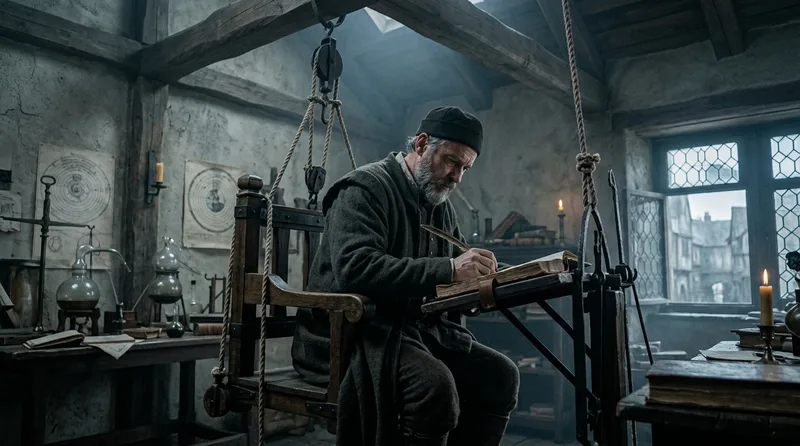
Santorio Santorio spent 30 years from 1614 to 1644 living on a giant balance suspended from his ceiling, weighing himself continuously before and after eating, sleeping, and excreting to measure “insensible perspiration”—invisible weight loss through breathing and skin. He discovered that roughly 5 pounds of body weight vanished daily through imperceptible evaporation, contradicting Galenic medicine which claimed all waste left through visible excretions. Santorio published De Statica Medicina in 1614, containing over 100 aphorisms documenting precise measurements showing that humans consumed approximately 8 pounds of food daily but excreted only 3 pounds through urine and feces, with the remainder escaping as vapor. This quantitative approach to bodily processes disturbed Church authorities who taught that the soul’s interaction with matter couldn’t be reduced to mathematics—weighing life processes implied the spirit itself had measurable mass. Santorio’s balance, accurate to 1 grain (approximately 0.002 ounces), demonstrated that metabolism followed discoverable laws rather than humoral mysticism. The Church worried that if breathing released invisible substance, perhaps the soul similarly escaped at death as weight loss, a heretical suggestion contradicting resurrection doctrine. His experiments established that even intangible biological processes obeyed physical conservation laws, showing that human bodies operated as quantifiable chemical engines rather than vessels animated by immeasurable divine essence.
Source: britannica.com
Did You Know?
Did You Know? The Catholic Church didn’t officially pardon Galileo until the late 20th century—more than three centuries after his conviction—and Pope Urban VIII kept Copernicus’s De Revolutionibus on the banned books list for over two centuries. Ironically, many of these condemned experimenters were devout believers who saw scientific inquiry as revealing God’s mathematical design. Their persecution wasn’t about religion versus science, but about who controlled the authority to interpret God’s creation—priestly decree or experimental proof.